A different kind of history

As you know, I love visiting historic houses and castles, preferably with lots of lovely textiles. However I also enjoy different types of historic buildings, and though I wouldn’t consider myself particularly into military history, I do love star forts.

These were popular during the Napoleonic era, as their design makes them able to defend against attack more robustly.

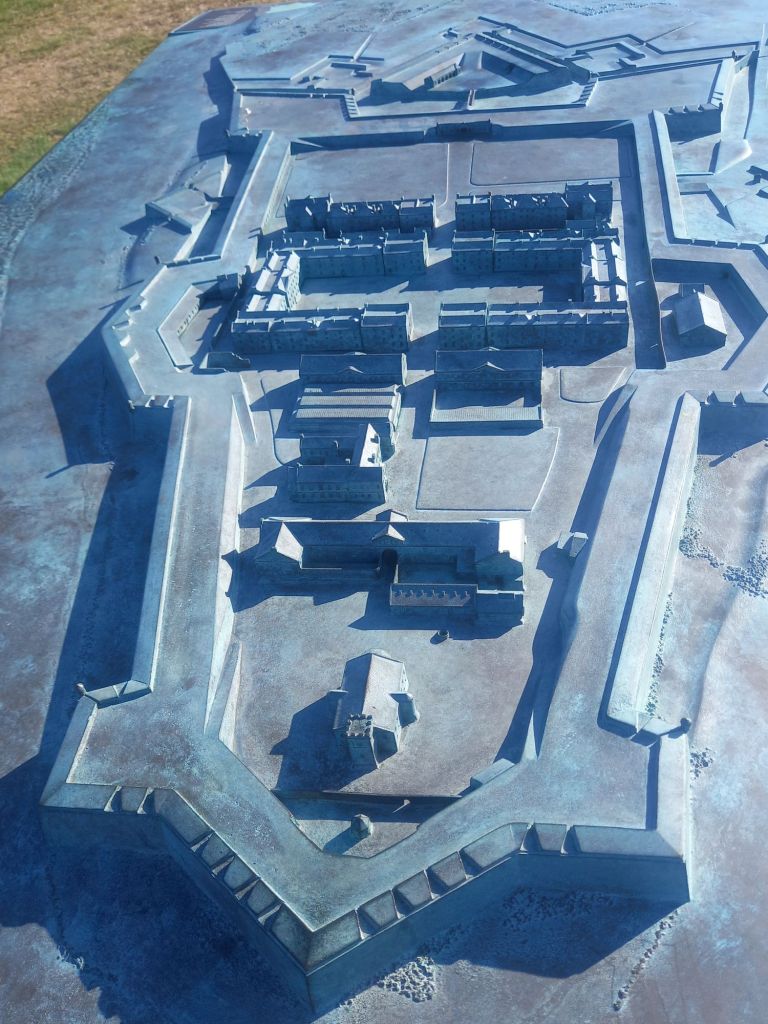
I have visited quite a few in Spain, and on the way back from Rosemarkie went to Fort George, on the Moray Firth not far from Inverness. This is more of an elongated star, but still has the distinctive pointed outer ramparts.

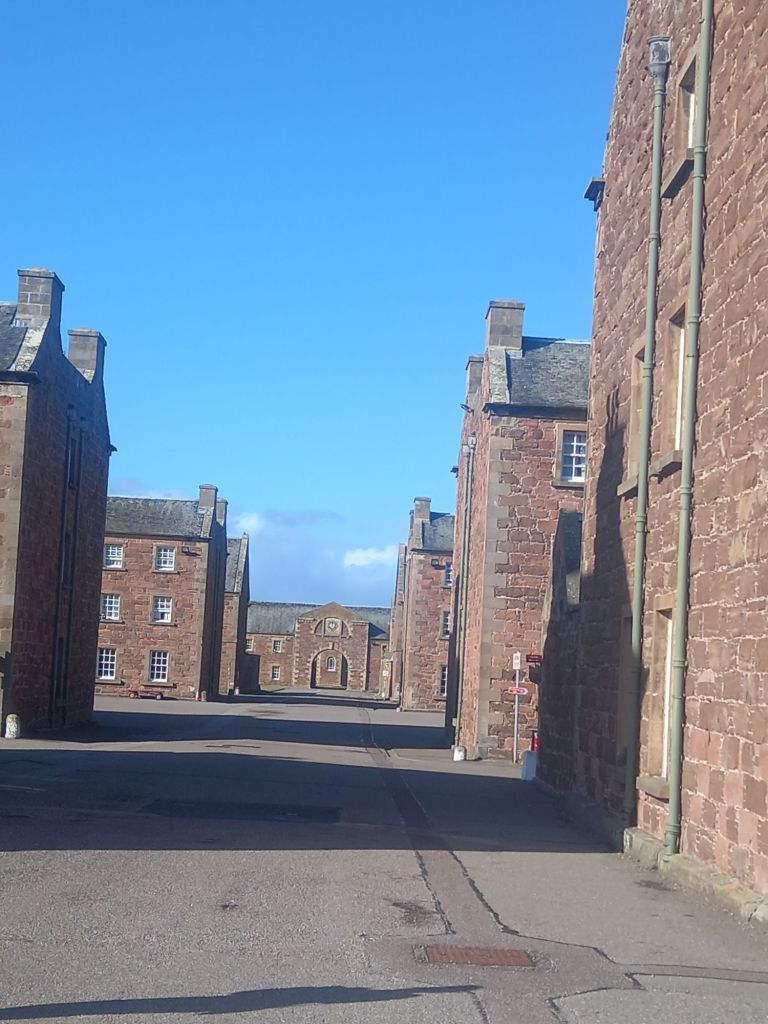
Although it was built in 1746, after the Battle of nearby Culloden, to house troops to suppress the Jacobite Rebellion, by the time it was finished it was no longer needed for that. It9 is still a working army base, as well as being a historic tourism attraction, and the site of the Highlanders Museum.

It was quite strange seeing the modern mess, cars parked outside the barrack blocks, and groups of young recruits doing their morning runs, with backpacks, around the ramparts, in and amongst all the visitors.

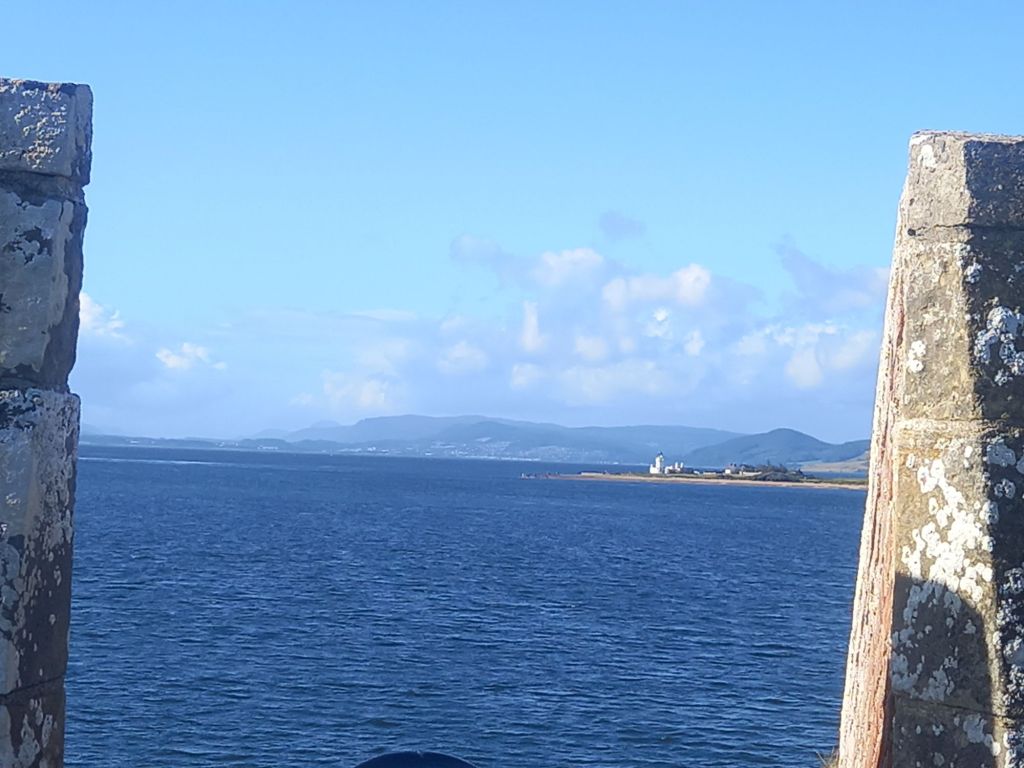
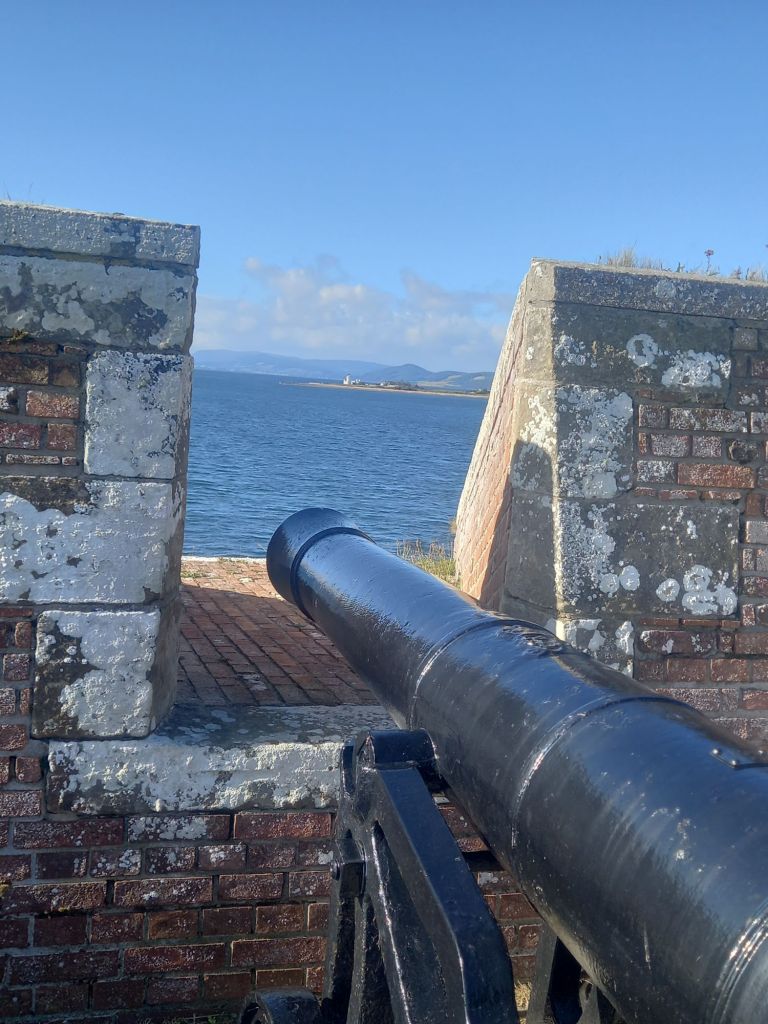
It has an amazing location on the coast, directly opposite the Rosemarkie campsite, in the photo below you can just see the lighthouse I walked to when I was there. It also famous for dolphin spotting.

It was a really interesting visit, there is some interpretation in one of the barrack blocks, showing aspects of soldiers’ lives throughout the different eras.

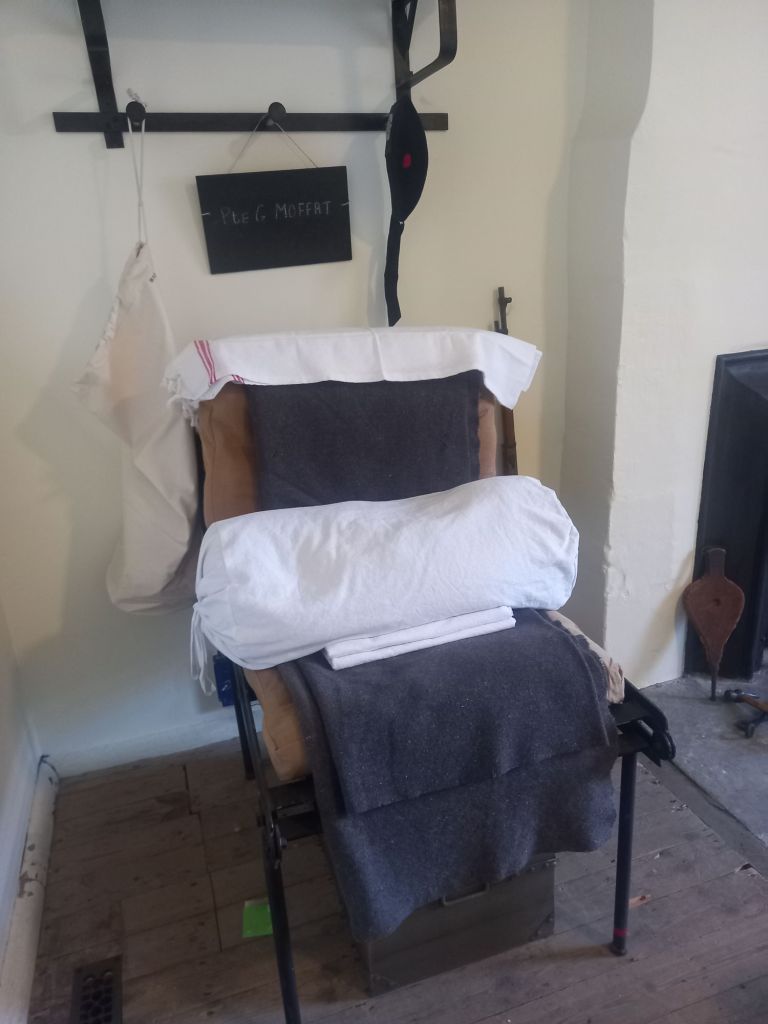
These folding beds were really interesting,  this is from one of the rooms for single men in the early 1900s.

At one point in its early usage, wives and children used to live in the rooms with the men, four families to a room, which was also used for cooking.

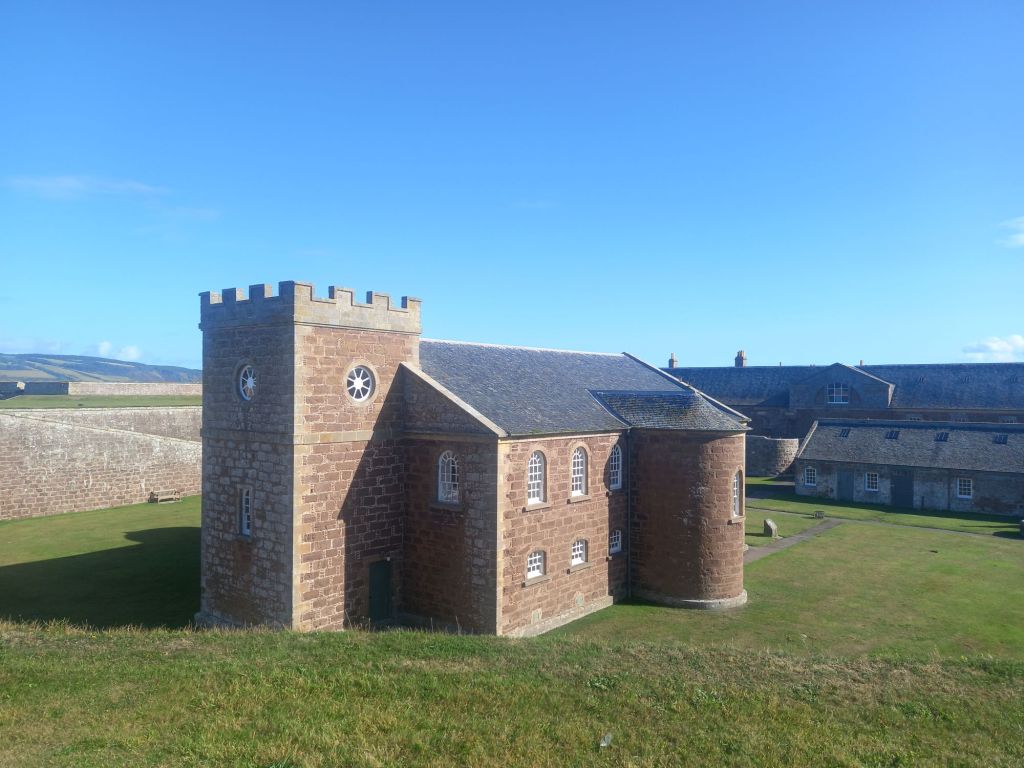
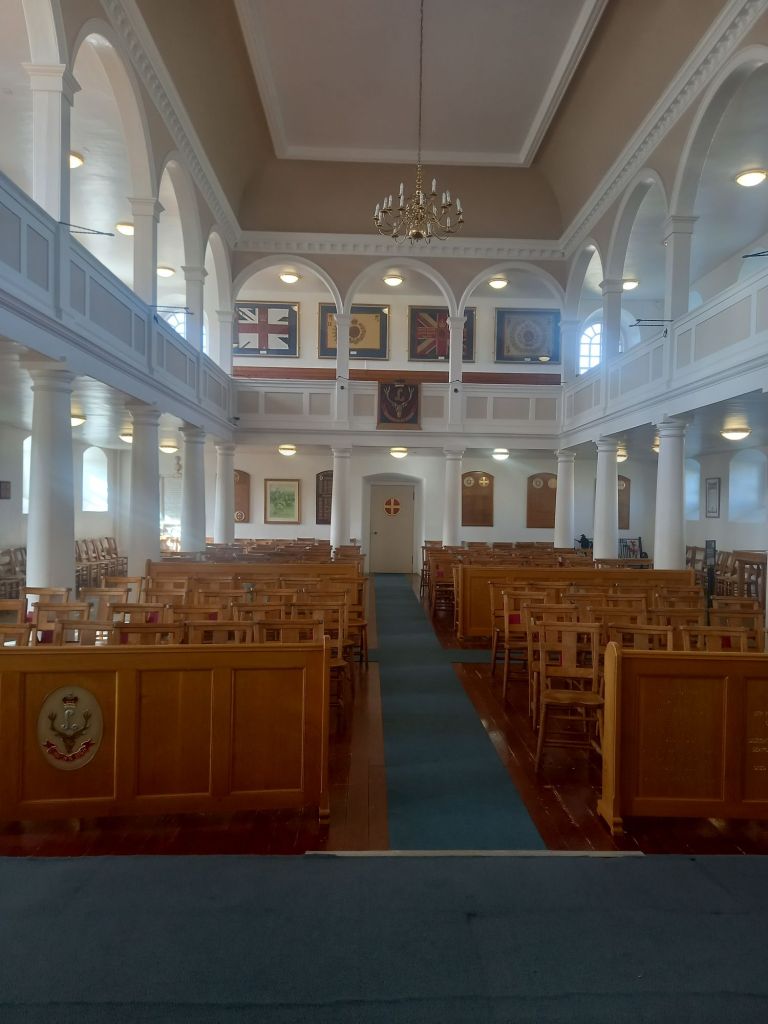
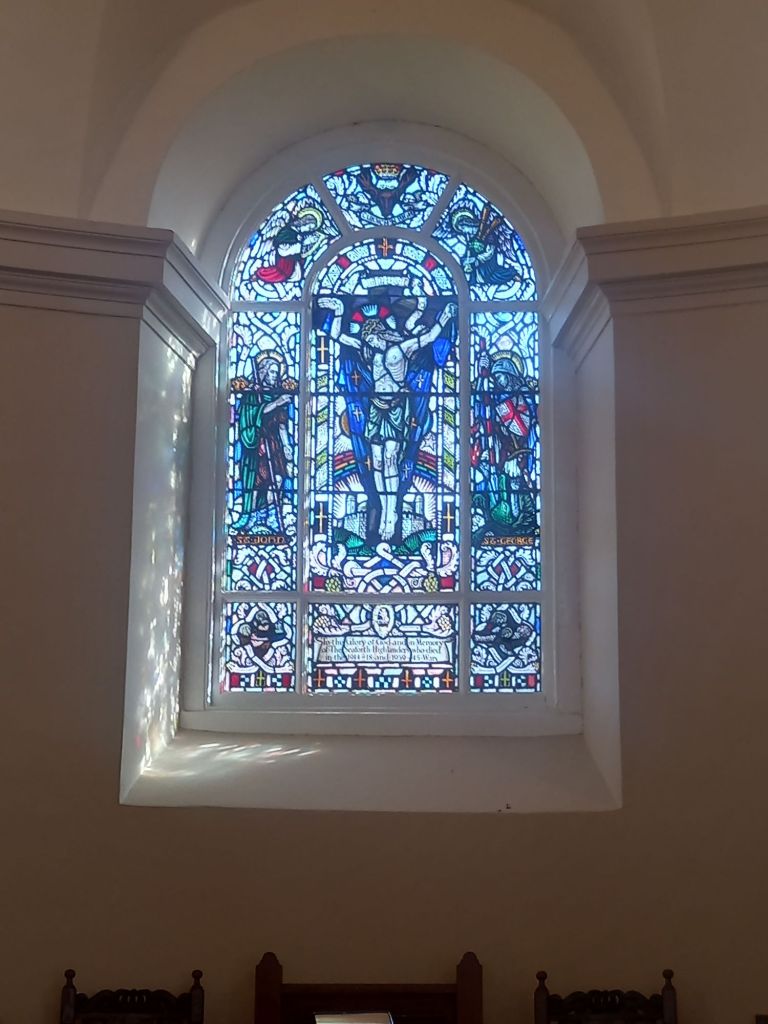
There is also a beautiful Chapel, the last building to be completed, and a nearby exhibition about Scottish gardens.

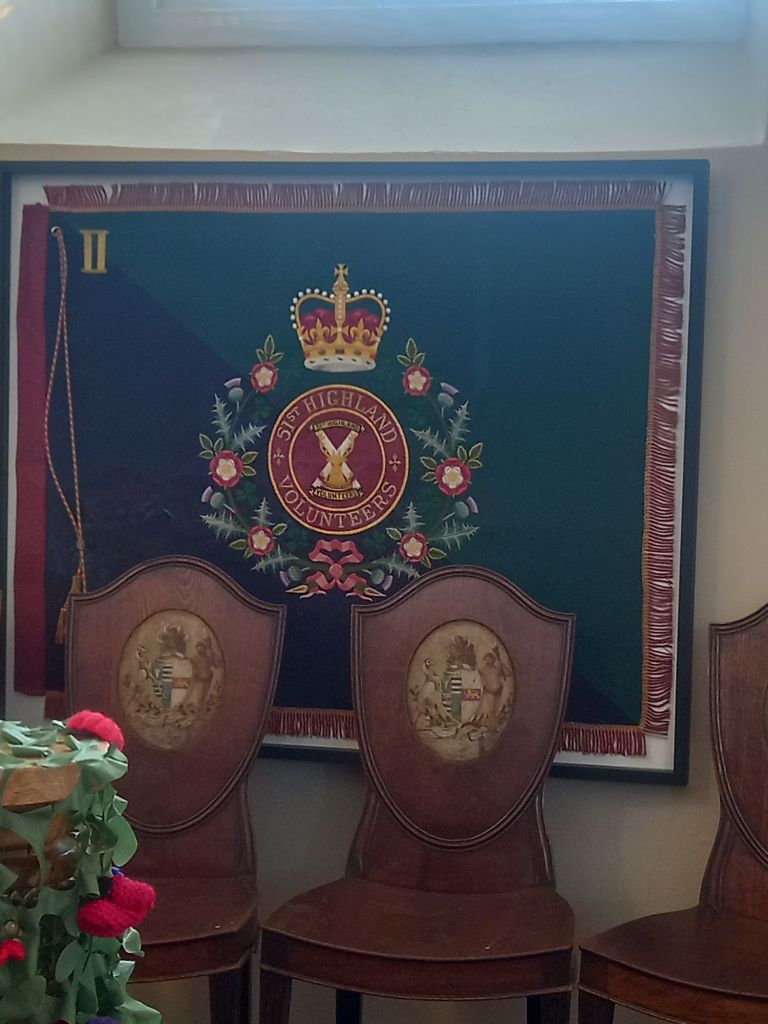
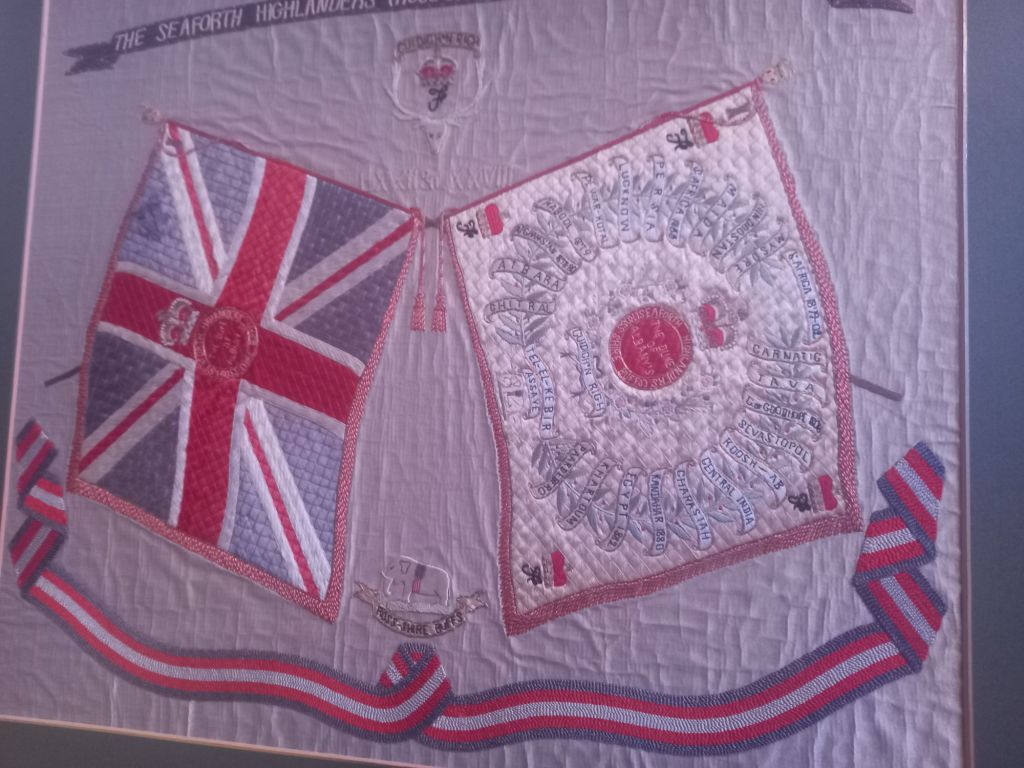
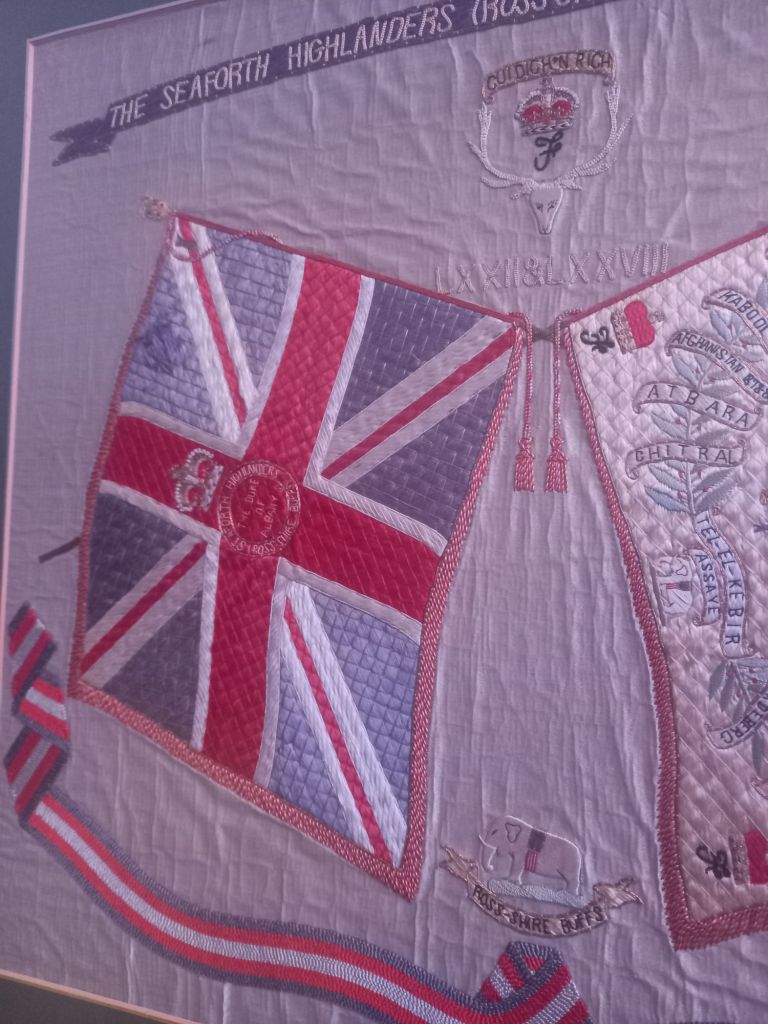
Of course there were textiles as well, the modern poppy tributes in the Chapel, as well as beautiful flags and banners there and in the museum.

A really excellent place to visit, for its location, and the sheer scale of the construction, especially when you consider when it was built. It took 22 years to complete and I can only imagine how that was done in the 1700s without the mechanisation we have now. 

The exterior walls and ramparts are so impressive, and it was fantastic to see a fort in almost the same condition as when it was first built, as the restoration really helps you visualise what it was like for those early soldiers. 

Well worth a visit, if you are ever in the area, sadly no dolphins when I went, but amazing views.

I have been on the Yorkshire coast again, just a little further south than the previous site, and still enjoying the fabulous walks in the area. Such an incredible environment, which I will share in a future post.

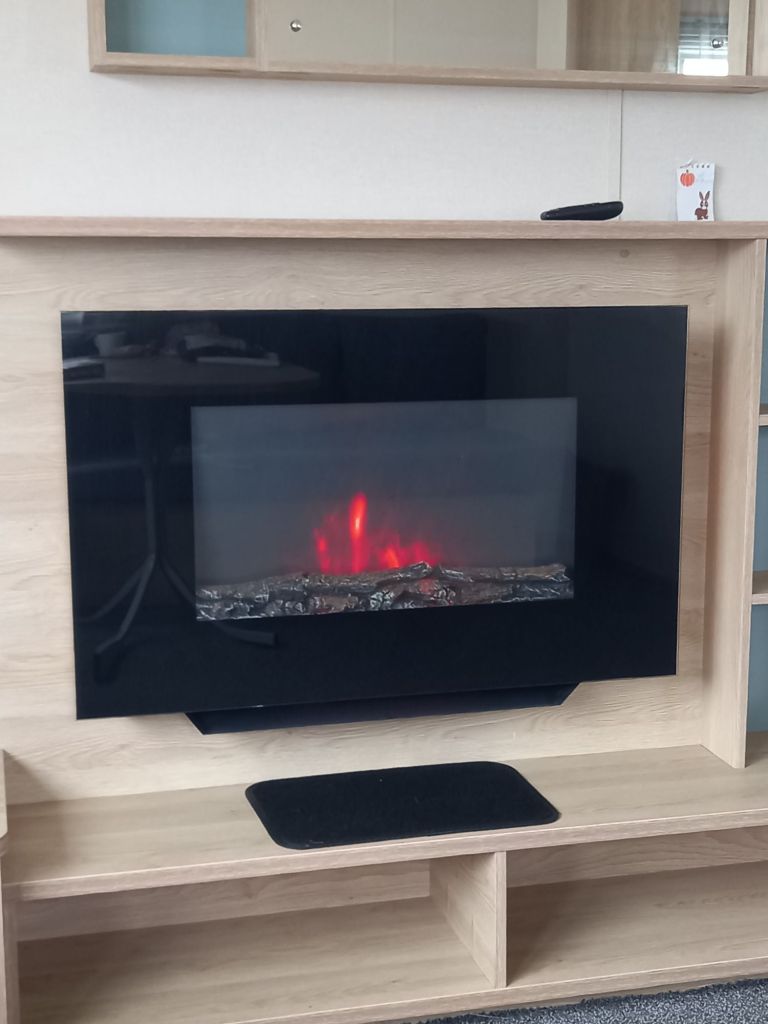
I have also enjoyed being back in the luxury of a static caravan, which is very nice after a few nights in the tent. I have a very lovely fake fire keeping me warm! However I am now in Wales on my final camping trip of the year, with my sister.

Until next time, have fun and thanks for visiting. 

Not all who wander are lost…., well maybe only a little bit!

The first part of the title of this blog post is a popular van life sticker, I don’t have this one, (yet!), but one of my greatest pleasures of my new life is the time to just wander around, and really absorb what I am seeing.

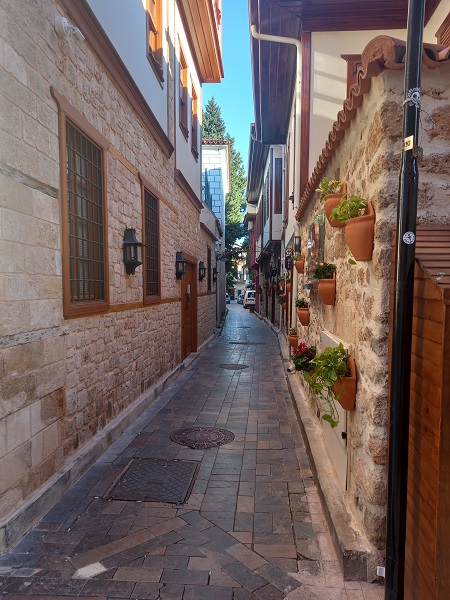
I did wonder if three weeks in Antalya would be too long, would I find enough to see and do here, but I needn’t have worried. I am going to have a busy summer, and so had decided that rather than see a lot in one month, as I did with Morocco, I will spend more time in each city in Turkey. There is so much loveliness to see here, and the Old Town is absolutely brilliant for wandering, without getting too lost.

Unlike the medinas of Morocco, where getting lost was very easy, the Old Town is open to the sky, which gives more landmarks to go by, particularly the many minarets that are in and around it. Also it is bordered on one side by the port, so if you head there you can easily find your way out.

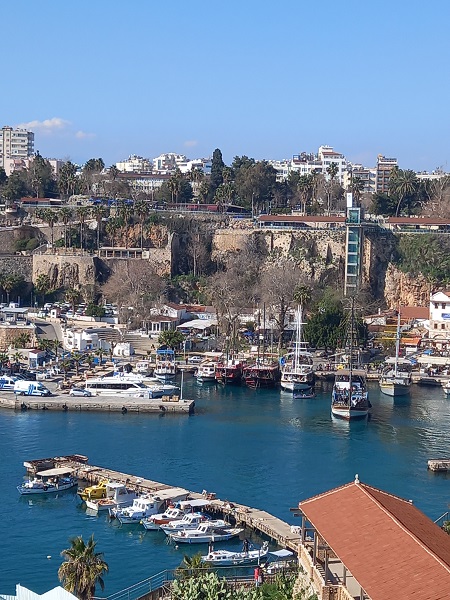
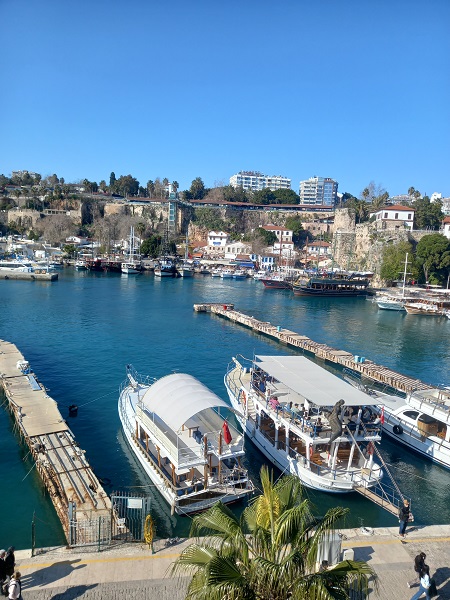
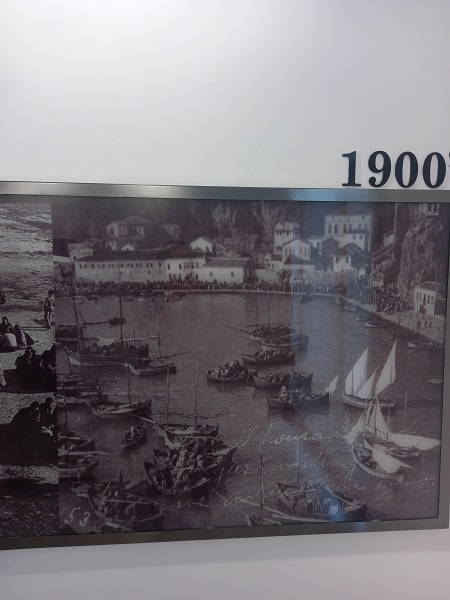
The port still has most of its original features, including the defensive walls. The city walls were demolished in the 1920s.

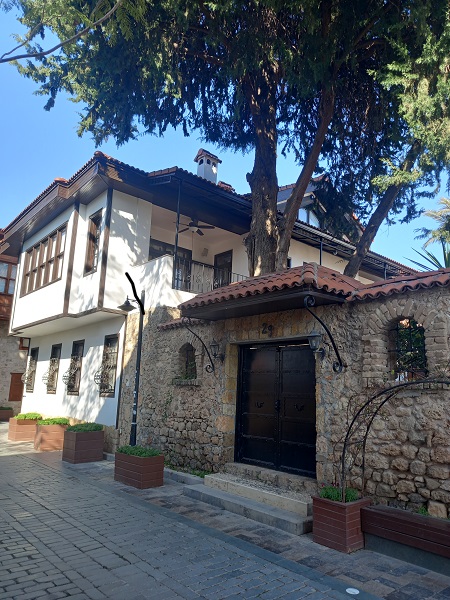
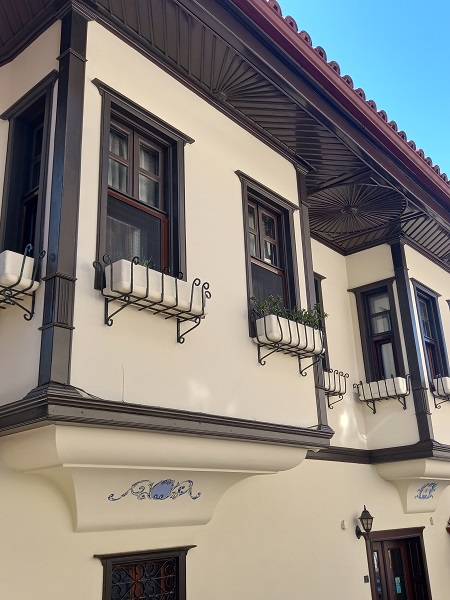
Most of the Old Town has been beautifully restored. There are so many houses, small hotels, apartments, bars and restaurants here.

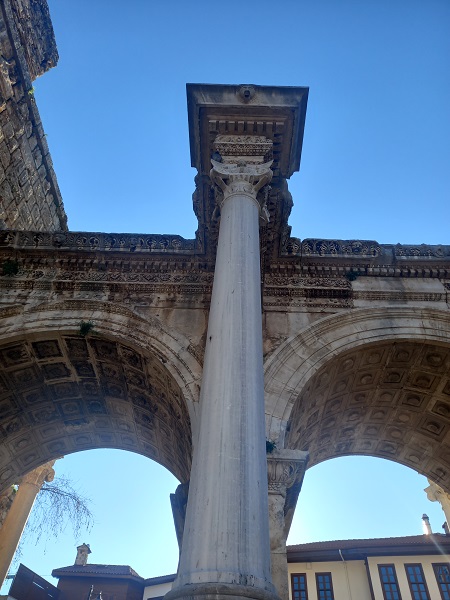
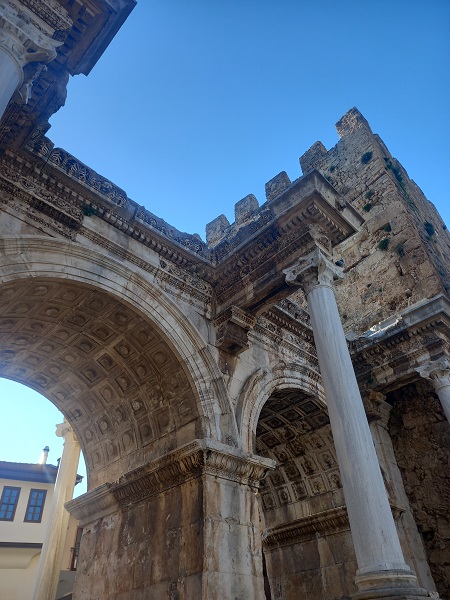
At the other side of the Old Town is Hadrian’s Gate, built to honour the Roman Emperor. It is brilliant that this has survived the expansion of the city. You can see in one of the later pictures how two of the columns have been replaced, and one of the crumbling ones supported.

There are also a few museums, and the university has a gorgeous restored painted building which is an Institute for the Study of Mediterranean Culture.

Some of the streets are quite wide, others are narrow alleyways, and each area has its own character. I love all the pots in the Barbaross area.

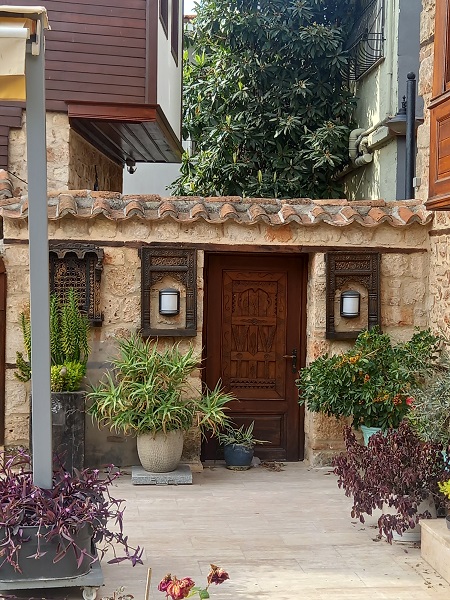
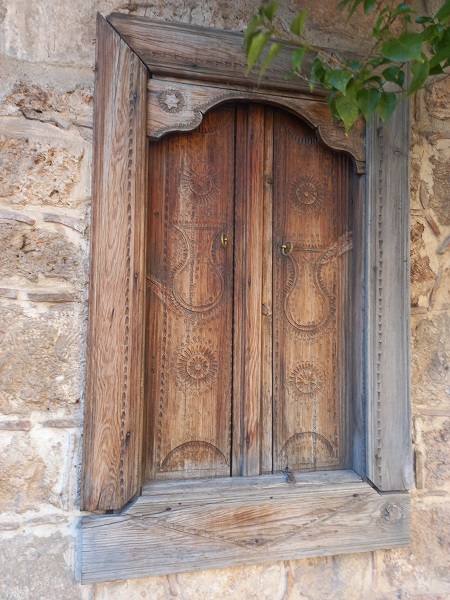
And of course there are all the doors, and windows. Just so many beautiful examples of woodwork and ironmongery, a real testament to the artisans here.

I think this one has to be my favourite, so far!

I have also seen a couple of the same motifs that I so loved in Morocco. I still have to design an embroidery based on this motif as it is my favourite design.

As most buildings are restored there are few older pieces, but I did find this beautiful carved window cover.

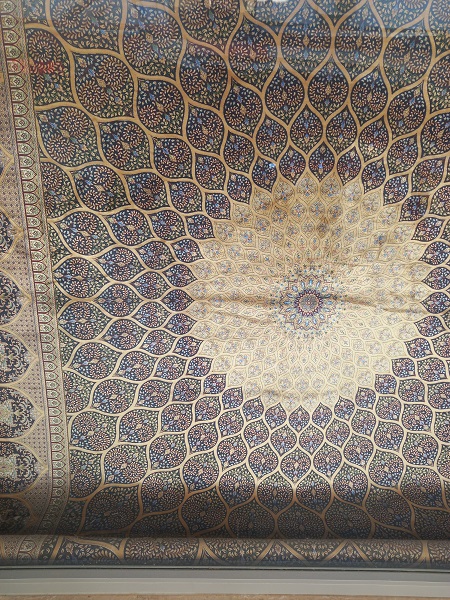
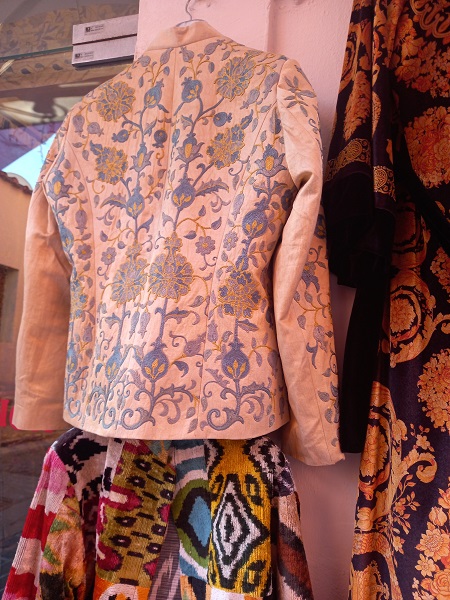
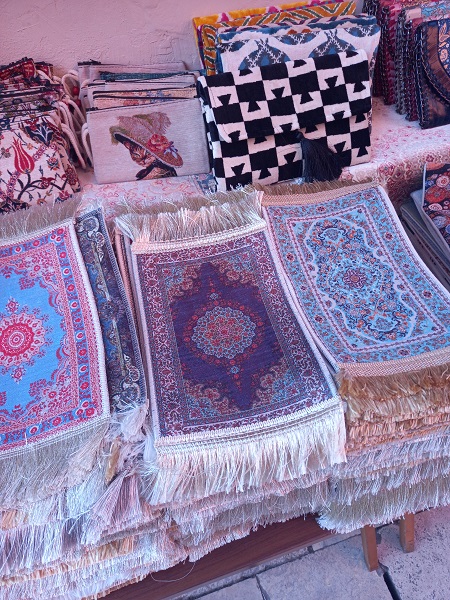
I have been really good and resisted all the many retail opportunities there are here. Turkey is famous for its carpets, but there are also some beautiful textiles and ceramics. However, I only have a very small bag back for the plane to Spain, and Katy is full!

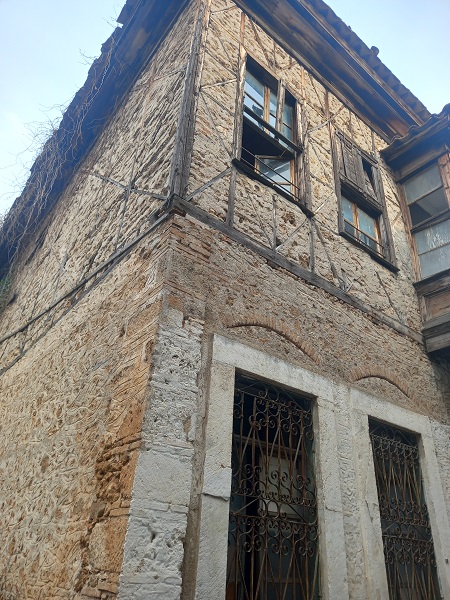
Although most properties have been restored there is still some work to be done. Hopefully there is some additional funding to help businesses do that, as it must cost so much to bring these places back to life.

These were two buildings opposite each other, one has been restored and is now a hotel, and the other is still falling apart. You can just see the sheer amount of work it would take to fix it.

I sill haven’t fully finished exploring the area, I have only visited two out of the four museums, and have yet to go into any of the mosques, so that is on the itinerary for next week.

I did have a boat trip this week as well. It was a glorious day, and we went an hour down the coat to see the Duden Waterfalls, where we were rewarded by a rainbow in the spray as well. A magical trip that I will remember forever.

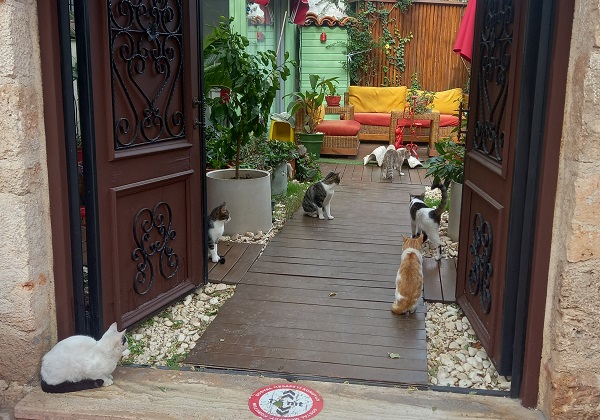
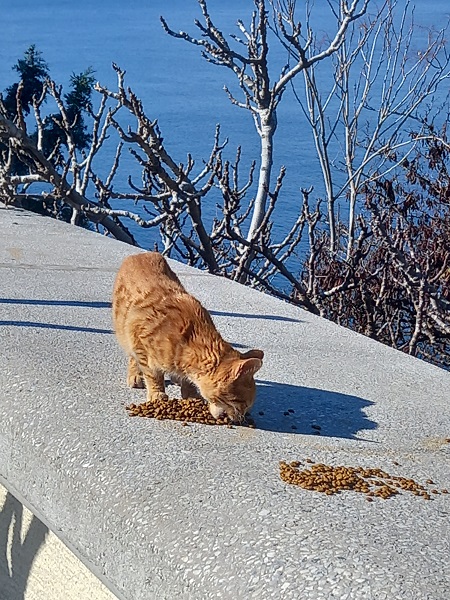
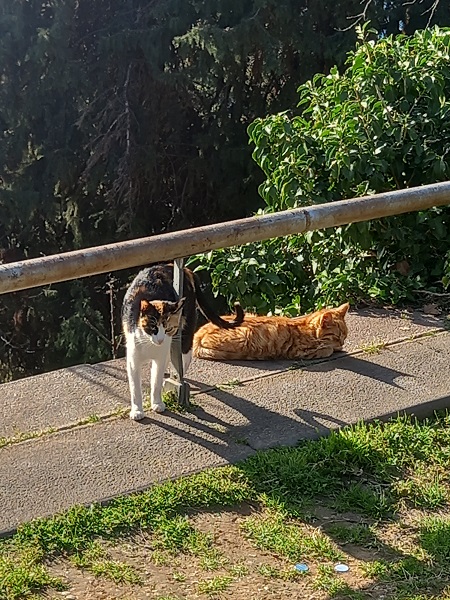
I also have to give a mention to the many, many cute cats of Antalya. All throughout the Old Town, and the rest of the city, and all of the parks, there are so many cats here. Some lives in the houses and restaurants where people feed them, and there are some little cat hotels in some of the parks, and at the port, where they can also get food and shelter.

I only have six days of exploring left, so will be spending most of my time doing indoor things now, I had wanted to take advantage of the good weather for wandering this week, just in case it rained again. It is due to be fine most of the week, so I am very much looking forward to soaking up as much sun and blue sky as I can before my return to the UK. March’s travels are to a place know more for its wet weather than anything else!
I shall return next week to share the last of my Anatolian adventures with you. Until then, have fun, take care, stay safe and thanks for visiting.

Skill and scale

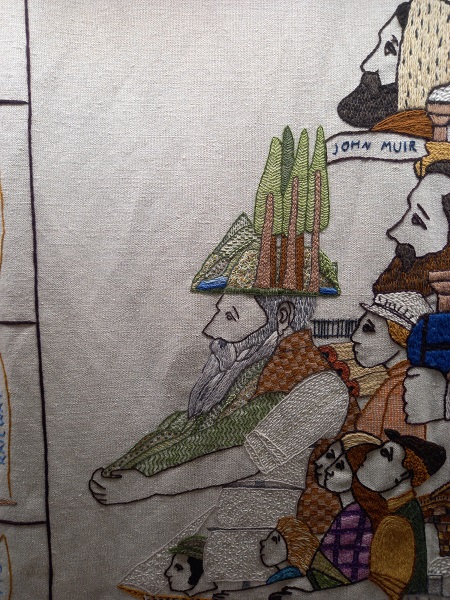
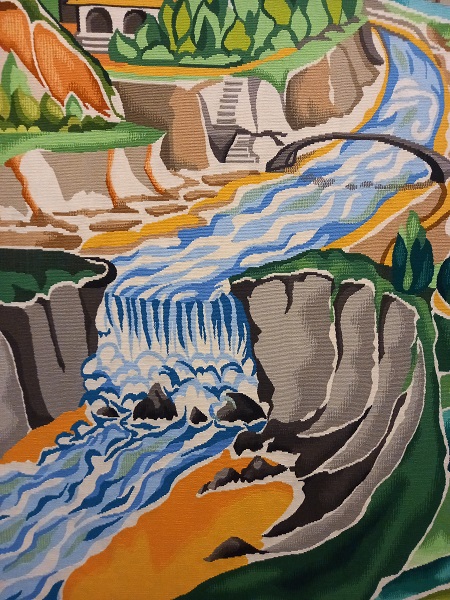
The textile treasure that was my last trip out in Scotland was The Great Tapestry of Scotland, now sited in Galashiels, about an hour away from my Dunbar campsite, a beautiful drive through pine forests and small towns. I hadn’t actually heard of the tapestry before, although it was completed in 2013, but found it by accident while looking for something else on Google Maps. Much of my planning is like that, either I just explore an area to visit on Google maps and pin things in advance, or I am inspired by other’s posts on Instagram.

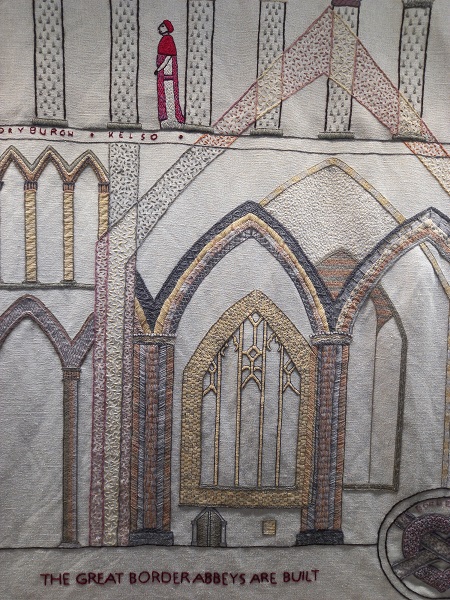
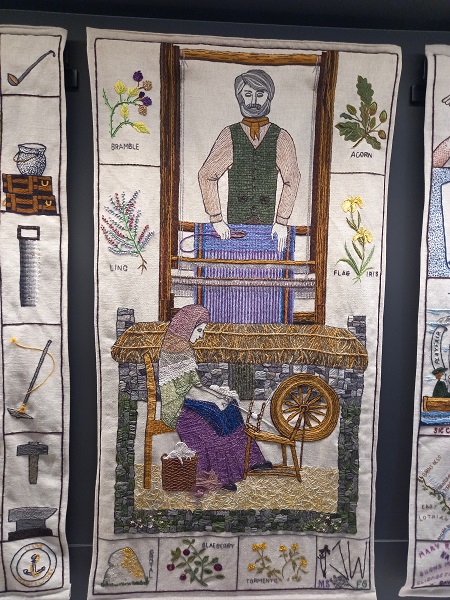
Although the tapestry was completed in 2013, it went on tour, and so was not in its present location, in a purpose built exhibition centre, until 2021. It is also not a tapestry, but in the great tradition of other tapestries, such as the famous Bayeux one, it is referred to as a tapestry, rather than a crewel work embroidery. I like to think that is has all the elements of a tapestry, as it is a textile based weaving in of Scotland’s history, told over 160 stitched panels, all created by over 1,000 volunteer stitchers, whose names are recorded at the entrance to the exhibition.

As I was going through the very many photos I took, trying to edit them down for this post, and trying to think of what title I would give it, the words, ‘skill and scale’, came into my mind. The sheer scale of this community stitching project is immense, as those 1,000 stitchers came from all across Scotland, some working in groups, and some alone. Therefore there was a huge logistical task in sending out all the materials for each panel, and in passing the work between stitchers.

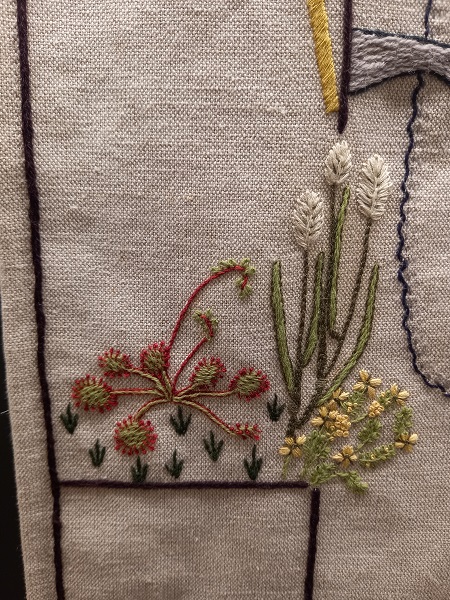
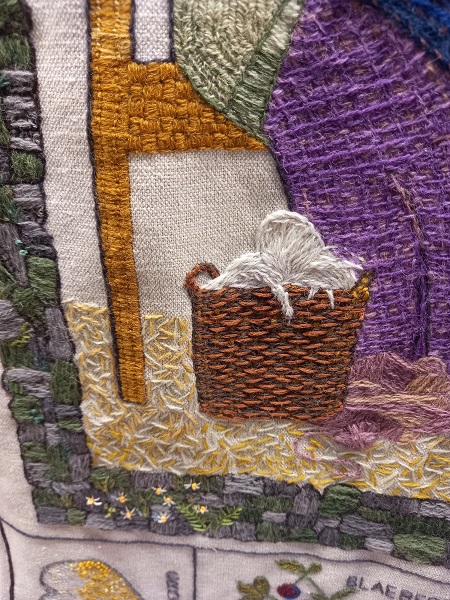
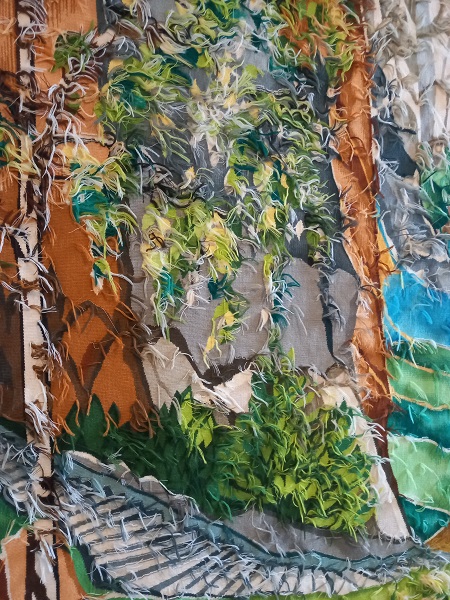
Not all of the stitchers were experienced, so many had to learn new skills. Some were very used to other methods of working, such as cross stitch, or silk embroidery, but not to crewel work, done in wool on linen. Although the stitchers were given panels that already had the outline drawings, done by community artist Andrew Crummy, they had to decide how to fill in the blanks and interpret flowers, natural landscapes, fish, horse armour and stone work, as well as a wide variety of textiles.

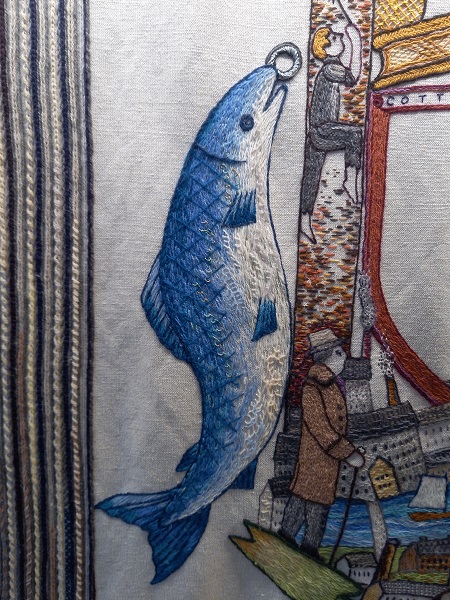
I love this stitched fish, such amazing detail and colour.

I also got to see my only red squirrels in all seven weeks in Scotland! Despite my best efforts, and many visits to pine forests, they kept eluding me.

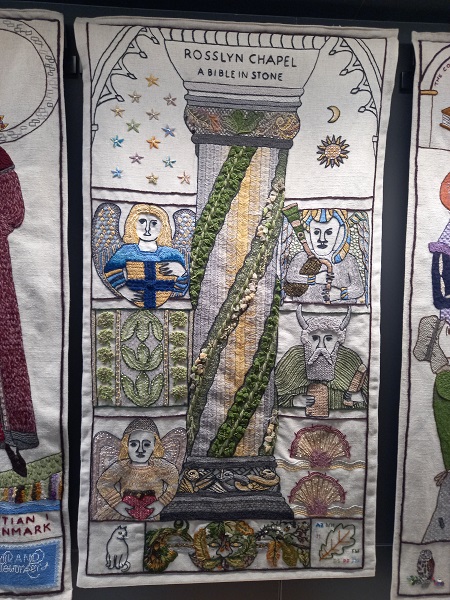
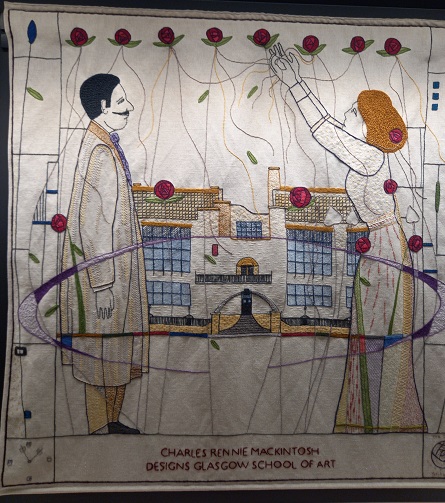
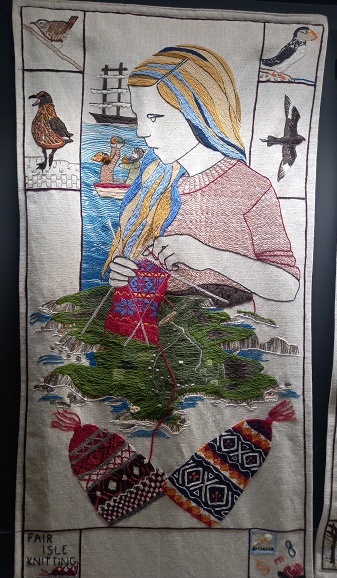
I have selected a few panels to share with you, there are so many I just didn’t have space to include, and also I would strongly encourage you to go and see it for yourself, it is amazing. It was lovely for me to see things represented that I already knew about, places that I had visited, such as Rennie Mackintosh’s design work, and John Muir.

I was also amused to see a panel representing the start of the Ordnance Survey mapping, which was inspired by the army’s need to find the fleeing Scots after the Jacobite Rebellion. Some years ago I read, and thoroughly enjoyed, (much to my children’s bewilderment), the story of how the Ordnance Survey map was created, written by Rachel Hewitt.

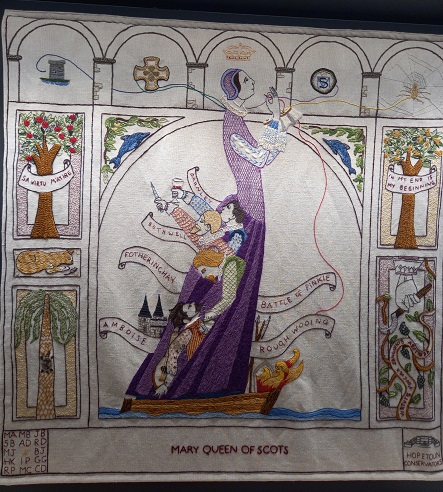
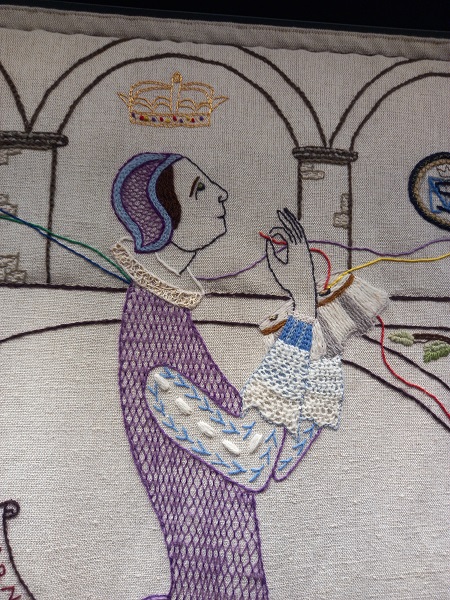
There was of course a panel on Mary, Queen of Scots, my ever present muse. What I particularly loved about her panel was that she is portrayed with her stitching, and in the borders are many of the pieces she stitched while with Bess of Hardwick.

Some of these are said to have hidden meanings, such as the cat and mouse picture, which is said to portray Elizabeth 1st as a ginger cat, toying with poor Mary mouse while she decides what her fate will be.

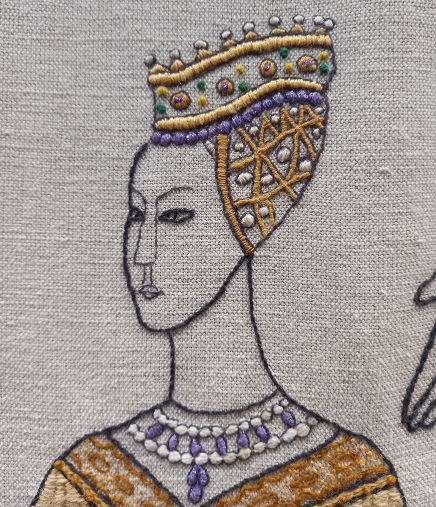
There were also representations of other royalty, and I loved the skills of the stitchers at representing them and their clothes with such detail.

There were also some beautiful panels on natural history, and early archaeological finds.

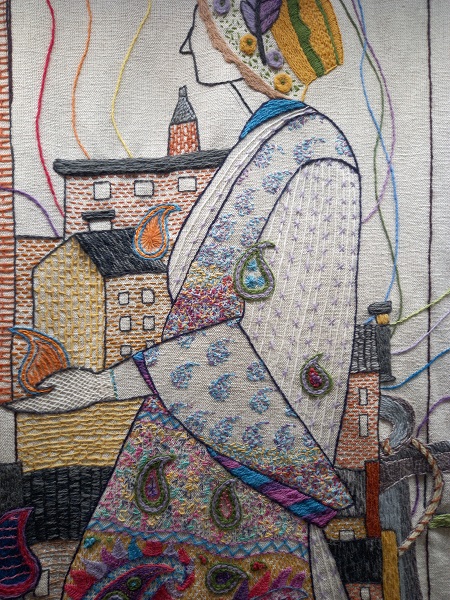
My favourite panels were the ones representing Scotland’s textile heritage, a dazzling array of different embroidery techniques used to portray the weaving, knitting, production of Paisley shawls, and Fair Isle jumpers. The skills of the stitchers in these panels are astounding.

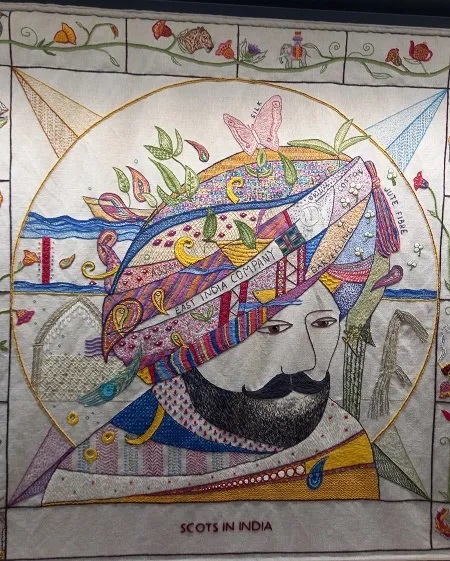
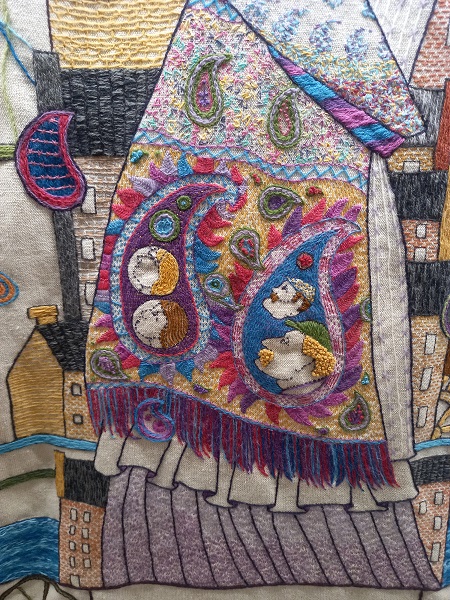
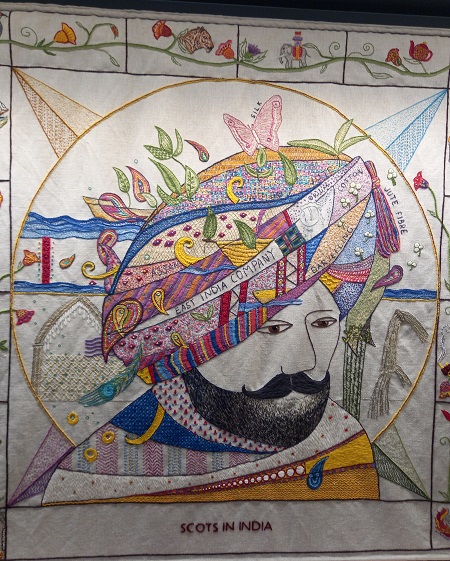
I also loved the different design elements, in representing complex themes, such as Scotland’s involvement in India. This panel is such a beautiful piece of art.

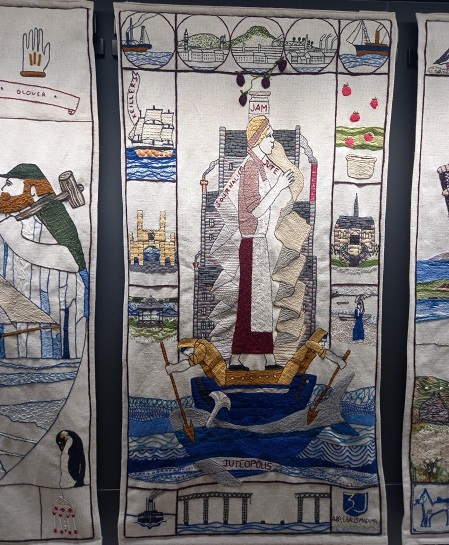
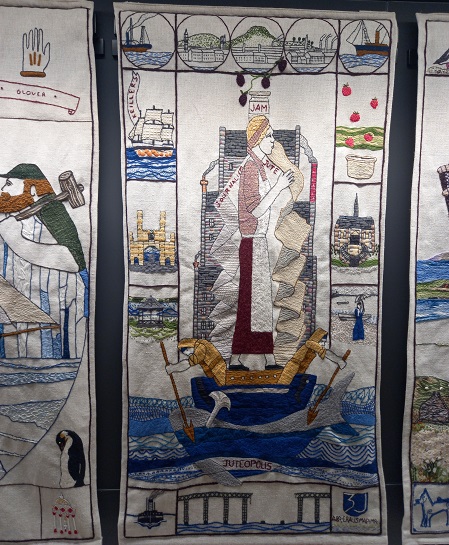
I had visited my friends who moved to near Dundee earlier in the trip, and they told me all about the 3 Js that Dundee is famous for, journalism, jute and jam.

I haven’t done any embroidery for a long time, but this exhibition has definitely inspired me. I bought the book about the making of the panels as well, and loved reading about all the people involved. It just spoke so much to me, and it is brilliant knowing that their names are recorded. Thank you to all involved, it is an amazing piece of textile art.

By coincidence I have just finished reading a book that I have had on my shelf for a long time, by an author who writes so wonderful about historic textiles. This is the fictionalised account of how one of my favourite actual tapestries, The Lady and The Unicorn series, was made, and is an excellent read if you like lots of detail about historical textiles, as you know I do. I have yet to visit the tapestries in real life, however the book brought back lots of memories of my visit to Abusson in France in May, a great centre of tapestry making, and an excellent museum.

Although there has been no embroidery done here, there has been a whole week of intensive work in the atelier, and I am pleased to report that six couture outfits have been made for Barbie. I have so enjoyed this, despite the odd complexity of working at that scale, and have definitely developed my skills this week.

I will post about them next, before I return to telling you about the English part of the summer travels and our recent trips. We have been very fortunate to avoid the worst of the storms and floods, but as you may know, there has been dreadful devastation and loss of life in Spain, so the local communities here have been trying to help out with donations.

I hope that you are all ok wherever you are, and enjoying life. I will be back as soon as possible, in between my hectic creating schedule 😉 Why does Christmas always seem to come a month too soon, even though I start stitching for it in January?

Have fun, take care, stay safe and thanks for visiting.

The old and the new, the textile edition

It was while I was at my friend Cate’s checking my route on the map, that I realised I was going to pass very close to the town of Aubusson. For anyone who is into textiles, you will recognise the name as being famous for thousands of tapestries, made in this town and the nearby ones, and they had a museum! So of course I had to go and visit.

Aubusson tapestry was designated in 2009 as one of the Intangible Cultural Heritage of Humanity aspects, and the museum is just a small part of the preservation of the heritage, along with preservation of other aspects of the craft, and exhibitions in the area.

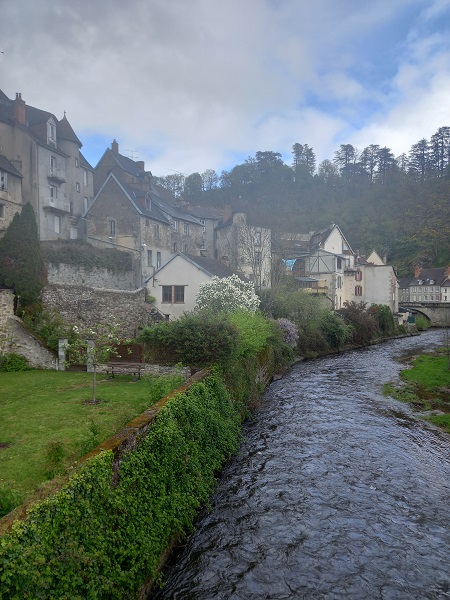
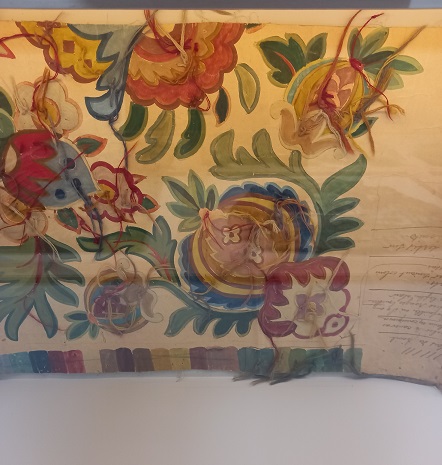
Aubusson itself is a very gorgeous little town, with an essential river running through it. As in my home village in Yorkshire, once famed for its woollen mills, access to water is vital for the industry, and you could still see the mills around the river area, as well as the buildings that now house the original designs, or cartoons, for the tapestries.

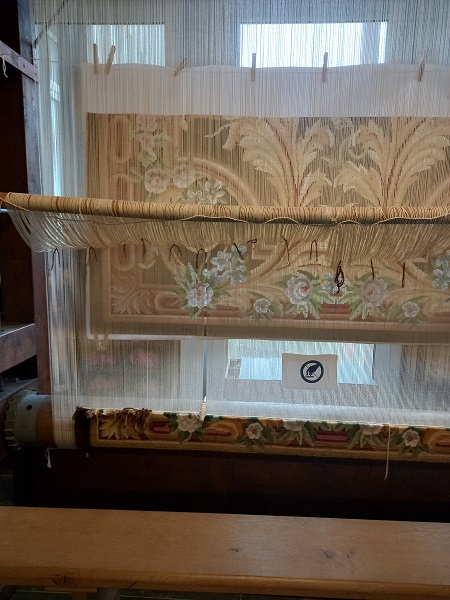
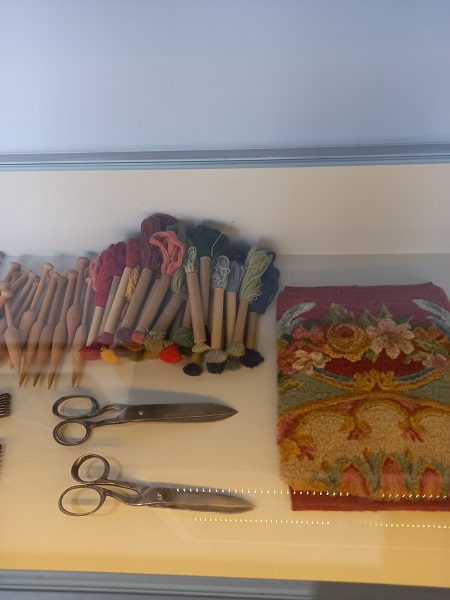
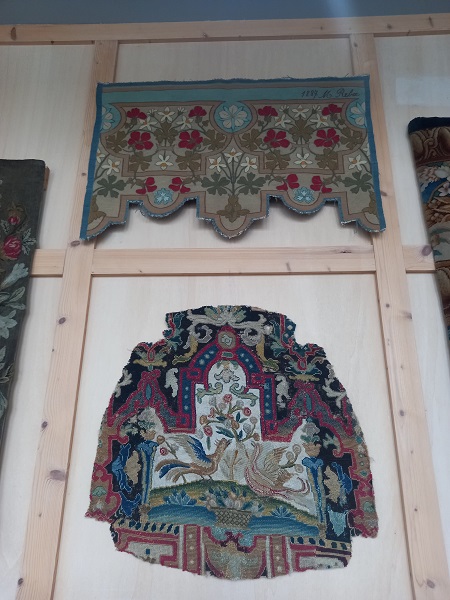
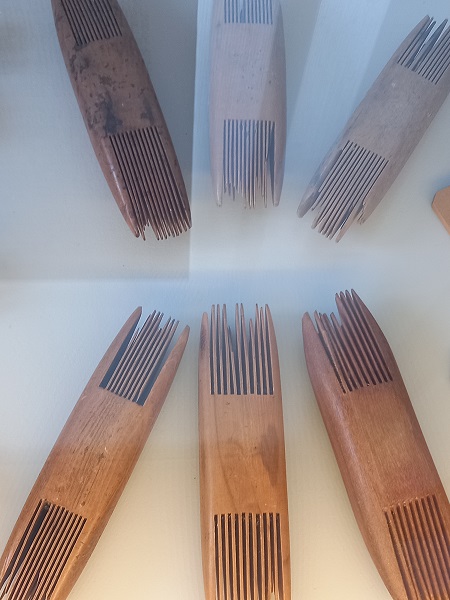
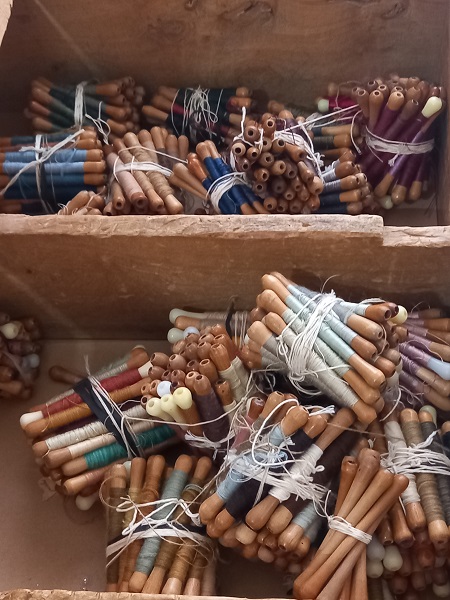
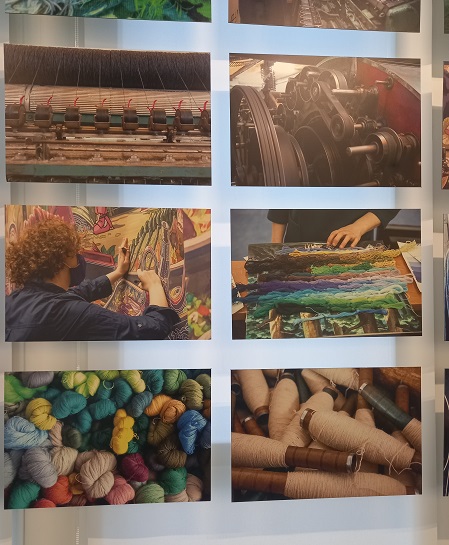
As well as examples of the heritage of the weaving, apologies as they were understandably in low lit, glass cases. so no good photos, what was really interesting was the focus on the process of weaving, and the tools of the weavers.

Tapestry has never been one of my favourite textile forms, I think because most of the ones that I encounter in National Trust properties and castles are faded, and the subject matter is generally not that interesting to me. However I have always appreciated the huge amount of time and effort it takes to create these woks of art.

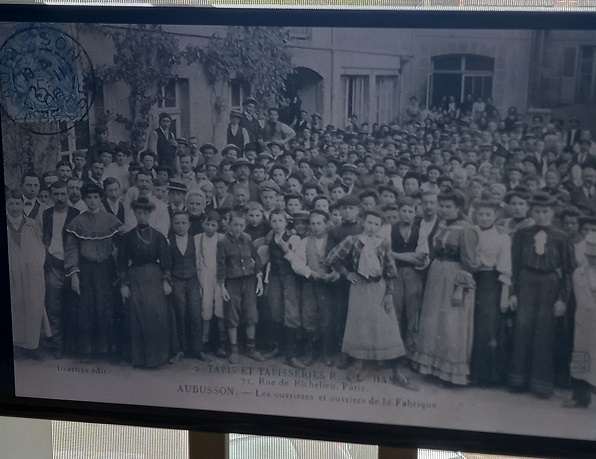
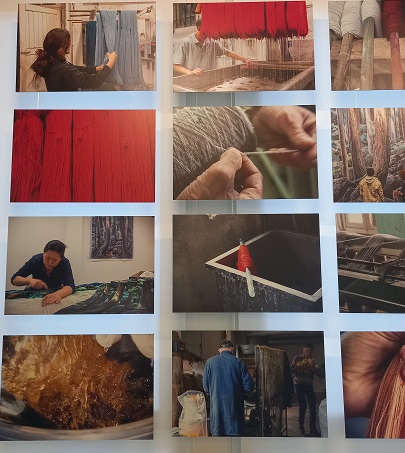
It was especially lovely to see photos of the weavers, both from the display of the historical archives, and the weavers working on current projects.

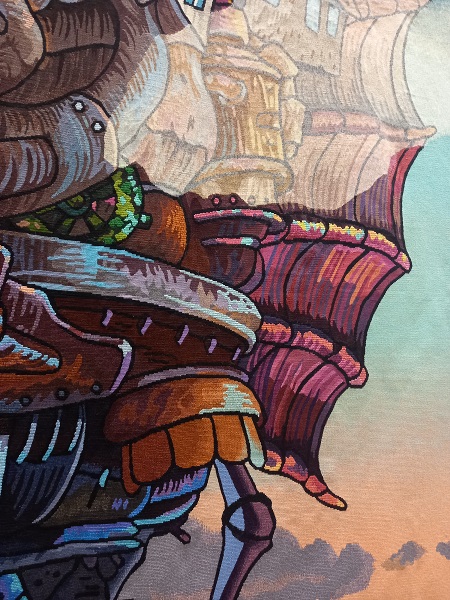
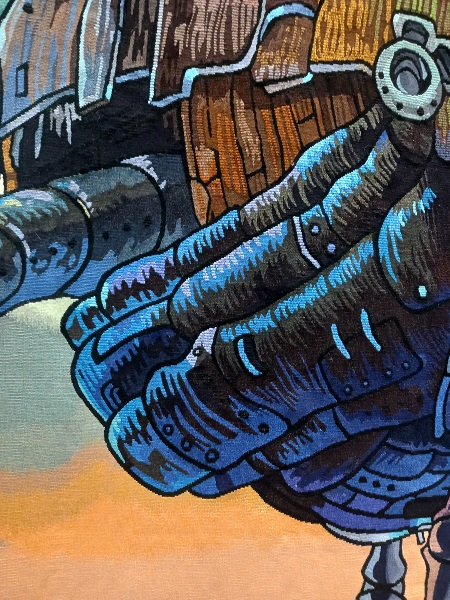
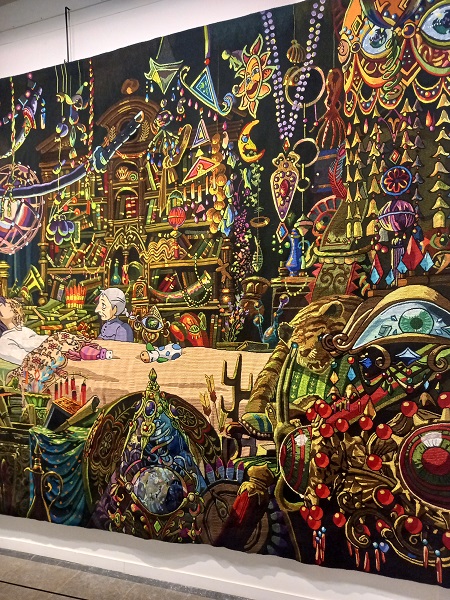
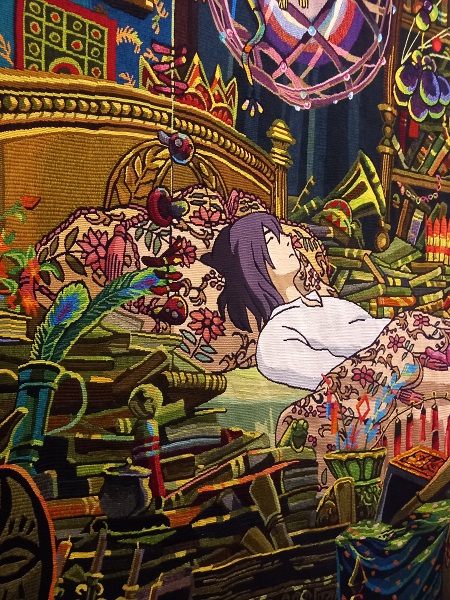
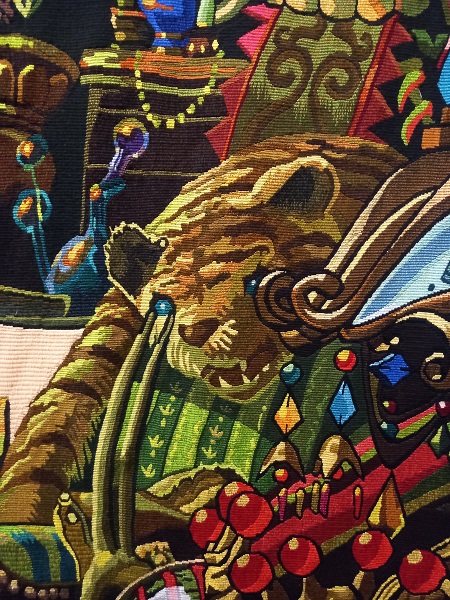
They had two exhibitions of modern weaving, which were really impressive. The first was of illustrations from a Japanese artist called Hayao Miyazaki. I am familiar with these, through my son Jake’s interest in anime, and these were illustrations from a film called The Moving Castle.

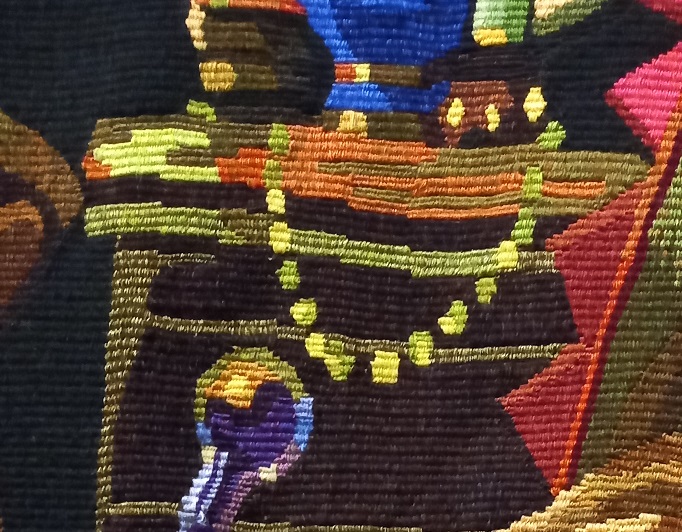
The level of detail here is amazing, the colours are so rich and the way that they have been blended is stunning, look at how the cloud has been woven over the other colours here. Just amazing work.

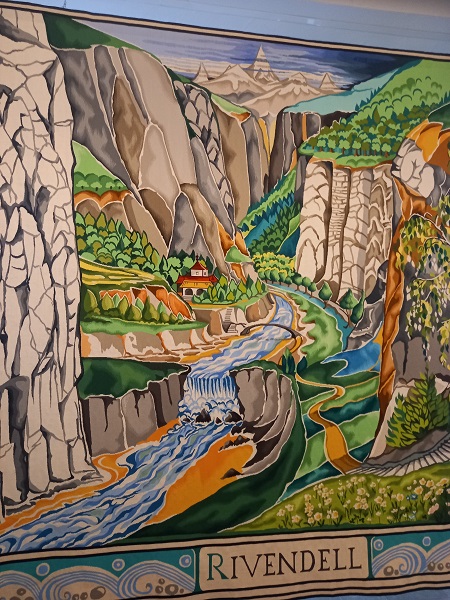
The other exhibition focused on illustrations by Tolkein, again such beautiful colours. It was also really interesting to see the back of the Rivendell piece.

Seeing these modern pieces really makes you realise how stunning places like Hardwick Hall must have looked when their tapestries were first hung in the 1600s.

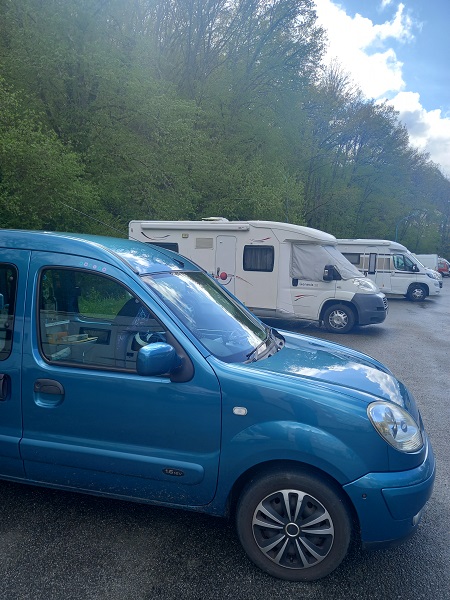
Abusson also offered a free park up, in a car park just outside the town, with free water, free electric, and a lovely backdrop of woods and a little stream, so Katy and I spent a peaceful night there, once again very grateful for the foresight of French tourist boards.

A lovely, and totally unexpected day, and I am so pleased that I managed to visit. My next post will be about another unexpected visit as well, to somewhere that had been on my wish list for around 20 years.

I have had a great week with Sue and Ange, here in Spain. We have had lots of pool time, delicios tapas, and been to visit Cartagena, one of my favourite local cities. They are now in Granada for a few days, visiting the Alhambra, and I will see them briefly before they return to the UK. Meanwhile I have a fox outfit to finish knitting before they get back, there was a major error with a pair of dungarees so they have had to be unravelled, and knitted again ;-(

I will be back soon with the next unplanned stop en route. Until then have fun, take care, stay safe and thanks for visiting.

The work of so many hands

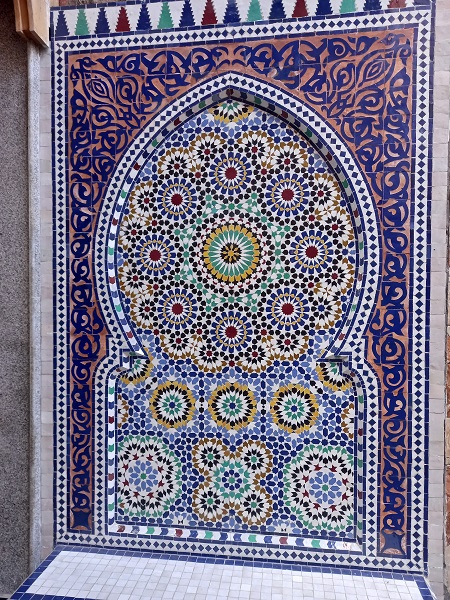
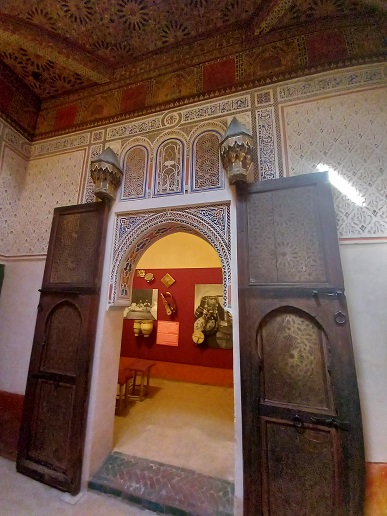
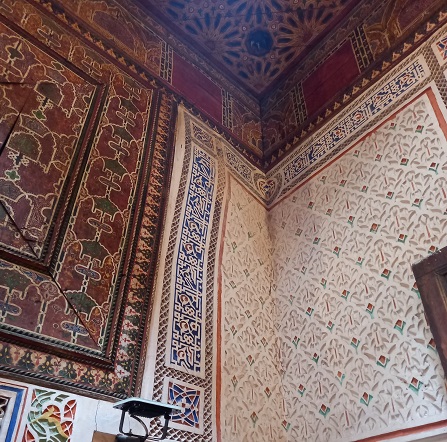
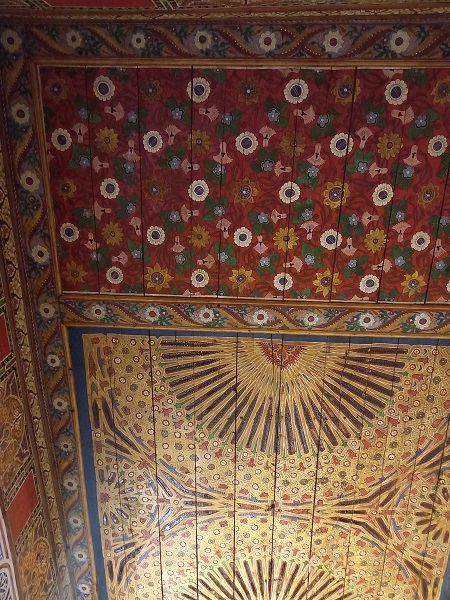
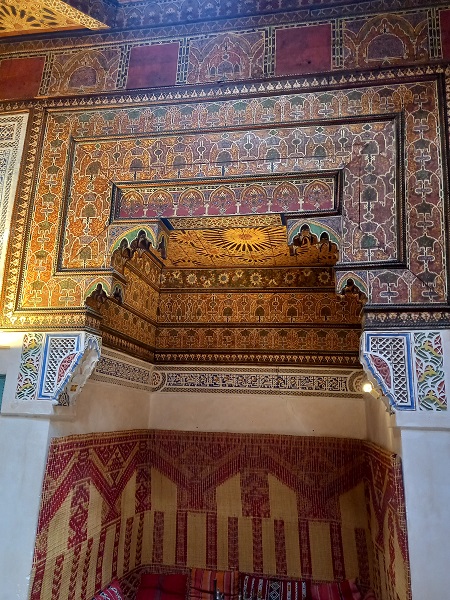
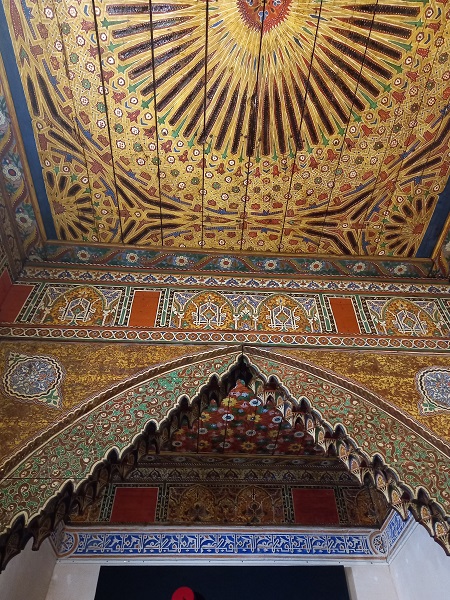
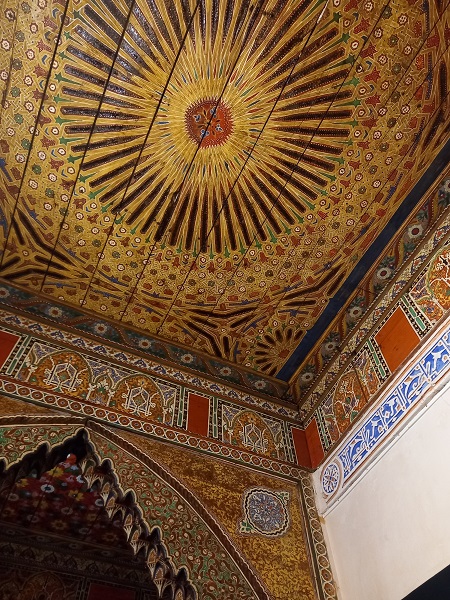
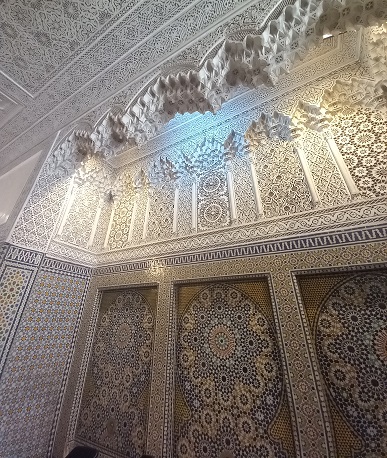
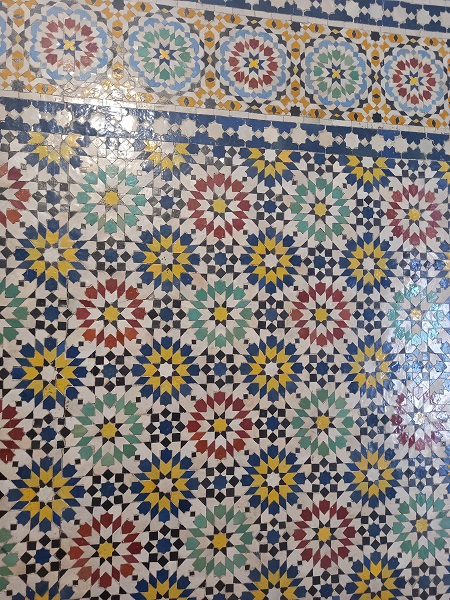
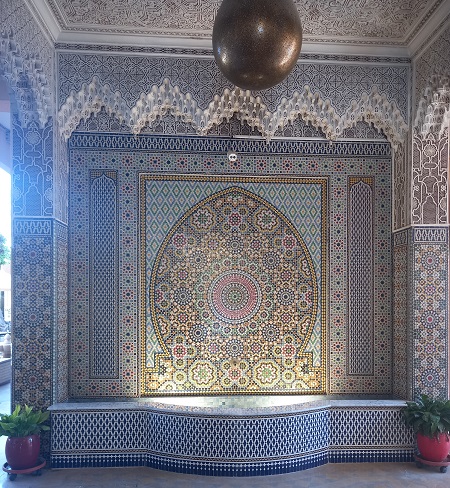
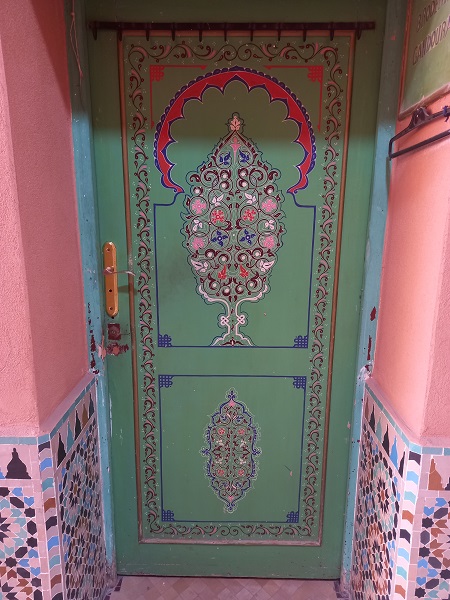
The lasting impression from Morocco is a culture with just so much rich adornment. So many beautiful wood carvings on doors and ceilings, incredible plasterwork, endless mosaics, decorated shoes, beautiful clothes, an absolute riot of colour and pattern that is breath taking and bedazzling. Now back in England it all seems a bit plain in comparison, and although it is lovely to be here, I am missing the tiles and the gorgeousness of it all.

Marrakesh was a great way to end the tour. I did originally wonder if I should have done it the other way round, and ended up at the peaceful seaside resorts of Essouria and Agadir, but on reflection am happy with the way it turned out. Morocco is a place of so much colour, and noise and vibrancy, (and traffic!), that it was probably better to ease into it.

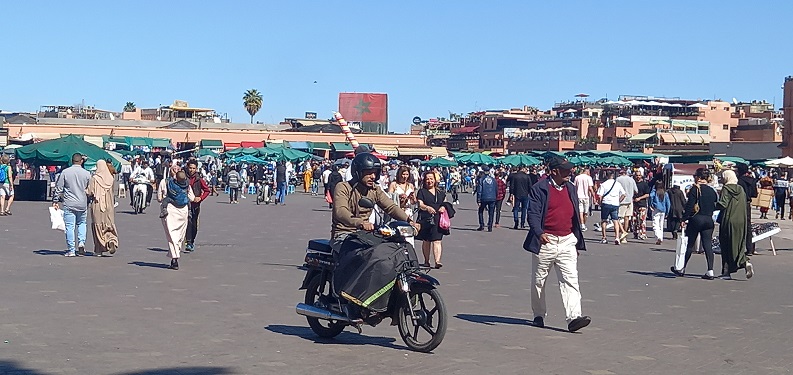
Most days in Marrakesh I visited the Jemaa el – Fnaa Square in the centre of the city. I have been before and knew that it is the lively heart of the medina, with so many stalls, and restaurants, and entertainers of all sorts. It is noisy and chaotic and wonderful!

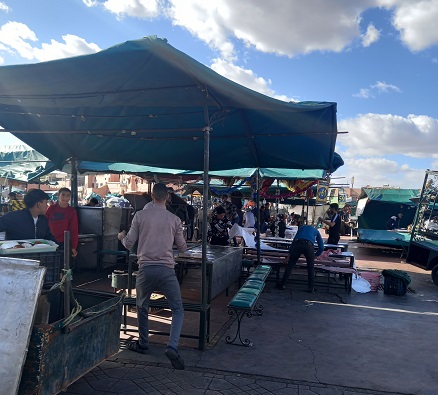
As well as all the daytime offerings, such as the horse carriages and the many cafes and juice bars, every evening from around 4pm a whole extra set of temporary food stalls get built, such a lot of work each day. I sat one of the days with another cup of delicious tea just watching all of the frantic activity.

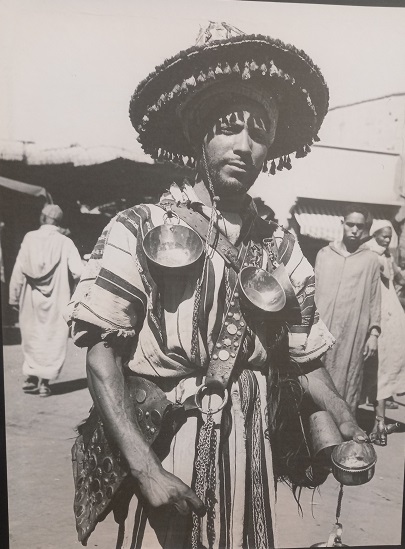
I love the contrast in the last photo above of the traditional water sellers, who pose for pictures, and the silver ‘statue’ performer.

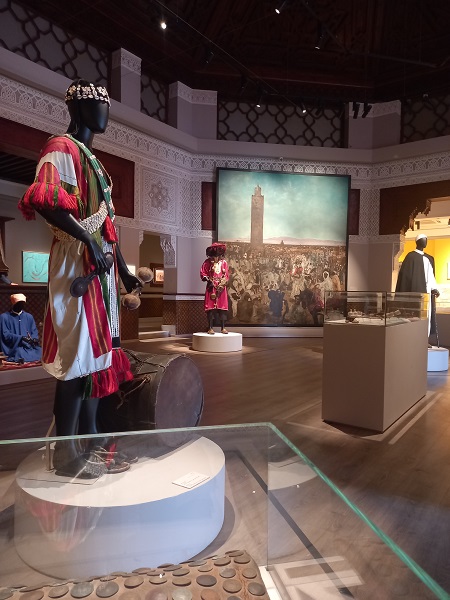
This trip I also went to the museum at one side of the square, which is housed in the old Moroccan National Bank building, constructed in 1927.

I didn’t realise that the square has been in existence since the 1600s, and has always been used as as place for musicians, storytellers and entertainers of all types. It was a lovely museum, mostly using old photos and film to document the life of the square, and really interesting.

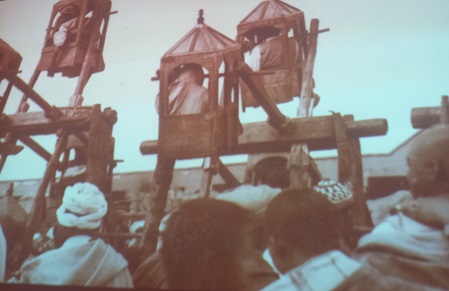
This water seller was photographed in 1966. I also saw these little roundabout seats in the woodwork museum in Fes, but am not sure when they date from.

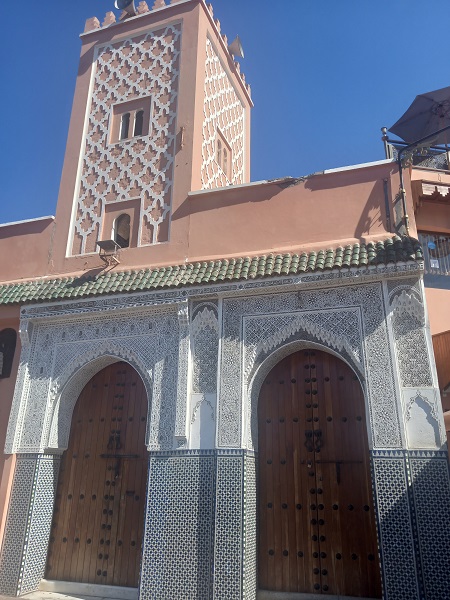
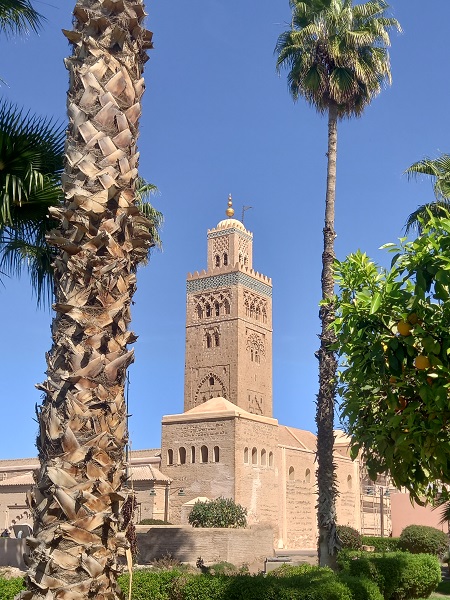
Near the square is the Koutoubia Mosque, thankfully it only sustained minor damage in the 2023 earthquake, and is being restored. It has parks and fountains all around it, so I usually had my lunch there.

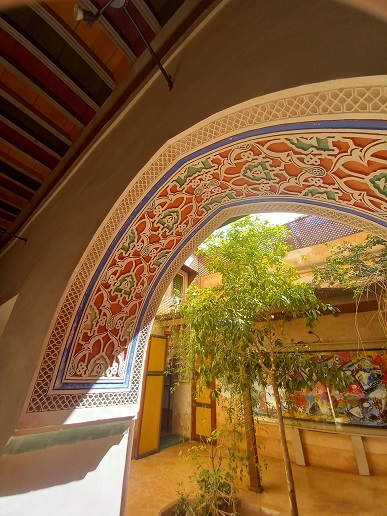
The other museum I visited linked in really well to the Jemma El-Fnaa one, the Mouassine Music Museum is in another beautifully restored mansion, which dates from the 16th century.

If I thought the lower floors were impressive, that was nothing compared to the guest apartment on the upper floor. They hold music sessions here every Monday evening.

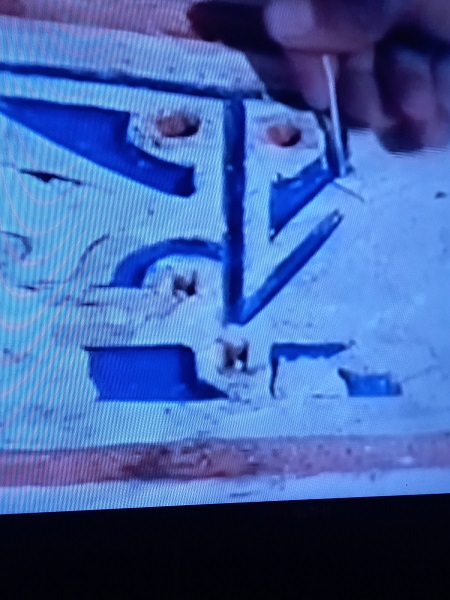
The building has been extensively restored and there were some really good videos showing the work. Apologies for the slightly grainy pictures, but this is when they were scraping off all of the plaster that had been put over the wall frieze, and cleaning the paintwork.

It is so brilliant to see so many skilled people being able to restore the buildings as well, there must be so much to do here, with so many wonderful places that need TLC.

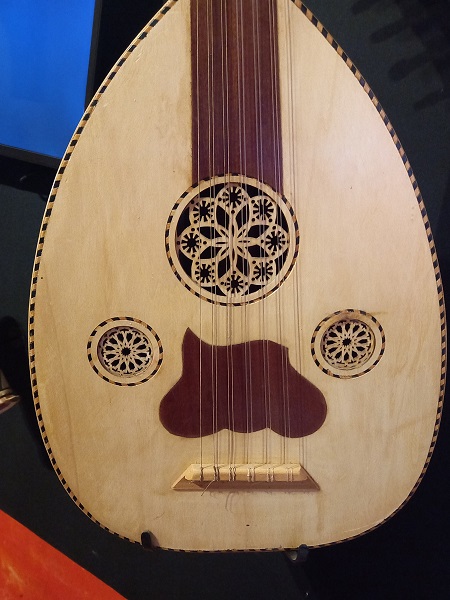
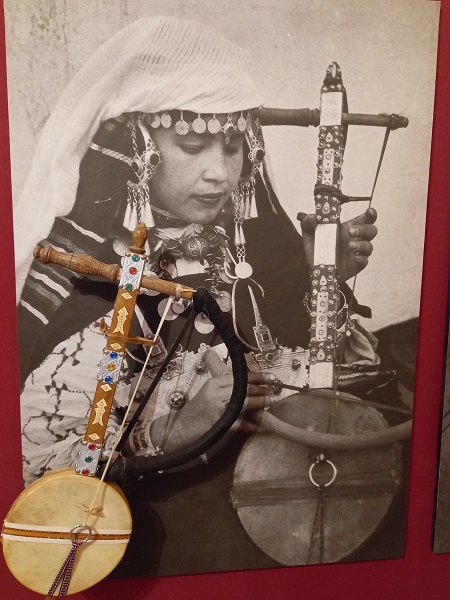
There were excellent displays of instruments, but more importantly for me, lots of videos and photos of people playing them, and dancing and a great focus on the dress of the performers.

These facial tattoos, in the second photo, are fascinating. These are from some of the women in the Atlas hill tribes.

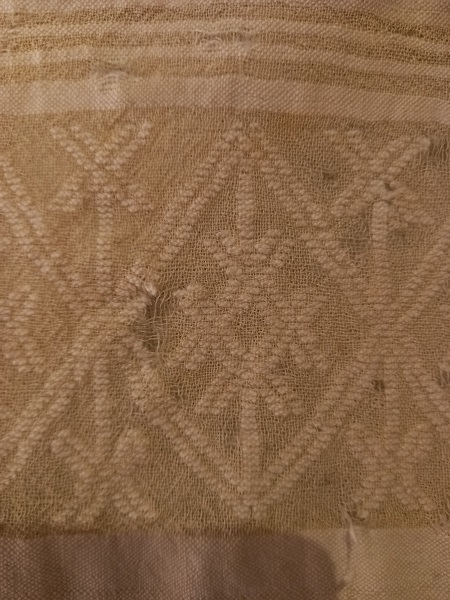
Although there was not much in the way of textiles in either museum, I did find a little bit. This gorgeous shawl had very delicate whitework embroidery. The main history museum is closed at the moment, so I expect there would have been more there.

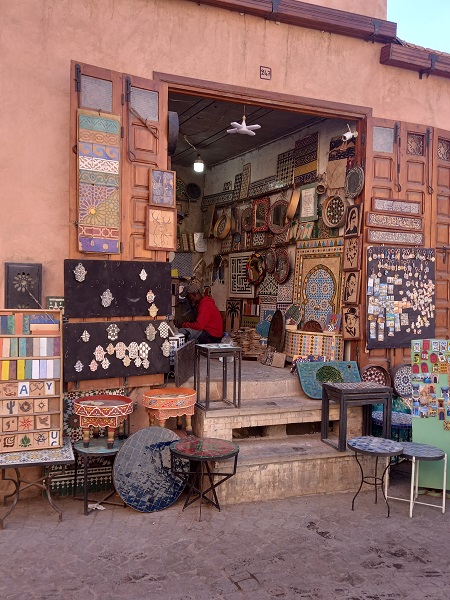
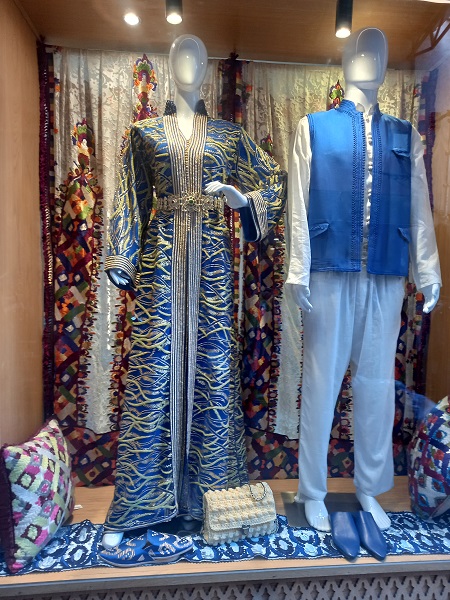
I did see quite a few shops selling traditional embroidery and textile goods as I wandered through the medina, as well as more modern kaftan shops. I was also very excited to see a little zellige workshop in the medina near my riad. I stood and watched the artisan chipping the tiles for a little while.

In the same way that the Hassan 2nd mosque in Casablanca is supporting training of current artisans, there is an artisan’s centre in Marrakesh, just outside the medina. It is an amazing building and contains workshops as well as places to buy the wonderful creations.

Of course I must finish my Moroccan series of blogs posts with revealing the taxi colour for Marrakesh ! It is a creamy yellow.

I think in this city there must be one taxi for every three people, I have never seen so many in my life. That does make it really easy to get around, though most of the time I enjoyed walking. You can’t stop and take door photos as easily from a taxi can you 😉

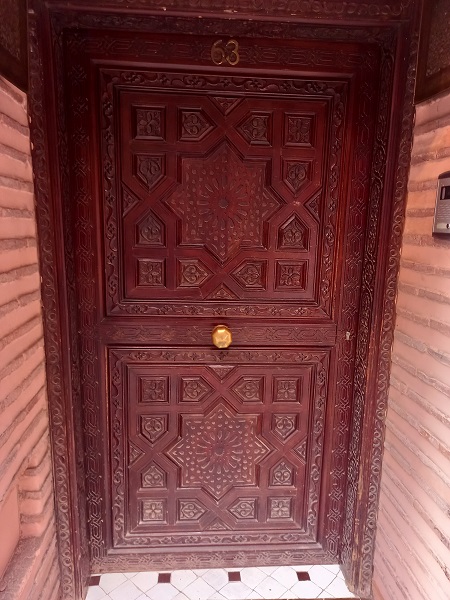
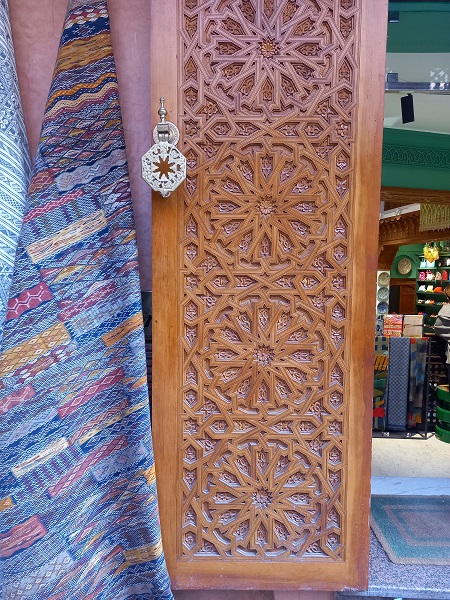
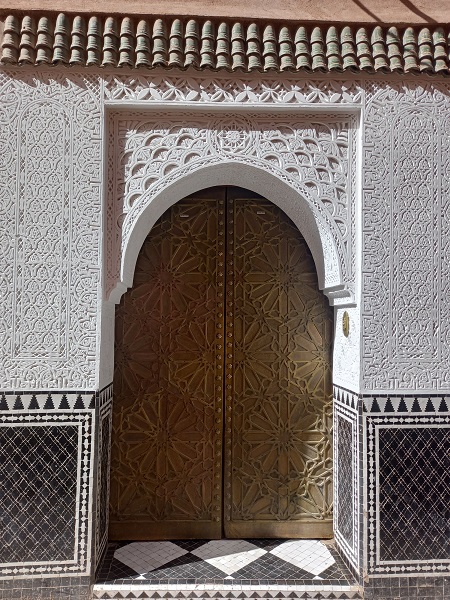
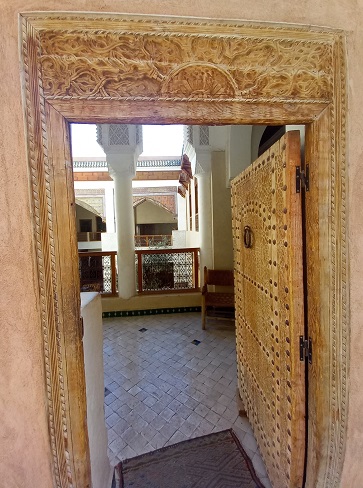
I shall finish this post with some of the wonderful doors from my last few days of wandering in the medina.

I was really thrilled to find this lovely old door open, and was able to peek inside at an amazing riad. I think it was still being restored, but what a palace!

It has been such a privilege to be able to visit this country, to see where all the inspiration for the places that I love in Spain come from, and to find out more about its history. I have really enjoyed the visit and would love to go back, albeit next time with a bigger suitcase and a lottery win to spend on lamps 😉

I have had a lovely couple of days with Ellen. She came back from her month in Europe the day I left for Morocco. She visited Spain, Switzerland, France, Belgium and The Netherlands in her time away, everything from mountain cable cars, medieval Alsace towns, and chocolate museums, as well as a quick trip to Disneyland Paris where she met up with her friends. She loved everything and is now planning another month in Asia for later in the year. I am so proud of her for being a confident solo traveller and having such amazing adventures.

I am off again tomorrow, to Scotland, to spend a few days with my friend Sue, can’t wait as I am so looking forward to seeing her, and the beauty of Scotland again. I will be back next weekend, so until then, have fun, take care, stay safe, and thanks for visiting.

Nicosia part 2 – more doors, and more textiles!
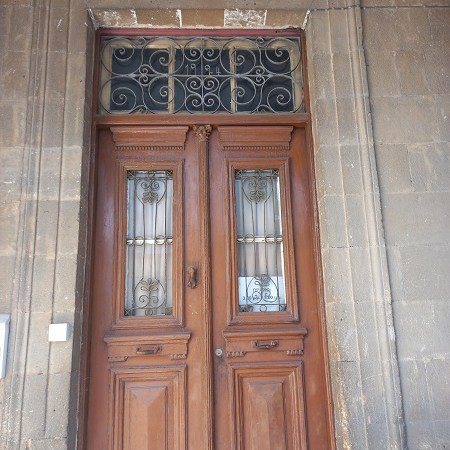
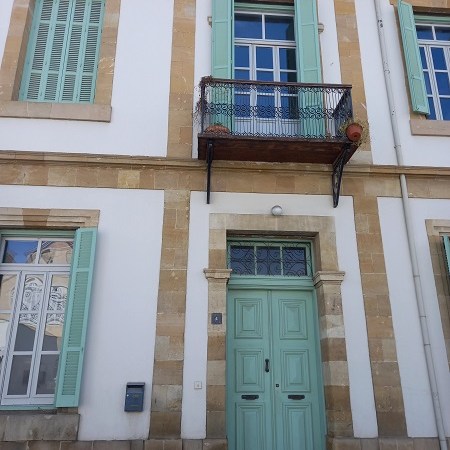
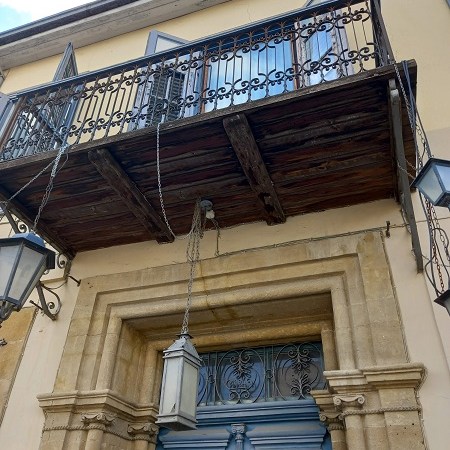
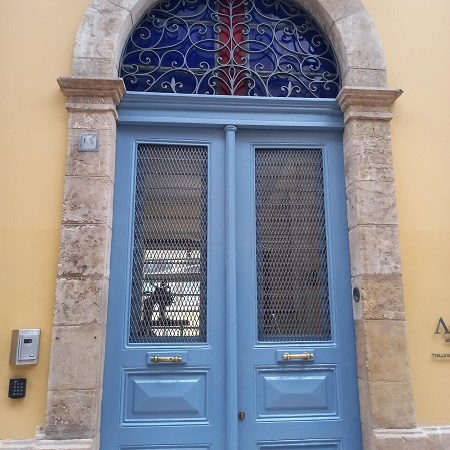
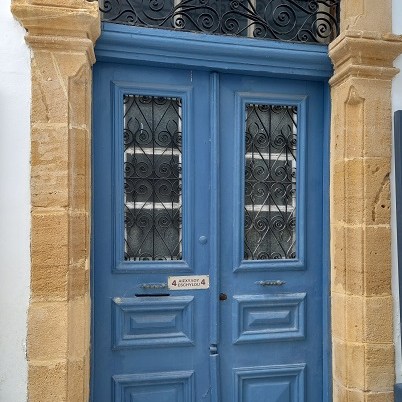
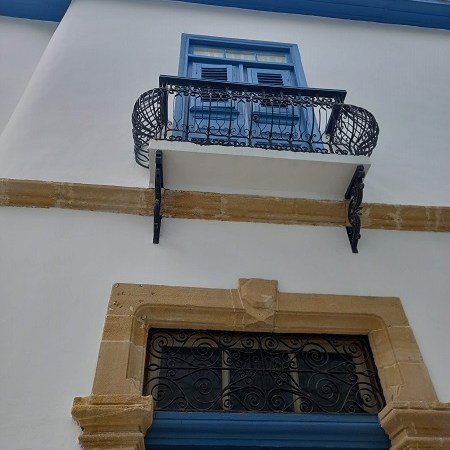
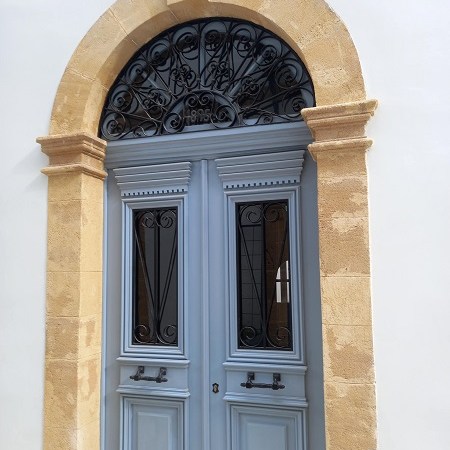
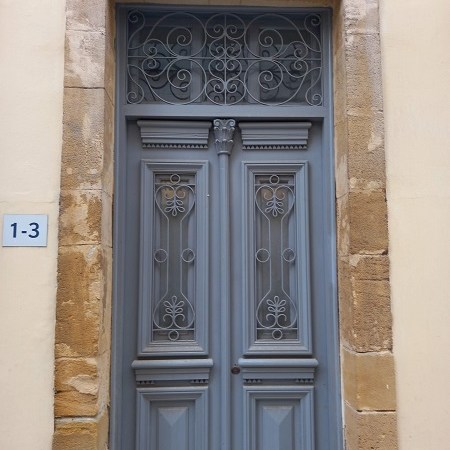
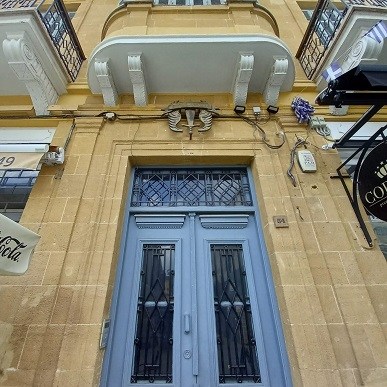
I am definitely loving the Cypriot doors, and balconies. Again most in Nicosia had the dates on, and all seemed to be from around the same era as in Larnaca, which I found very interesting.

I did find one dated to 1718, and part of the city walls with a gate, but all the others are a very similar style and from the early 1900s.

Being an amateur building historian I can only assume that they was a lot of building in all of Cyprus at this time, and that possibly a lot of older buildings were destroyed to make way for these ones.

Unlike other cities that I have visited there seems to be no specific medieval area, though the Venetian walls do date from the 1570s which is the later medieval period. I did see a medieval hall near the walls as well.

I can only assume that when the British occupied Cyprus from the 1870s there was a lot of building from that point, which may explain the lack of older buildings apart from things such as the forts and castles.

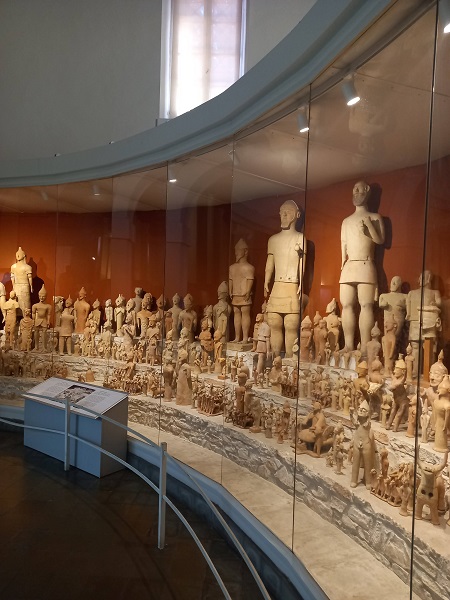
I visited three museums on my second trip. The first was the main Museum of Cyprus ,which had lots of pottery and statues. I am not normally that interested in the different types of ceramics, they just don’t get me as excited as textiles do. However, there was an amazing display that was all found together.

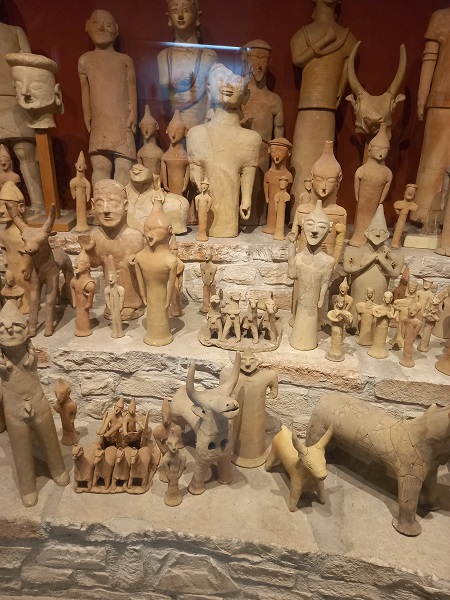
These 2000 figurines were found displayed like this in the sanctuary of Aiya Irini, and date from the 7th and 6th centuries BC. There are mainly soldiers, waggons and horses, and there are only two female figurines.

I love the face on the bigger bull at the front of this picture above, he looks as if he is smiling!

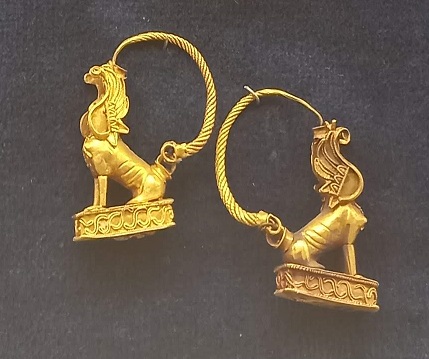
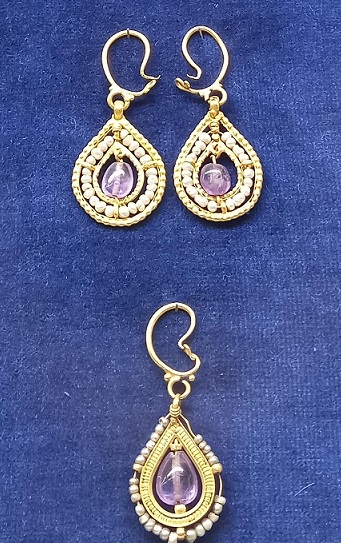
The other really interesting thing was this jewellery display, dating from the Byzantine period of the 6th century. As well as being beautifully detailed it was interesting to see how the designs have not really changed at all, even down to the way we fasten earrings all these centuries later.

My favourites were the winged creatures in the top left picture, they were so detailed at only about one inch tall.

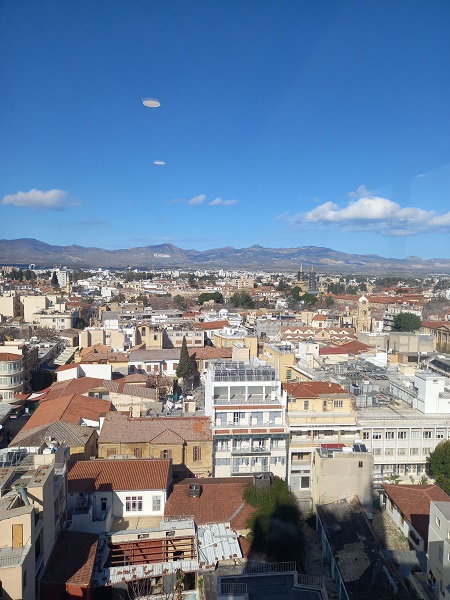
The second place was, The Shacolas Tower , which has a panoramic view over the city and a small exhibition and video about the history of the city. It is well worth a visit as it so interesting to see some of the landmarks from above.

I spotted the church and archbishop’s palace that I had visited in this first photo.

The one below looks towards the occupied part of the city where you can see the towers of the Selimiye Camii mosque that was once a cathedral, at the back right of the photo in front of the mountains. It has been a mosque since the Ottomans came to the city in the late 1500s so is very much part of the very diverse history of this city.

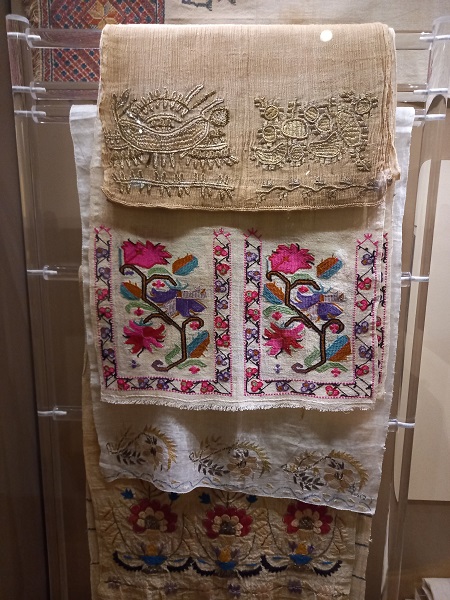
The final museum was the Leventis Museum, which is housed in three restored buildings within the city centre. This was a great museum for giving you a timeline of all of the different cultures that have lived in Cyprus, showcasing Venetian glass, Ottoman jewellery, and having some excellent examples of textiles.

There was a whole display devoted to maps and books written by the many people that had travelled to Cyprus, often on their way to the Middle East. I love old maps and the history that they represent so colourfully.

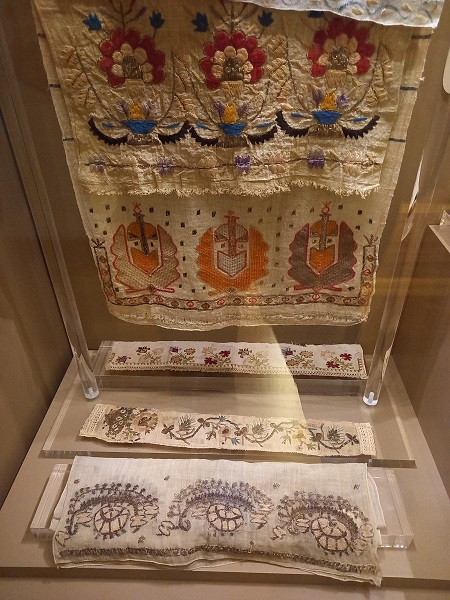
There was a costume display, and also some excellent examples of Cypriot embroidery and lace.

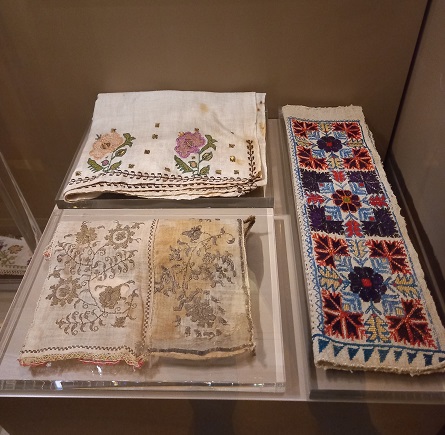
I think the motifs on this beautiful piece below are pomegranates, which reminds me that I really must get started on my pomegranate goldwork that I have been promising to make for about 20 years!

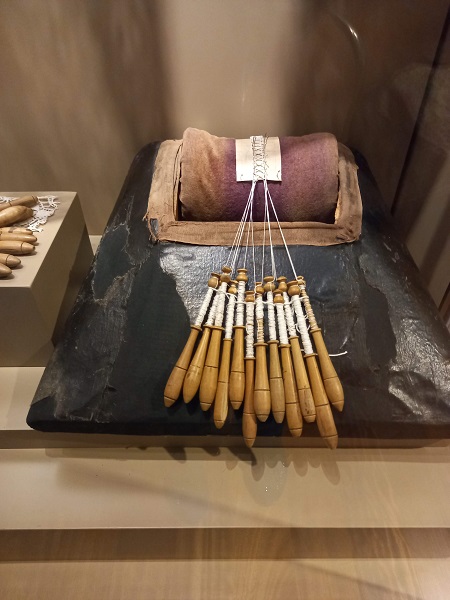
The lace is described as crochet lace on the label, so I am not sure how some of it was made, although they do show bobbins as well. I think there may be a mix of techniques used.

The embroidery examples were very interesting as well, Cypriot embroidery takes many forms, there is heavy influence from the geometry of cross stitch, but also flower motifs.

This top piece seems to use gold thread as well, as far as I could see through the case.

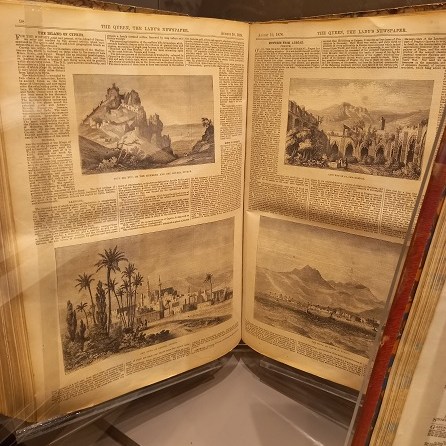
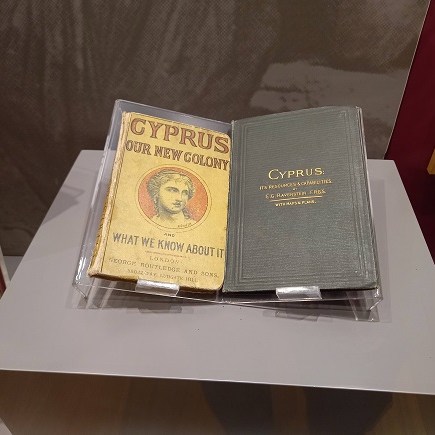
The final section of the museum looked at the influence of the British occupation from the late 1870s. There were some of the magazines published at the time, and this very interesting book. I would love to have read this to see what the impression was of Cyprus at this time by the British public.

The cross over of fashions was also mentioned, contrasting the traditional dress of the Nicosian people, with that of the Victorians who came to live there.

As with the kimono exhibition we saw recently in New York, it was interesting to see pictures of how the dress became adopted by the Cypriot people. There are few differences between the garments really, in terms of style, but dress was very much linked to social status and religion, so at first there was little mixing of fashions.

I just had time for a short wander before getting the bus back, and found another church, not hard when Nicosia is full of them!

This one was particular interesting for a mosaic of Mary, (I assume), with a distaff spindle in her hand.

Images of Mary spinning are knitting are quite common and I found this interesting blog post with more information and additional pictures.

I will be travelling over the next few days and settling into my next accommodation, so I will return soon with more adventures. I am loving this nomadic lifestyle and really looking forward to the last couple of weeks in Cyprus. I will then be reunited with my beloved Katy Kangoo for further adventures in the UK.

Until I see you next have fun, take care, stay safe and thanks for visiting.

New York, the iconic bits

As Ellen said before our visit, New York is the sort of place that you feel that you know before you get there. So many movies and tv shows feature parts of the city that they are all so iconic.

We did have a list of things that we wanted to visit, and it was very exciting to see things in real life that we have only seen on film. Although I visited New York about 18 years ago, that was only for a weekend, and being so near to 9/11 many things still weren’t open.

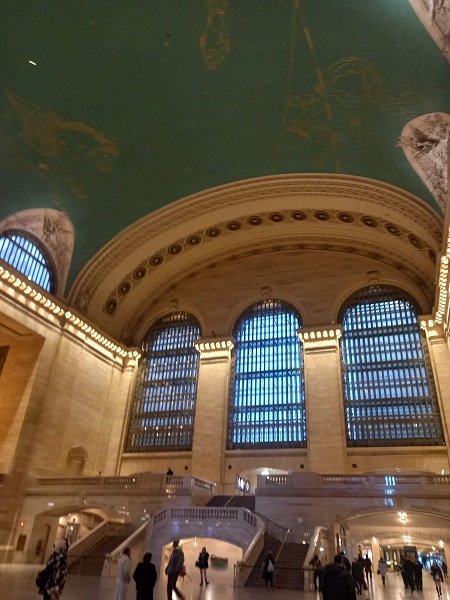
We stayed in a very lovely hotel, near to Grand Central Station, which is just as beautiful as it looks, even the ticket booths are masterpieces of art.

Our hotel was called Pod 39, and is similar to ones that I have stayed in before for city breaks, with a bunk bed layout and a small bathroom.

However the beds were very comfortable and the location was excellent. We weren’t really in the room much anyway, and the hotel had a lovely comfortable lounge with games and free hot drinks and water available so we spent some time there as well.

Our first day out was to the Statue of Liberty and the Ellis Island Immigration Museum and we could not have had a better day for it. Although it was cold, the sky was a wonderful blue which made for excellent shots of Manhattan from the ferry.

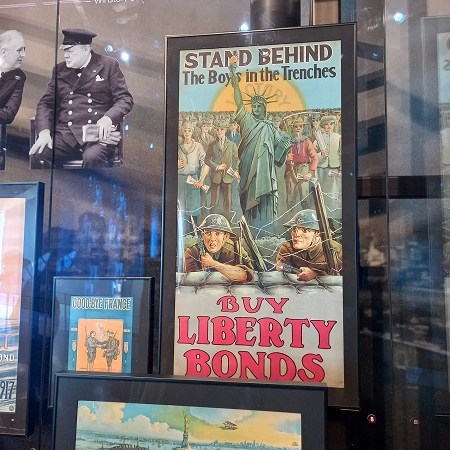
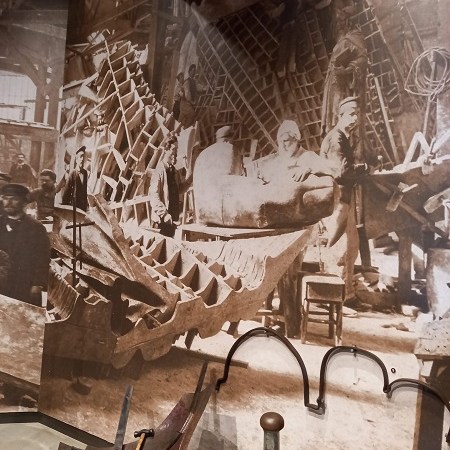
The Statue did not disappoint and the accompanying museum was excellent with really good interpretation, not only of the story of the build, but also looking at how the statue has been portrayed in all sorts of different ways since it was built.

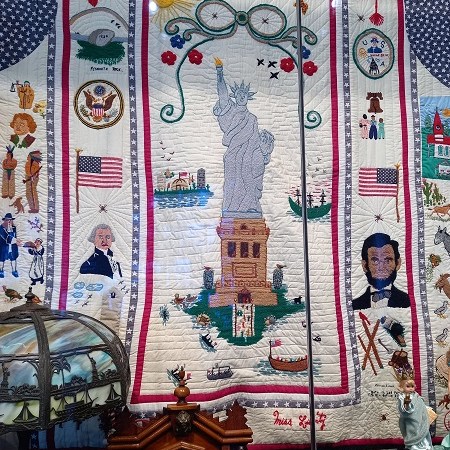
There was a lovely quilt and a Barbie dressed as the statue, which Ellen suggested should be one of my next makes.

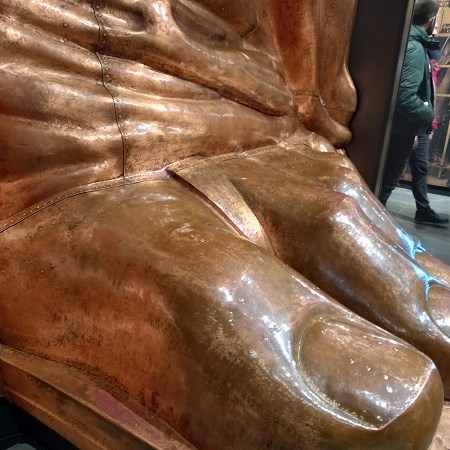
They had used the restoration in the late 1990s as a chance to show how the statue was made, with recreations of the moulds that were built for the casting, including a recreation of the statue’s foot.

I didn’t realise that she was bronze coloured to start off with and the green is the patina that has built up on the metal over time. I think it looks a lot better green, especially against the blue sky. We also saw the original torch, which had to be replaced due to its collapsing on itself.

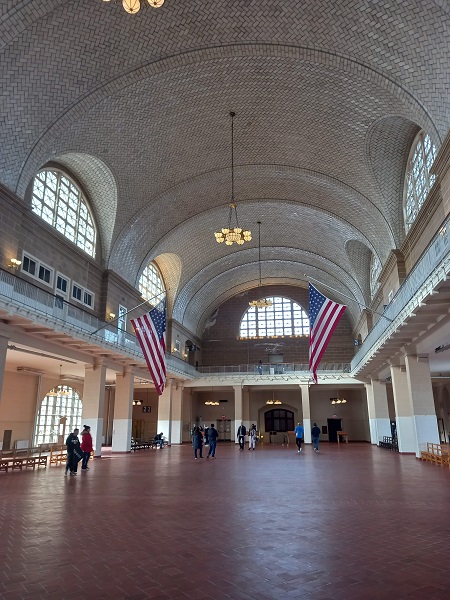
The Ellis Island Museum was equally well interpreted, with lots of the stories of the migrants and their many reasons for coming to America. It was very poignant seeing the large hall where they would wait to be assessed before entry, and the postcards of the numerous ships that brought them from all over the world.

I have always had a huge interest in migration and people’s stories of why they leave their homes and having visited other museums, such as those in Oslo, that tell the story of those who left, it was fascinating to see where they arrived. Being part of a family who have migrated, and who now live all over the world, it is always really interesting to me to hear these histories.

Our second day was to Central Park and the Metropolitan Museum. Central Park is somewhere that I have been to before, and it never ceases to amaze me how large it is, and how great it is to have that space in the city. They also have the fattest squirrels I have ever seen!

The Met Museum was stunning, as we knew it would be. The scale of the collections is amazing, whole Egyptian temples, courtyards of castles from Spain, Tiffany loggias and windows and so much wonderful medieval art.

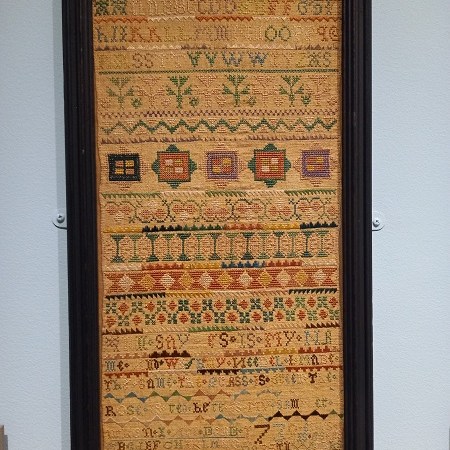
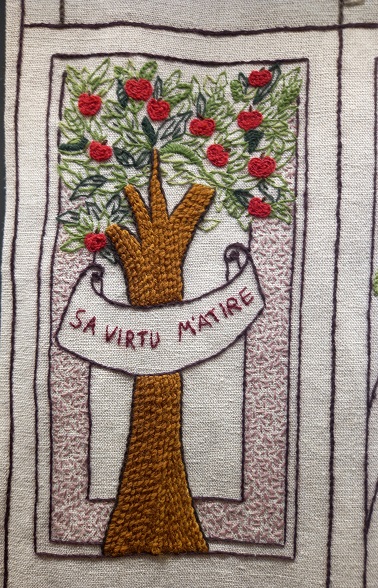
There were also some gorgeous early 18th century samplers.

However, the most stunning piece in the collection for me was this store of linen, buried with one of the Egyptian queens for the afterlife.

The fact that it is still around, thousands of years after being woven, such simple textiles but amazing that all that work of the weavers centuries ago still exists.

We also spent a lot of time just marvelling at all of the wonderful buildings, the Chrysler Building is a real favourite of mine, but I also loved Penn Station.

This beautiful building that was one of the ones represented by brass plaques in the pavement. I think it looks like it came from a Lord of the Rings film.

New York still had the skating rinks at the Rockerfeller Centre and Bryant Park, and trees and decorations everywhere, so it still looked very Christmassy.

We managed to tick off our food bucket list as well with pizza, bagels, pancakes, hot dogs and burgers, only failing to find a gluten free pretzel.

A brilliant trip and I am so glad that we were finally able to get there. These next few months are hopefully going to be full of us doing things that we have been planning for a long time.

I am loving my winter sojourn in Cyprus so far and shall be sharing the first set of pictures with you later in the week. I have been so lucky with the weather, so have been out enjoying the stunning coastline here.

Until then have fun, take care, stay safe and thanks for visiting.

Making lace while the sun shines

We have had a fantastic morning joining in with the local lace makers’ day in the nearby town of Guardamar. One of our sewing group, Vivienne, has previously shown us her amazing tulle lace work and she organised the tickets for us to join her and the lace group she runs.

I had not heard of lacemakers’ days before but they are common in Spain, there is more information and a short video at the link above.

Whenever you go to the fiestas there are the ladies with their lace mantillas, so I knew that lace was very popular here but did not realise how popular it was still to hand make it.

Some of the ladies were making the mantillas, others panels or fans.

All of the work was amazing.

We particularly admired the group above who all had matching customised trollies to carry their lace making equipment in.

I love this circular design. I don’t think I could ever do this type of lace though, look at all those bobbins to keep track of! I am bad enough with two knitting needles and often start knitting backwards if I put a piece down.

There must have been about 200 people at the event, from as far away as Gandia which is about 90 minutes drive from here. We had a table and were working on our own projects, so we got the chance to meet, and practise our Spanish, speaking to some of the other women who came round.

I took English Paper Piecing. That really helps develop your language skills trying to explain how to paper piece! Lynn also took her work, she has made excellent progress with her cushion that started as a hexagon at our workshop a couple of weeks ago.

There were also some stalls so I took the opportunity to stock up on some more Christmas ornament fabric, and some embroidery thread.

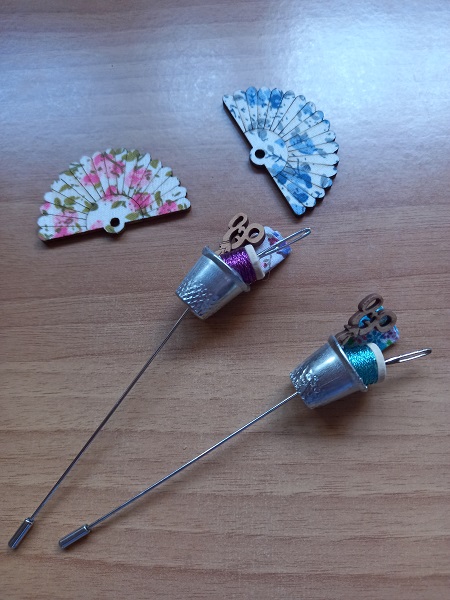
I also picked up the cutest little fan charms. Many of the lacemakers were making fans and Vivenne did have some fans for sale, with an offer to design a pattern for me. However, I really need to finish some existing projects before I take up tulle lace, amazing though it is. I also got these very cute little lapel pins. I am going to leave one in my craft room and take the other one back to the UK to add to my seamstress Steampunk hat.

This is Vivienne’s fan, designed using characters from children’s books.

This is Sue’s beautiful lace stole, she is now making a fan to go with it.

This one was from another member of Vivienne’s lace group, Claudia.

The charity event where I was doing, ‘Guess the name of the Luna rabbit’, went very well yesterday and I sold the 50 guesses of the name really quickly. I have even got a commission to make another one when I come back in October. It was a lovely afternoon, celebrating the Jubilee and raising funds for the local foodbank.

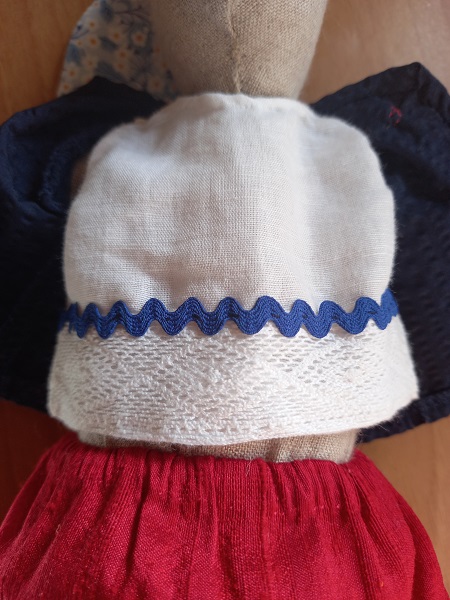
Here is Scarlett in her Jubilee outfit, the winner also got three other outfits as well. I made all of these from the three Luna Books that I have. There was a shorts and top set, a sleeveless wrap dress and a short sleeved dress.

The jubilee outfit was a smart skirt and blouse set with a jacket and little red rose on the lapel.

I also made her some French knickers as my sewing group thought she needed undies! Apart from the red silk for the skirt everything else was repurposed charity shop finds.

We had an amazing week in Galicia last week, such a magnificent part of this wonderful country and so very different to my lovely, and now very hot, La Marina. There will be lots of stunning Galician scenery coming to the blog soon, just as soon as I have sorted through the 327 pictures I took!

I have just less than 4 weeks left now so really need to get stuff done, time has really flown by as it does when you are having such fun!

Hope you are all having a good time whatever you are doing, have fun, take care, stay safe and thanks for visiting.

A very special dress and a pattern review – Simplicity 1045 dress

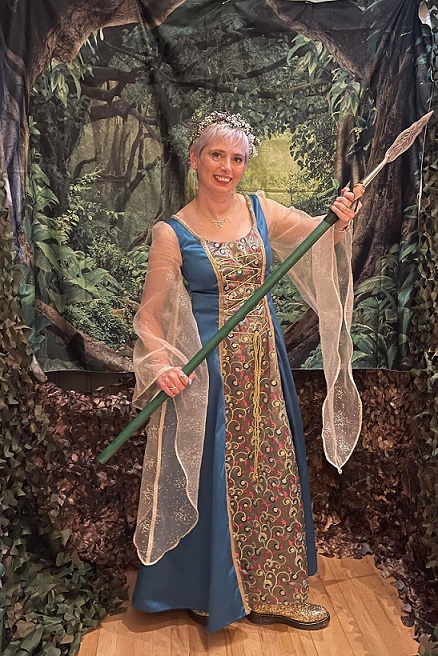
This post has been a very long time coming, I first wrote it two years ago as my friend Sarah, the very talented knitwear designer from Marsden, had asked me to make her wedding dress. The celebration was originally scheduled for April 2020 and the dress was finished on March 16th, just in time for her to tell me they were going to have to postpone for a bit 😦 Poor Sarah finally got to have the ‘official’ ceremony in August that year with just two witnesses, but the party only got to take place this last weekend, two years to the day that it would have been.

I am so glad that she finally got to have her celebration, the theme was Lord of the Rings as she and her partner Alan are huge fans. I wasn’t able to go, as knew I would be back in Spain for Mum’s birthday, but Sharon very kindly sent me some photos and she looked amazing in the dress. I will hopefully have some more photos of every else at some point as well as everyone dressed up.

Sarah's dress - large 1

Sarah's dress - large 2

When Sarah first chose this pattern for her dress I looked for reviews of it but didn’t find any so I thought it might be useful to write one in case anyone else wanted to make it. I have also talked about fabric choices as well.

Choice of garments in the pattern

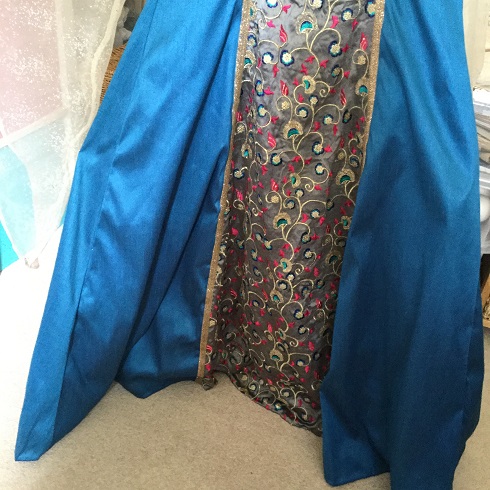
This is a good value pattern as you get different choices of sleeves and necklines. I made a combination of view A for the sleeves and the length of the dress and View B for the centre panel with braid and the cording loops. View A also has three panels at the front, but in the same fabric they are not as obvious.

Sarah's dress 1

Sarah's dress 2

Sarah's dress 3

Fabric choices

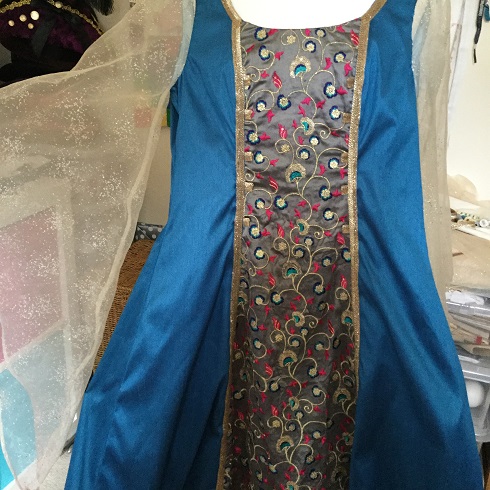
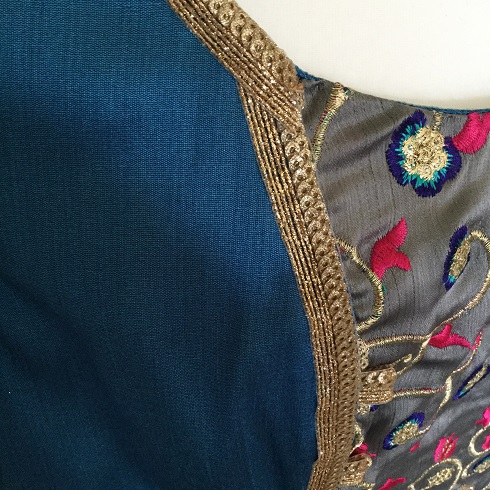
The pattern calls for light fabrics so we chose a beautiful blue polyester art dupion for the main body and a heavily embroidered grey silk for the centre panel. I trimmed the loose threads from the silk before using it.

Sarah's dress 9

The centre panel fabric did cause a few issues as it was quite difficult to sew the tabs for the front cording onto the panel. The tabs were made of the braid we chose for the edging and it was a really good match with the embroidery as it had the same kind of sequins but they were quite stiff to sew on.

Sarah's dress 6

Sarah's dress 11

The front seams needed redoing several times as they would not stay still. If I made it again I would use a less textured material as the embroidery was very difficult to stitch through in places although it is a gorgeous fabric. The dupion was beautiful to work with, it was very easy to handle and didn’t crease easily so didn’t need ironing.

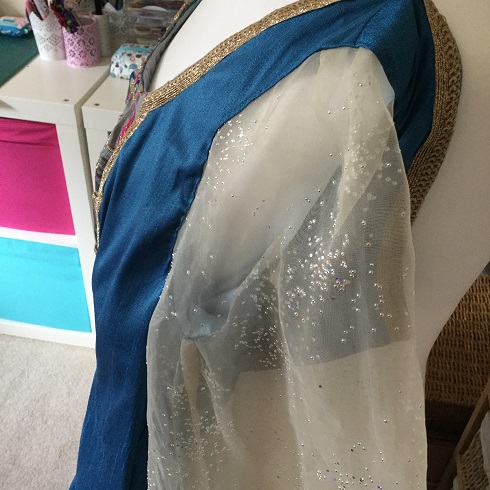
The sleeves were made of  an organza with tiny sparkles on rather than a chiffon which meant they were a little stiffer. I think this looks good as they hold their shape more easily without having to hold your arms out all the time as the model is doing 🙂

Sarah's dress 8

They do take up a lot of fabric as there is a lot of waste on the layout. If you want to save money you could have shorter, narrower, sleeves and be able to get two cut out of each width. They would still be very pretty being a little smaller.

We bought extra fabric than that specified just to be on the safe side but due to an issue with the dye on the dupion ending up cutting all panels horizontally out of the width of the 60 inch fabric so could have got away with much less. The length was fine, although we had to cut 3 inches off each pattern piece to do that. My friend is of medium height but it was a good length with just a tiny hem.

Sizing

As with all patterns it bore little relation to shop sizing, I cut it out at size 16 for the bust as her bust inch measurement was 1/2 inch more than that for the size 14 and I am glad I did as it fitted really well. It gives 2 inches of ease on the finished measurements but there didn’t seem to be that much ease.

Sarah's dress 4

The waist was cut at size 16 as well although the inch measurement was a size 14 as the hips needed to be a size 18 and I didn’t want it to end up too tight on the waist. It is a very flowing design so does not need to be too specific in terms of the hip sizing.

Sarah's dress 5

I made a toile out of an old bed sheet which was a similar weight to the actual fabric and there were no real fit issues. I did take the shoulder seams up by half an inch to give a better fit on the bust line and cut half an inch from the bottom of the armholes after the final fitting as it was a little tight there.

Instructions

The instructions were clear, I didn’t need to really follow them in detail as the dress was very easy to work out, it has seven panels and since they are all different shapes it was clear what went where. There were no complicated techniques.

The pattern had two pieces for each sleeve which would have meant a seam on the top which given the sheerness of the fabric I didn’t want so I cut it out using only the back piece (as it was slightly larger) on the fold and it was fine. I used French seams as instructed for the seams of the sleeves. This was all hand stitched and I also inserted the sleeves by hand as the organza was quite slippery and the sleeves so large I thought this was easier than trying to get it all through my machine.

Sarah's dress finished 7

Sarah's dress finished 2

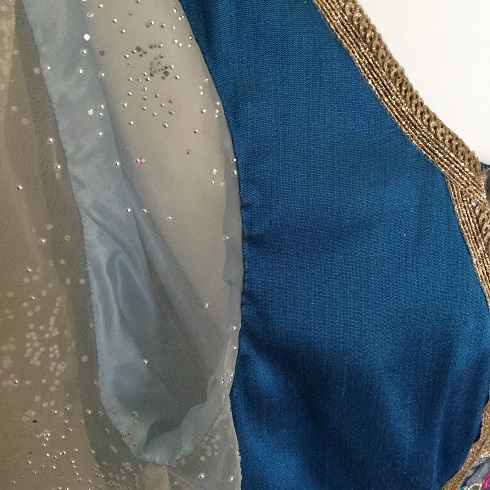
I wanted to line the dress which wasn’t in the instructions so we bought some lining fabric and made another dress for the lining. This was then sewn to the neckline then hand stitched into the armholes and next to the zip.

Sarah's dress finished 8

There was a facing as well which I made and attached as instructed but it showed through the dress fabric and looked bulky so I trimmed it back to 1/2 inch, zig zagged it and then used that to attach the dress lining to.

Construction notes

All body pieces were zig zagged after cutting before sewing up which was a good strategy as the blue fabric frayed a lot. The sleeves were not treated in this way, they did not fray too much when cut so I left them raw and the French seams and the rolled over hem at the edges hid the raw edges of the fabric.

We did not have an invisible zip due to wanting to match the colour exactly so I inserted the zip leaving an overlap each side which was then sewn with small stitches so that the zip was hidden.

I cut the cording loop tabs at 7 cm according to the instructions but they looked too big so cut 2 cm off each. The pattern also asks for 1/2 inch cord but that looked too bulky so it was swapped for thinner cord.

Sarah's dress finished 9

Overall feelings

This was a very easy pattern to work with, the only issues we had in construction were to do with a few glitches with the fabric. I am not sure why they split the sleeve in two pieces but other than that and the removal of most of the facing everything worked well. I would make the pattern again and think it would be suitable for someone with little sewing experience as it is a straightforward make.

Sarah's dress finished 3

Sarah's dress finished 5

Sarah's dress finished 4

Sarah's dress finished 6

Time taken was around 50 hours in total but about half of that was hand stitching so if you were machining sleeves, lining etc it would be far less. I hand stitched the hems on both lining and main dress as I prefer the finish and enjoy hand stitching but if you are just making a costume you might not do that and the braid could have been machined on as well.

I hope that this has been useful, as I make more things with commercial patterns I will review them as I find it very helpful to read other people’s thoughts about what they use before I decide which patterns to buy.

I will be back in a while with more travel pictures, in the meantime, have fun, take care, stay safe and thanks for visiting.

Spiritual stitching

One of the things that was so brilliant at Exeter was the level of information given about all of the textiles on display. As well as a dedicated display of ecclesiastical garments in the centre of the cathedral there was information all around the site about the work.

The Company of Tapisers was formed in 1933 and although the individuals are anonymous there was a real sense when visiting of the human hand behind the work.

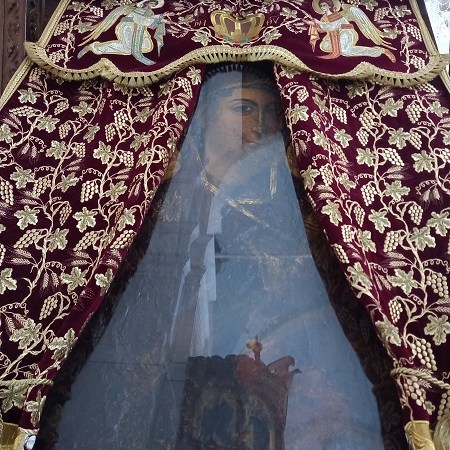
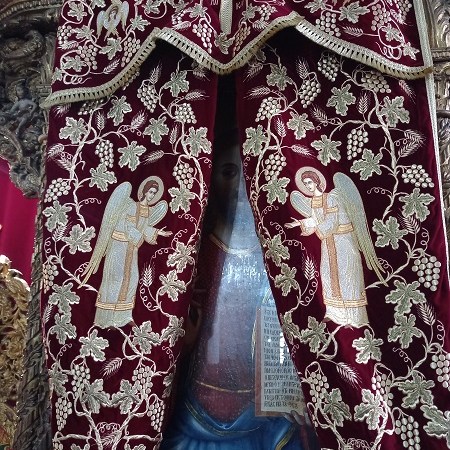
Some of the interpretation was very poignant as with this beautiful banner piece of the Virgin Mary.

This was a stunning and very unusual piece, seating along the length of the chapel telling the history of Exeter.

Everywhere there was so much lovely work, from kneelers to altar frontals. It really enhanced the experience for me to be able to read the additional information and I gave my thanks to the staff after the visit.

One thing that I am passionate about is the human story behind textile creation. The novels that I am writing are all based around individual pieces of textiles and the women involved with them. The history of textiles is the history of people, whether it be to celebrate, or simply to keep us warm. It is just so fascinating to me how all of these things are made, and why they are made.

I am so pleased that I have so many friends that share my passion for textiles, and that Ellen is so keen. She has made some stunning things recently, one being a very lovely crochet cushion cover that I am keen to learn how to make as I think it would look great in my new van.

I went to her crochet group last night and that was lovely. She is helping to run workshops with a friend of hers, Vic, who is a very talented creator so are you are in the Nottinghamshire area I can thoroughly recommend Made by Torty B. Her workshops can be found here and are great for beginners or more experienced crafters.

It will have to have a very good sort out of all of my new craft space soon as the machine will have to be found a new home and there might just have been a few purchases made while I have been in the UK. Some storage shopping is on the cards I think!

I hope that you are all enjoying life. I am so looking forward to the next few months of beautiful spring and summer weather. I have promised myself that there will be a new outfit for Whitby and a new dress for Tewksbury so need to get organised and fit all that in.

Have fun, take care, stay safe and thanks for visiting and commenting, it is always lovely to meet my readers!