A sense of history

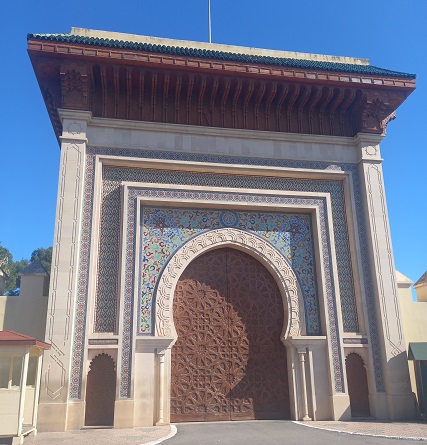
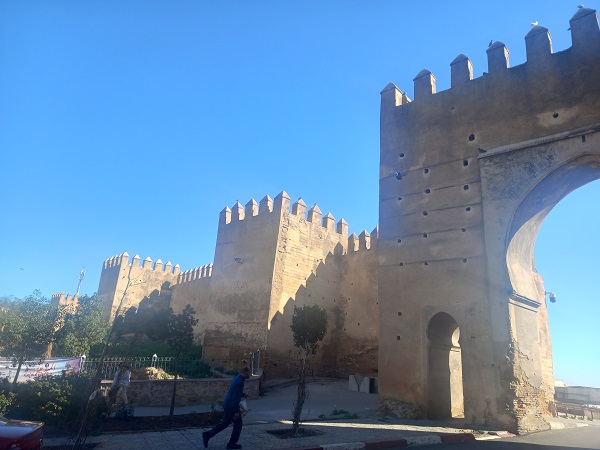
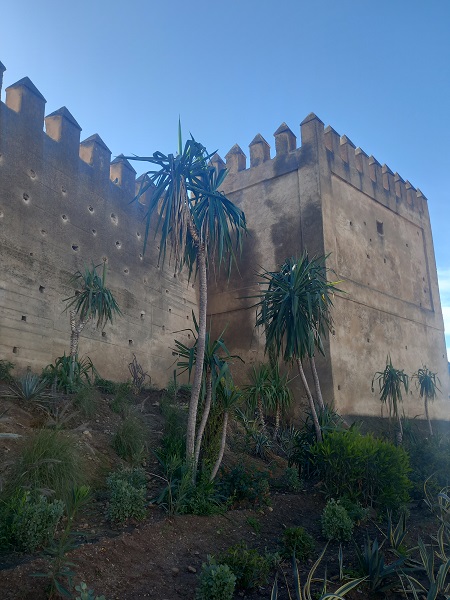
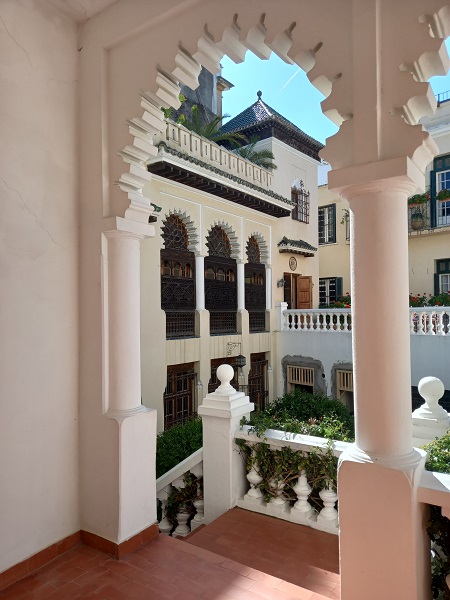
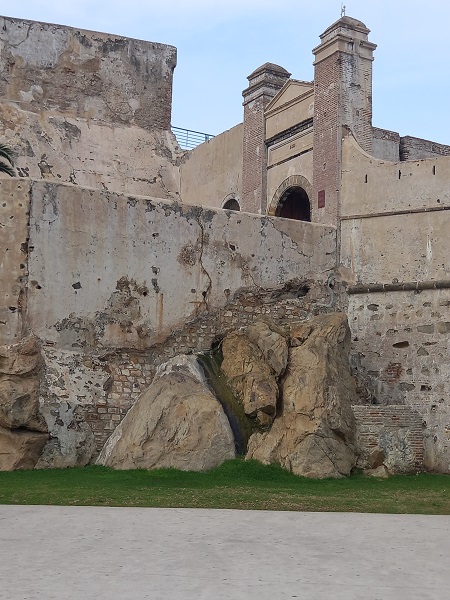
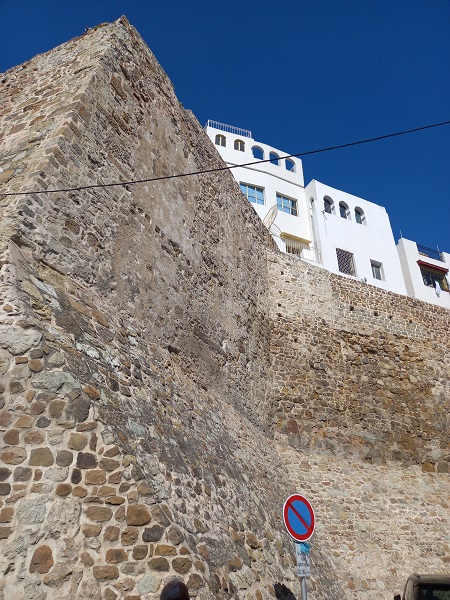
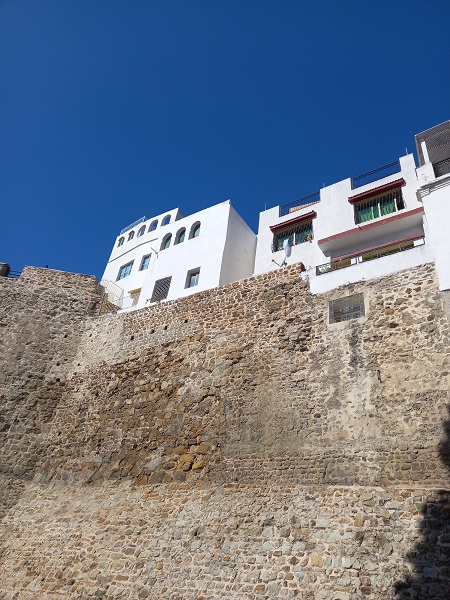
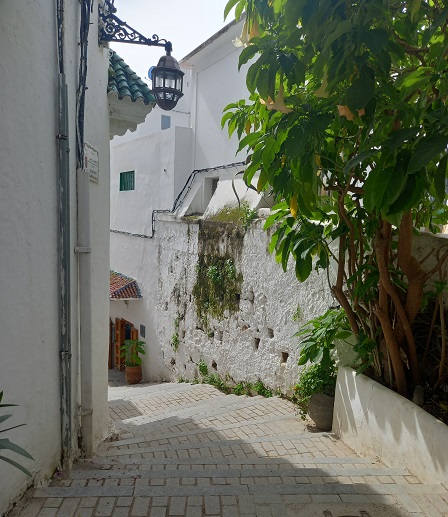
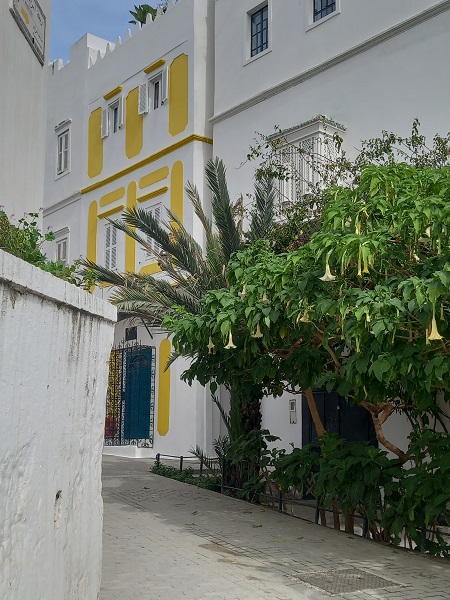
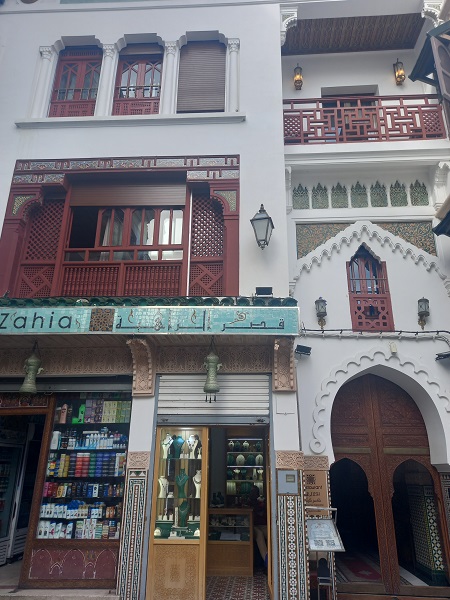
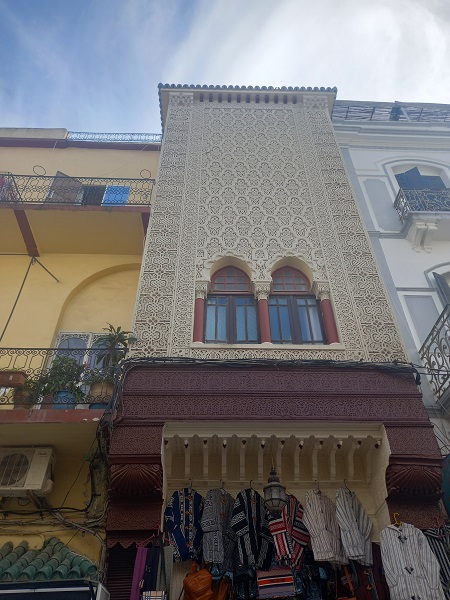
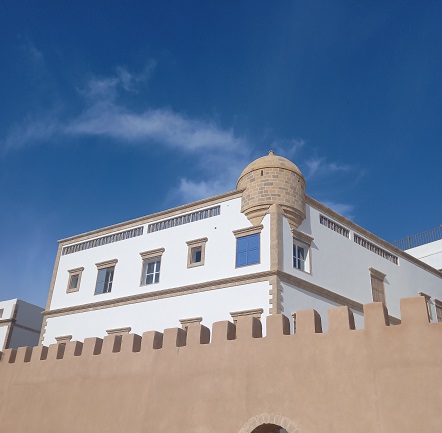
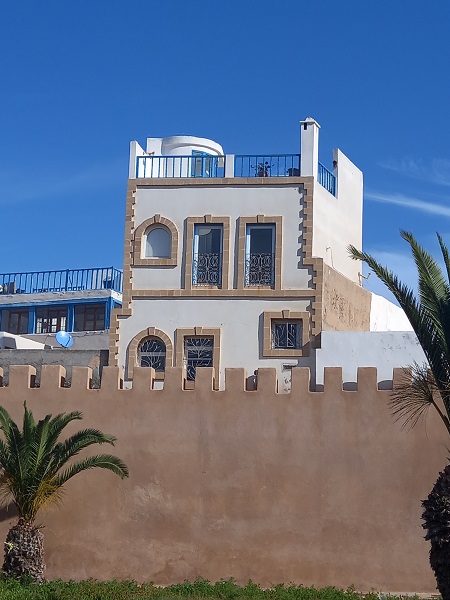
This is my third day in Tangiers, and it is very different to Casablanca. I am staying in the heart of the medina, which is very Spanish inspired, all around me are yellow and white buildings. However the medina itself looks very similar to others in terms of its gates, walls, and lots of little shops with wooden porches.

I am going on another wander later today so will take more pictures of the walls for you. It was a bit mizzly and grey yesterday so I have not done much scenic photography yet.

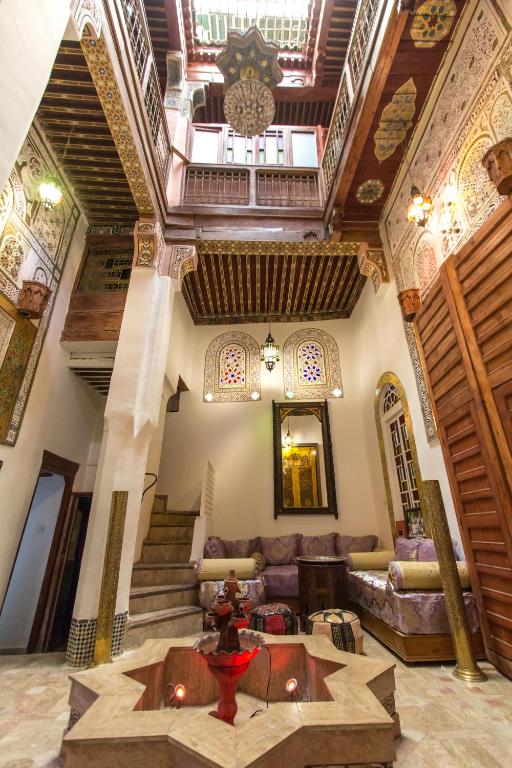
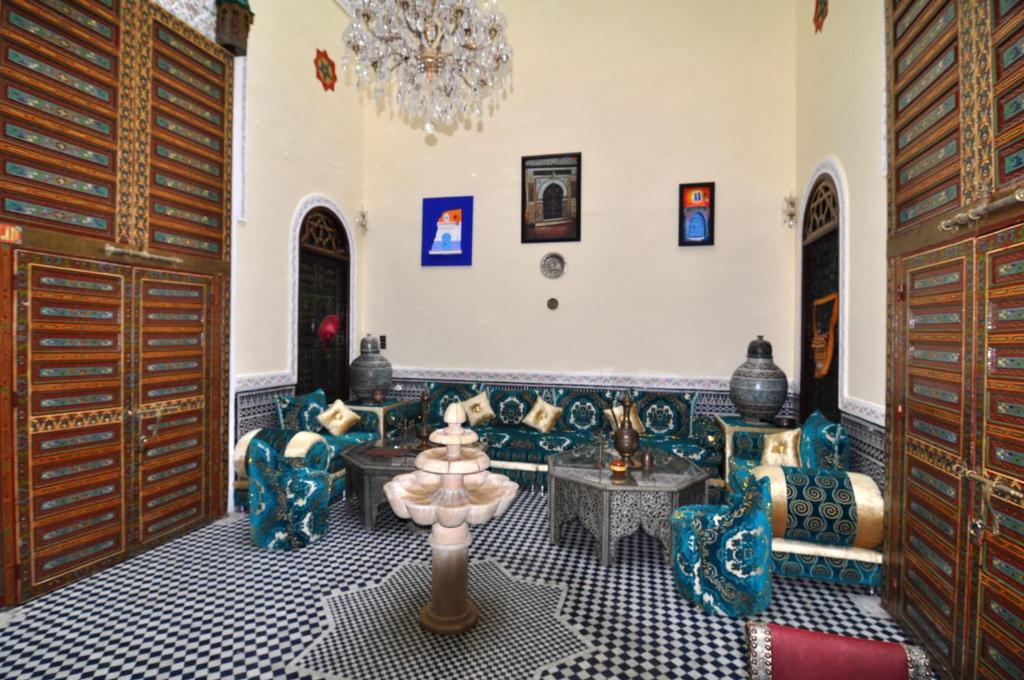
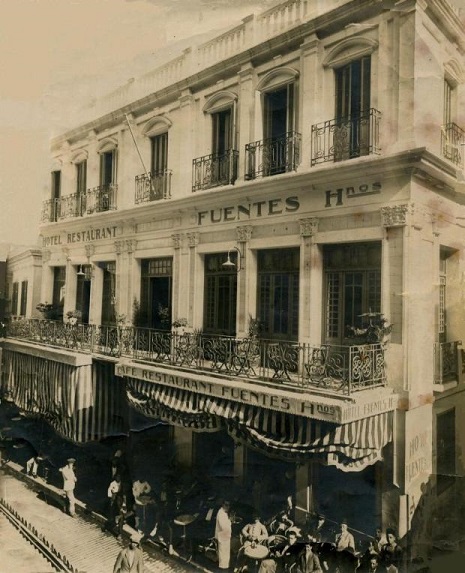
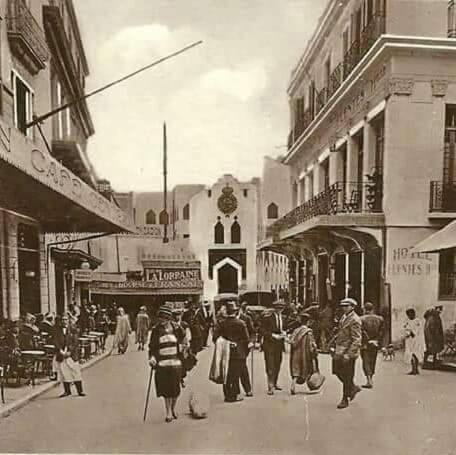
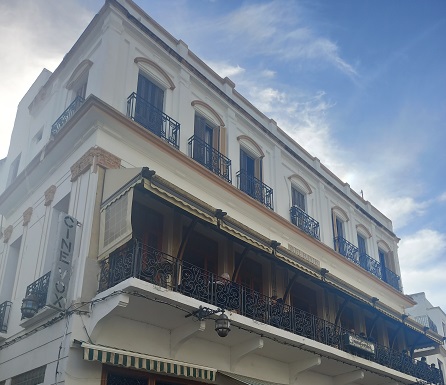
I actually partly chose where to stay, the Hotel Fuentes, as they had these photos on their description. The Petit Socco which is the little square where my hotel is hasn’t changed much since the 1920s when these pictures were taken. They have a café downstairs which looks like it could have made a fabulous ballroom.

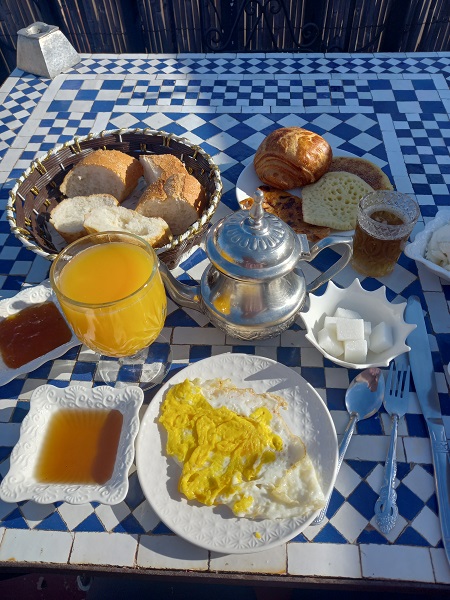
As you can see the hotel has hardly changed at all, and I enjoyed my breakfast on the terrace yesterday people and cat watching.

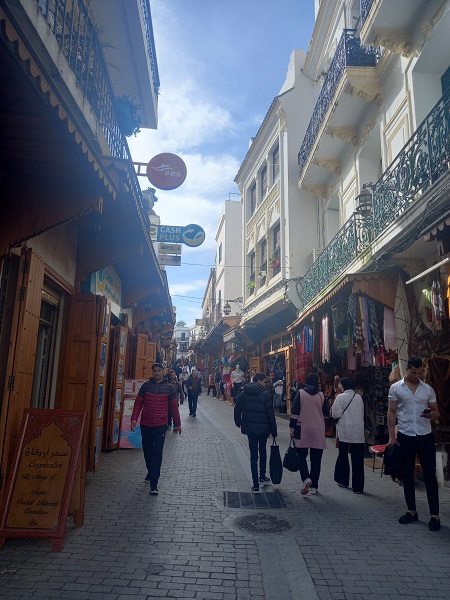
There are far more tourist shops now though, but the medina is still lovely. There has been a lot of restoration, and there are gorgeous cafes and restaurants, and lots of jewellery shops, among other souvenirs. I am trying to be really good and remind myself that I have at least six Moroccan candle holders at home, but it is very difficult!

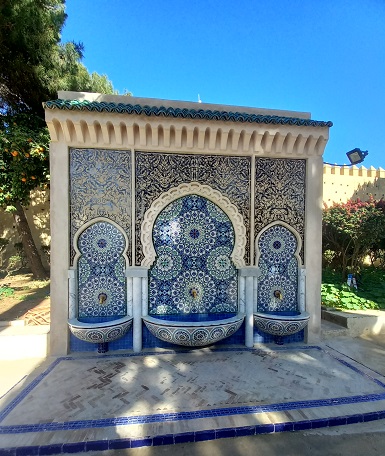
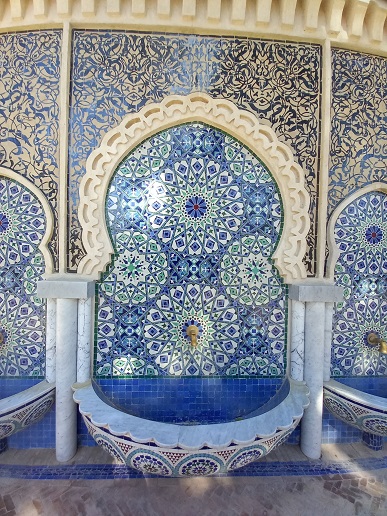
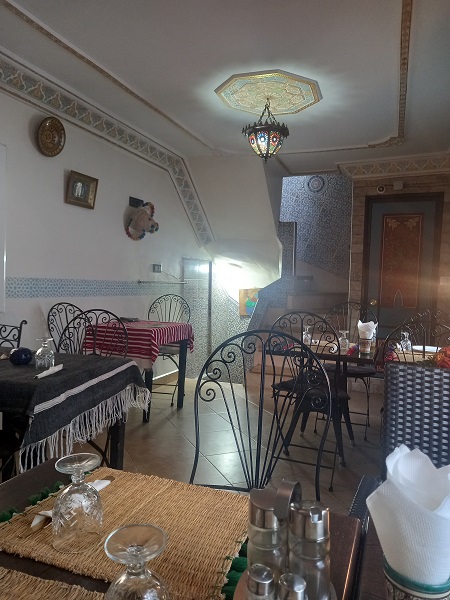
This is the place, Restaurant Al Maimouni, just inside the medina walls, that I ate in on the first evening, which I may just have chosen for its beautiful tiles. Look at that gorgeous cutlery as well! The tapas was a delicious olives and Arab soft cheese dish.

This is a city with a fascinating history and you can really feel it here. Casablanca is so modern, and although there is a modern city here at the other side, the older areas are still very thriving, whereas in Casablanca they didn’t seem to be. I expect that is due to tourism, it is clearly far more of an international tourist destination, and I have seen people of more nationalities here than in any city I have visited so far.

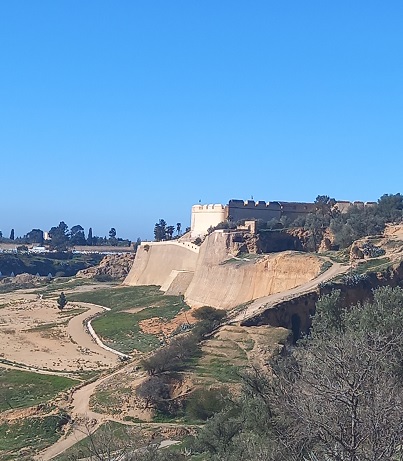
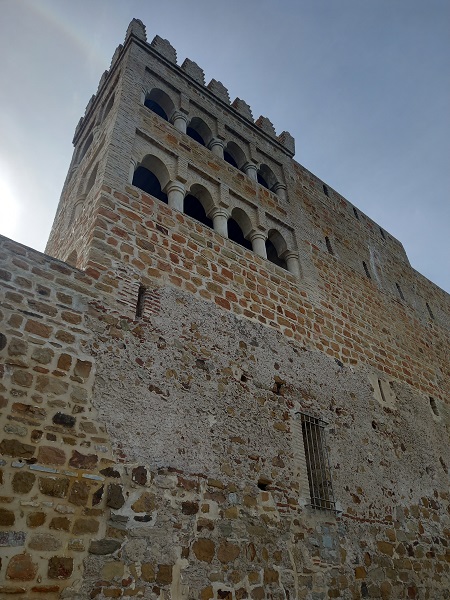
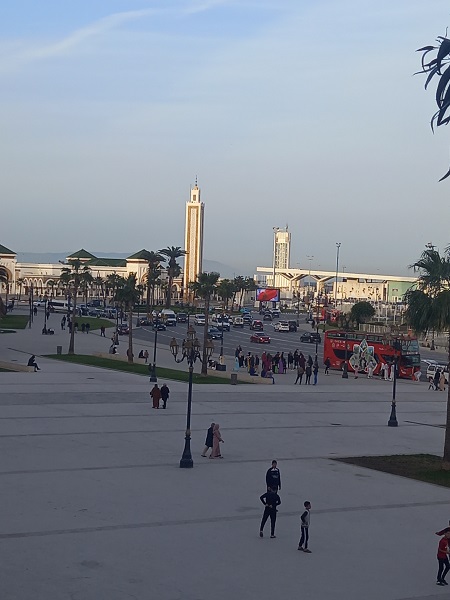
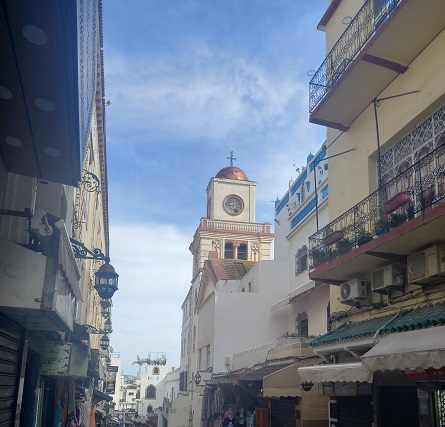
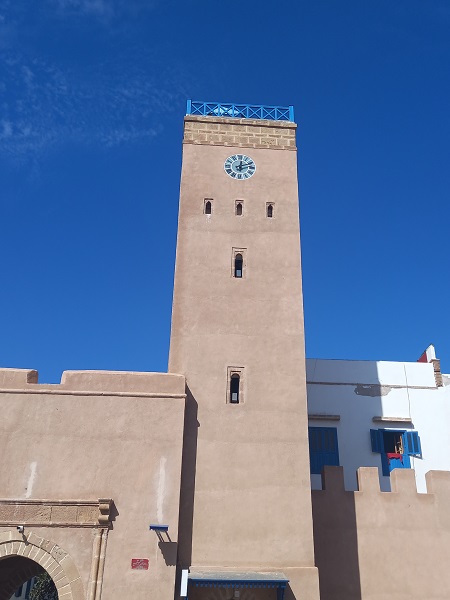
This very much reflects the history of the city, Tangier has been owned, occupied, shared by so many different countries in its lifetime. The photo above shows the tower of the Spanish mission, and a little further down the street is the main mosque.

It was actually given to England as part of Catherine of Braganza’s dowry when she married Charles 2nd, at the time it was occupied by the Portuguese. England built fortifications and used it as a defensive port.

In the late 1800s it was the diplomatic capital of Morocco, and in 1923 it became known as the Tangier International Zone, administered by France, Spain and the UK. From then on until Moroccan independence in 1956 it developed a reputation that Wikipedia describes wonderfully!

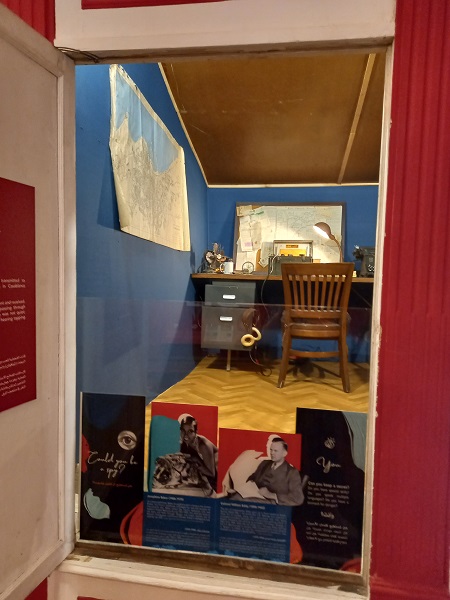
In the 1940s until 1956 when the city was an International Zone, the city served as a playground for eccentric millionaires, a meeting place for secret agents and a variety of crooks and a mecca for speculators and gamblers, an Eldorado for the fun-loving ‘Haute-Volee’. During the Second World War the Office of Strategic Services operated out of Tangier for various operations in North Africa.’

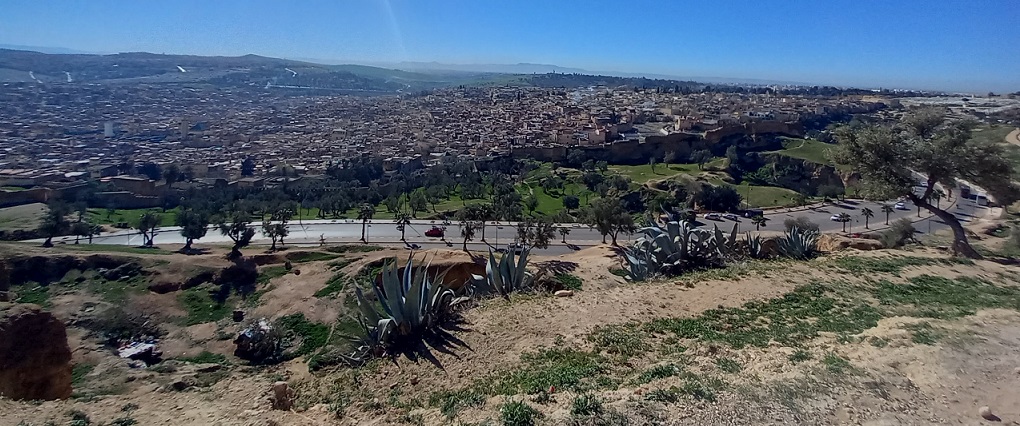
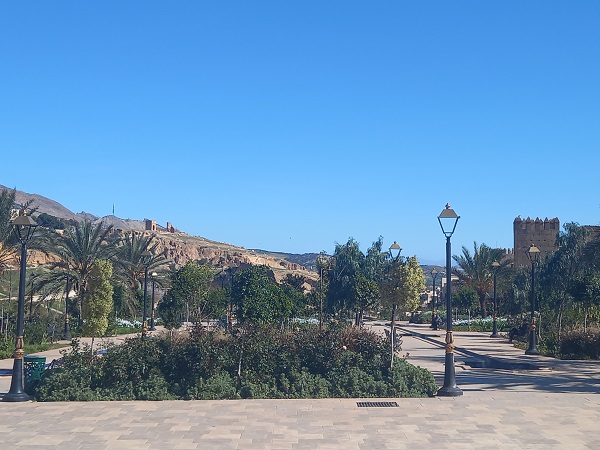
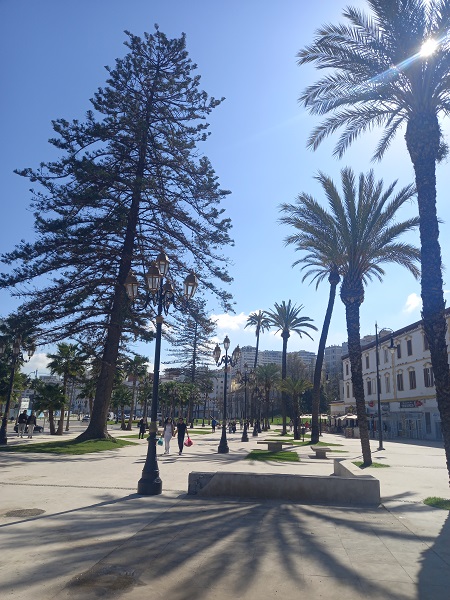
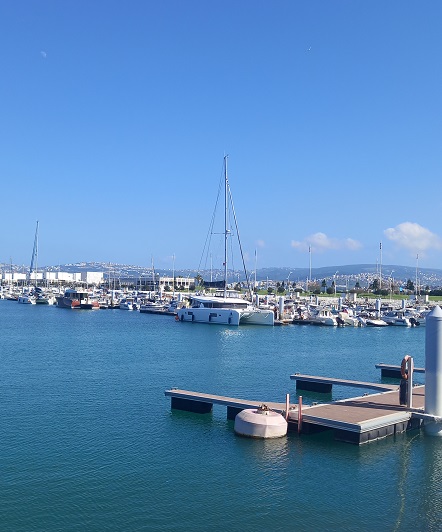
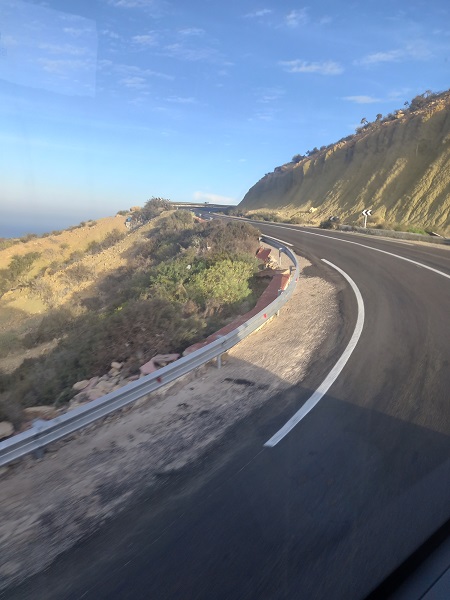
I have not seen any of the above so far, but it definitely has a vibe to it that is very different to other cities. The setting is also beautiful, it in a city built on hills, and I can see the Spanish coast from here! Pity I am not allowed back in until April 9th 😦

I think the other thing that helps with the sense of history for me, is that there are so many museums. As you know I love visiting museums and am looking forward to seeing three here. They are all housed in historic buildings as well, which is a double dose of history!

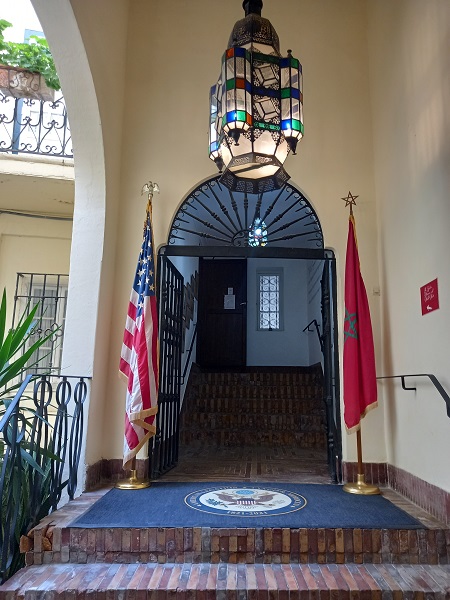
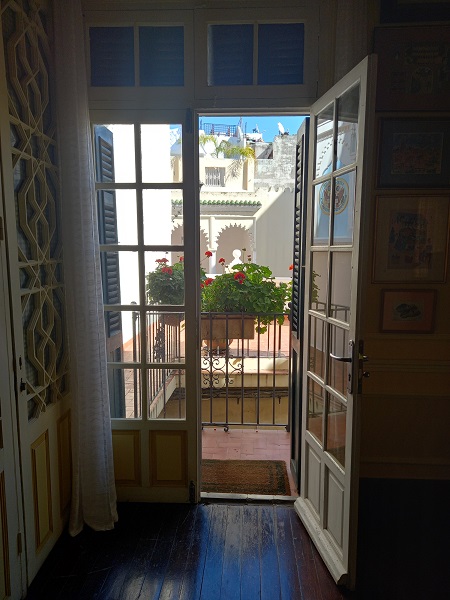
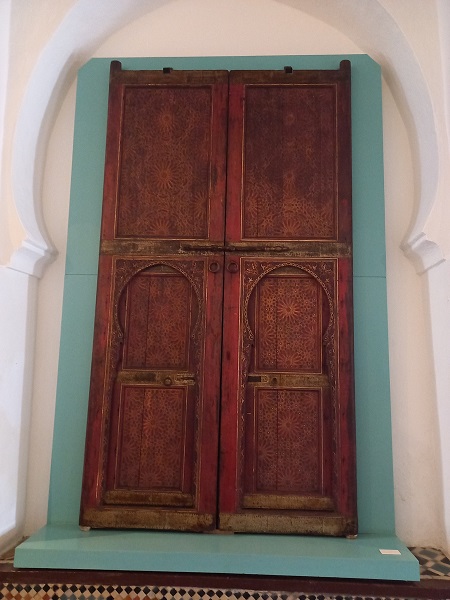
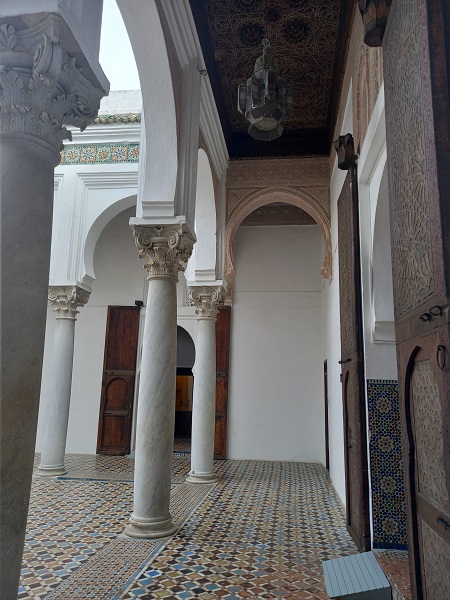
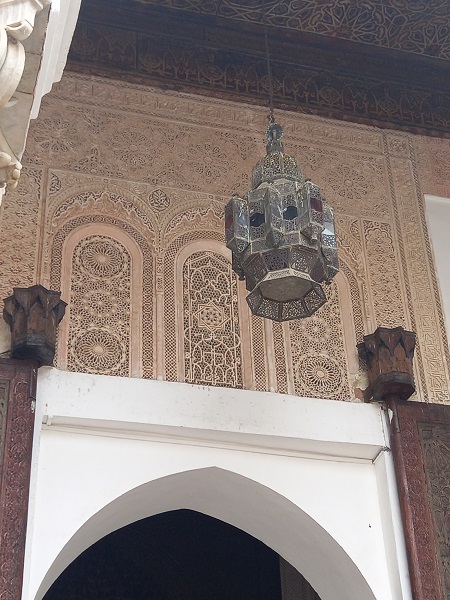
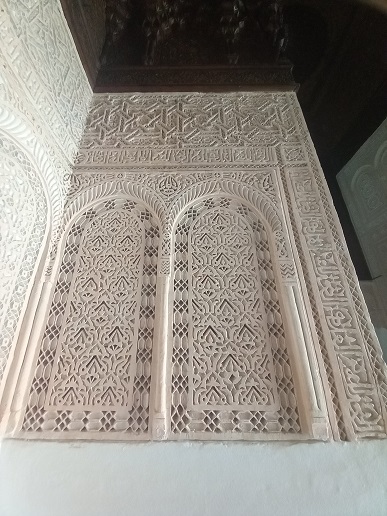
My first visit was to the old French Consulate building, now the Musee Dar Niabla, just a short walk from my hotel in the medina. It has been beautifully restored from its very sad former state as pictured here.

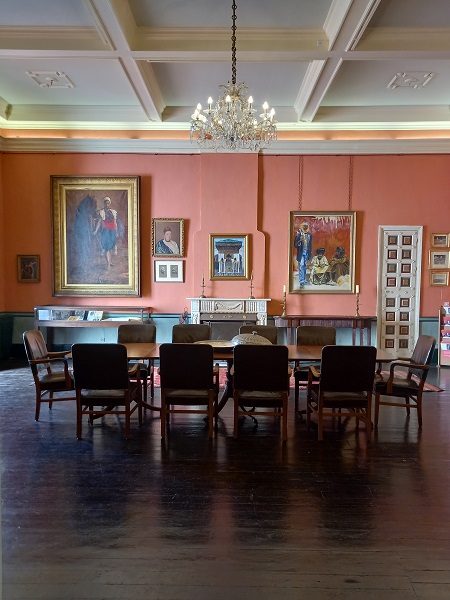
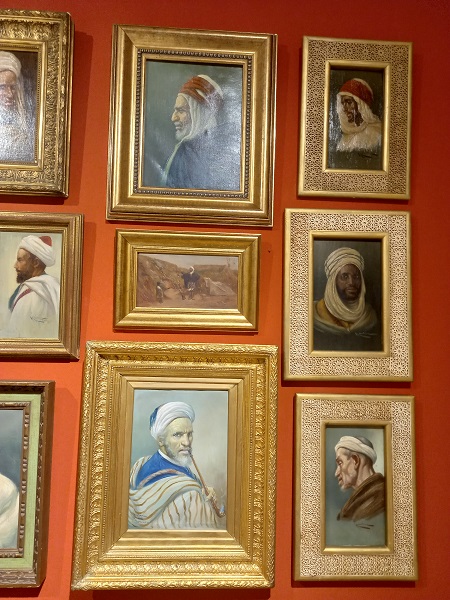
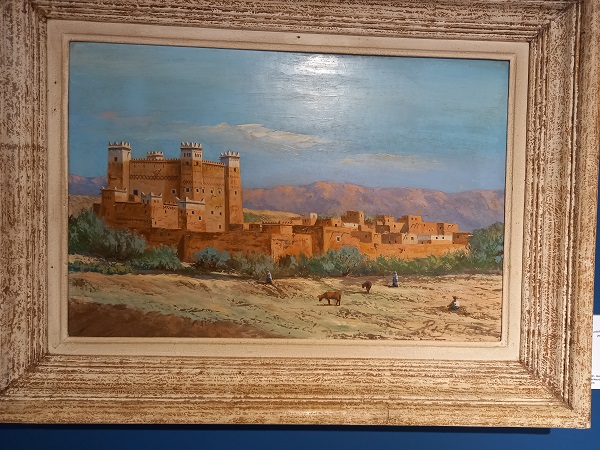
The museum has a really interesting timeline of Tangier’s history on the ground floor, and is also an art gallery. Tangier has attracted many artists and writers in its history, and they currently have a selection of portraits and landscapes by international artists. They are not only lovely to look at, but beautifully framed.

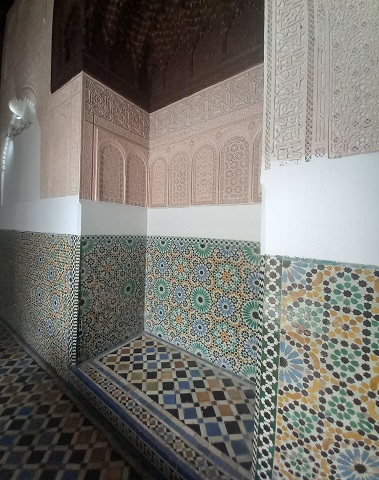
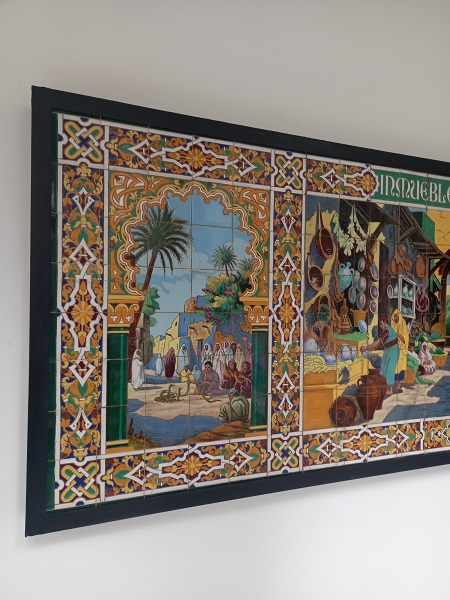
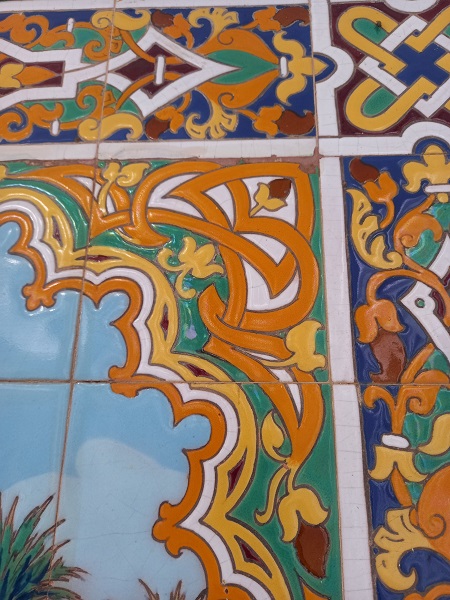
They also have some ceramic panels, depicting scenes of Tangier life. You may remember that I posted about zellige (or zellij) which is the mosaic style used in the mosque and my last hotel. This grew in popularity in the 1900s, but is incredibly time consuming to make. The solution was to create zellige style enamelled tiles like these, which are faster and cheaper. I have seen them before in many Spanish buildings, and didn’t realise the connections.

I am off for a wander around the port area soon, and to museum number two. In between I will of course have to stop off for more delicious Moroccan tea, and a spot of people watching while imagining myself here in the glamour and intrigue of the past!

Oh and in answer to my question about petit taxi colours, here they are all turquoise with a yellow stripe. Guesses for Fes and Marrakesh please!

See you all again soon. Until then have fun, take care, stay safe and thanks for visiting.
Trees, traffic and a time machine

I have spent the last couple of days just wandering the streets of Casablanca, looking at all the buildings, and visiting a few more landmarks. I wasn’t quite sure what to expect from the city before I got here. I know it is the largest in Morocco, and that it is the economic capital, and a very busy port and popular cruise ship stop. I also knew of its colonial past, the French influence in terms of the architecture and that, fun fact, none of the famous film starring Humphrey Bogart and Lauren Bacall was actually filmed here.

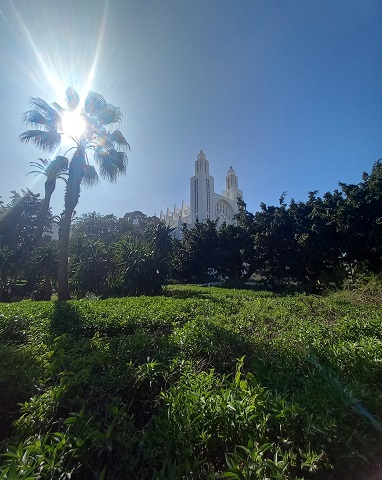
In lots of respects it does look very much like other French cities that I have visited, but there are some very notable differences in the vast amount of trees here, particularly palm trees. My first impressions of the city arriving by bus were of so many trees, lining the streets and in the squares. It makes me feel very at home, as do the parks and squares with their fountains. I had a picnic in this park yesterday and it was lovely.

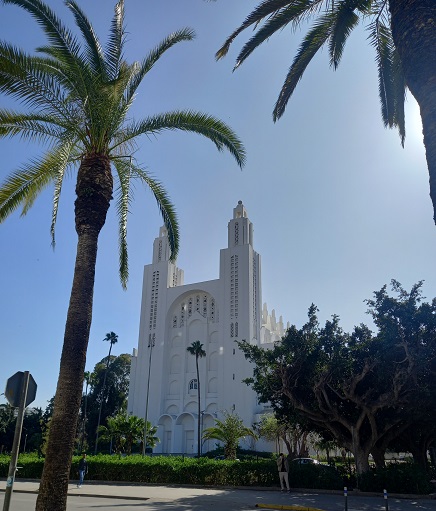
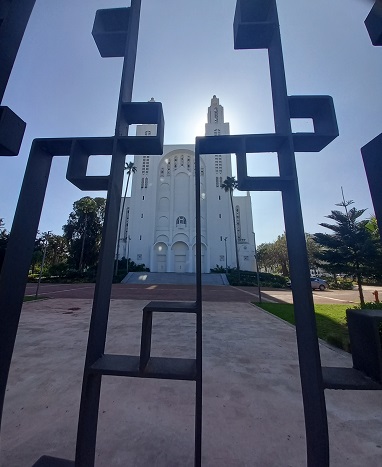
The Arab League Park is right next to the deconsecrated Sacred Heart Cathedral, a relic from the French days which is currently closed for renovation and will reopen as a cultural centre.

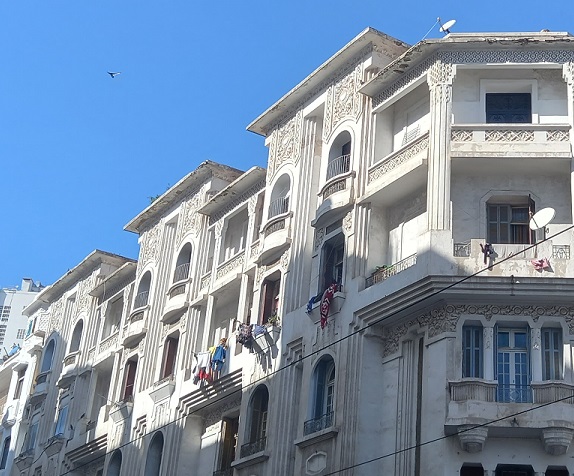
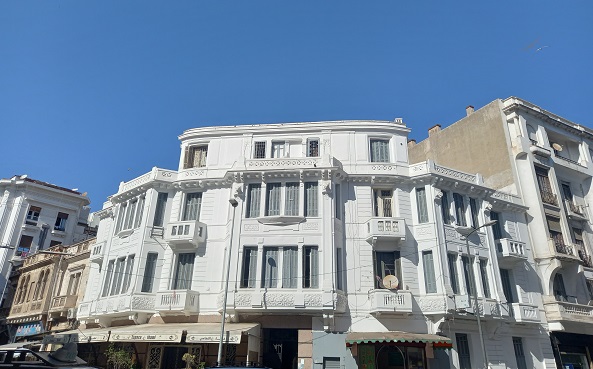
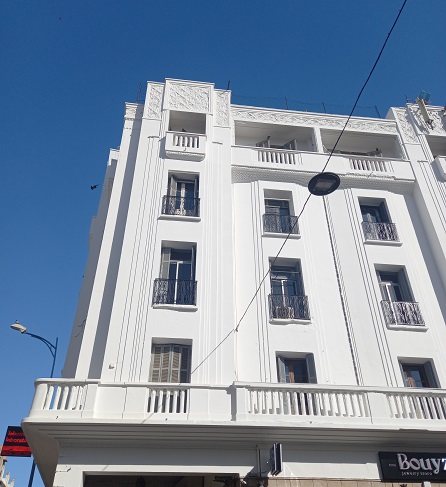
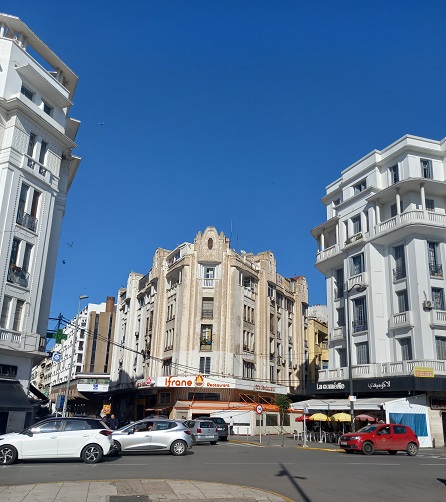
It emphasises the other very noticeable thing about Casablanca, and that is the number of beautiful white buildings, very in keeping with the name of the city, which means ‘white house’ in Spanish. This is both a blessing, as the buildings look lovely against the blue sky, and a curse.

As I have mentioned before in a post about architecture in Spain, there is a good reason why so many houses in these climates are painted yellow like mine. A sandy, dusty environment does not treat the paintwork kindly. You can see the contrast between those that have been repainted really clearly.

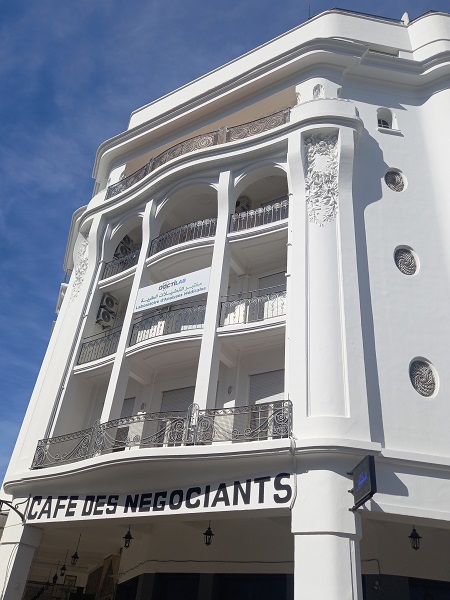
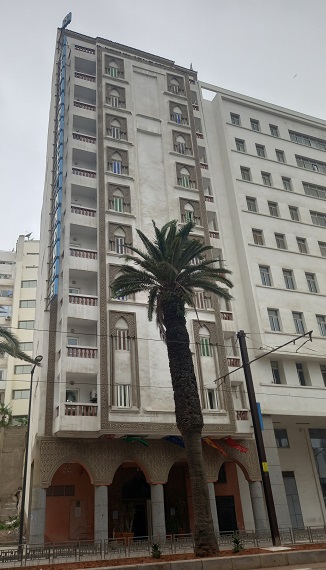
There is so much restoration going on here, like this hotel just up from mine. This clearly a focus for the government, as there are signs in most of the streets detailing the work being done.

The ones that haven’t been repainted are still beautiful but many look very sad.

It is also a very busy city, the traffic here is quite crazy and everyone loves to use their horns. There are so many pedestrians crossings, but no-one stops at them, so I have been crossing in large groups where I can, safety in numbers!

About 50% of the traffic seems to be taxis, there are two types in Morocco, grand and petit, and they are great as the petit taxis have a flat fare of about 80p. Another fun fact for you, I will check this out in the next three cities but so far each one has its own colours for the petit taxis. Agadir was orange, Essouria blue and Casablanca red. You can see three of them in this picture. Every third car seems to be a Renault Kangoo or some kind of MPV so Katy would feel very at home, but not sure I would want to drive in this city!

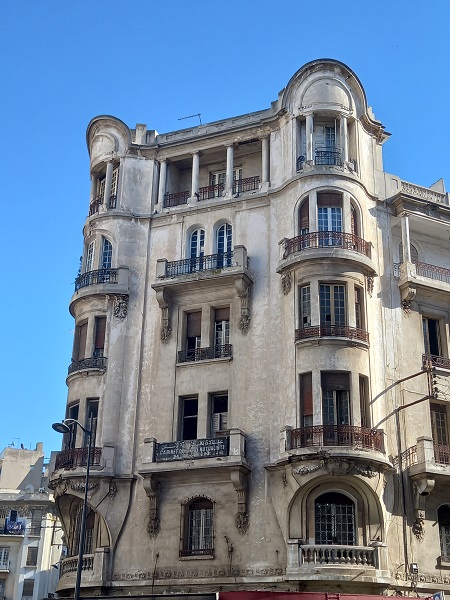
So it has been a very interesting city to visit. There are some really beautiful buildings here, but sadly lots that are just falling apart. There is a huge amount of work going on to restore things, but I would really love to have been able to visit the city in 1920 in its heyday. You can see that it must have been even more stunning. It is lovely now, but it also has a sense of being overwhelmed by the sheer amount of work there is to do in keeping Casablanca beautiful.

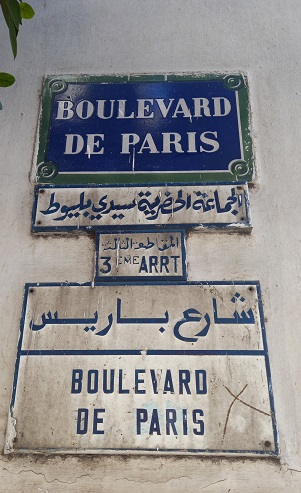
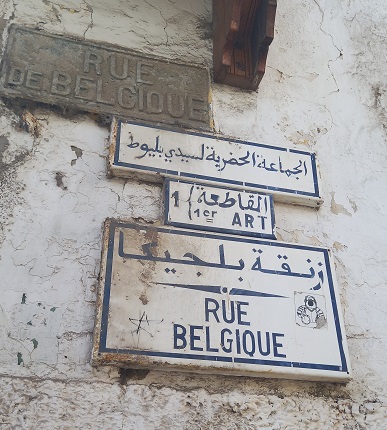
I love the street signs here, which really sum up the dual heritage of the city. I have not seen as much of the Berber language here, it is mainly just French and Arabic, although a lot of people speak Spanish as well, at least basic phrases, so I am getting lots of practise in both languages.

By the time you read this I will have arrived in my fourth city. I am very interested to see how different that will be. Tangier has much more of a Spanish influence than French, partly due to its geography, so it will be really nice to see how that influences it.

I am so glad I’m getting to see so many aspects of the country, it is difficult when planning a trip to know what to include, but I feel as if I’ve got a good mix of locations. See you next time, from a hopefully sunny Tangier! Have fun, take care, stay safe and thanks for visiting.

The wonders of Islamic art

When I used to teach maths to my teacher trainees I used the marvels of tessellation that are Islamic decorative pieces to introduce the subject the my students. There are so many parallels between art and maths that people rarely see, and of course tessellation is a key part of other things that I love, such as quilt patterns.

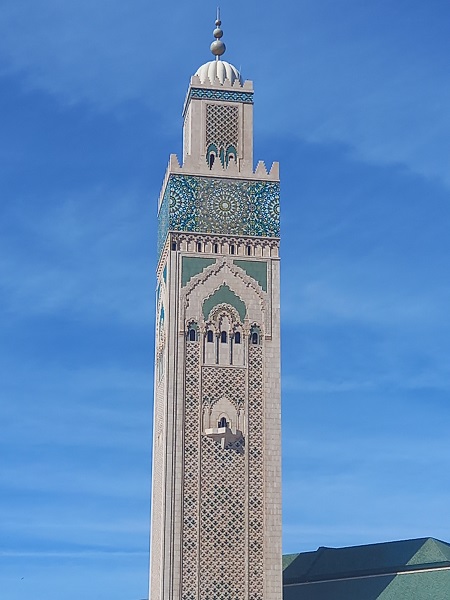
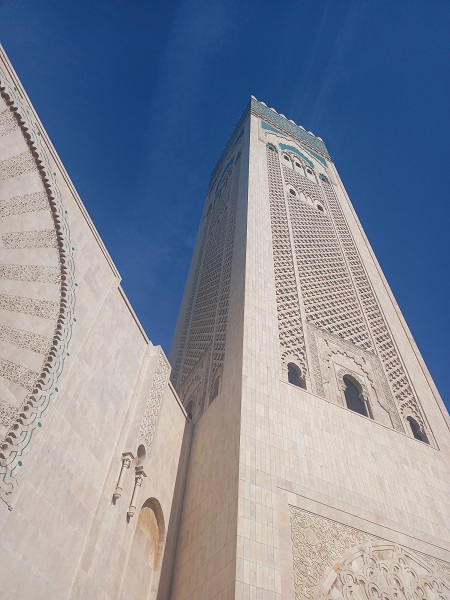
I have long been fascinated by how these patterns are made, and the history of their design, so my trip yesterday, to the Hassan 2nd Mosque here in Casablanca was brilliant for having some of those answered. The mosque is the third largest in the world, and the largest in Africa, and it was built in the 1990s. It took 6 years, and over 12000 craftspeople were involved. The scale of the place is incredible, 25,000 people can worship inside at a time, the mosque covers 2 acres out of a total 9 acres site, and underneath the plaza there is parking for 1000 cars!

It is one of the few mosques that can be visited by non-Muslims, I booked my tour with Get Your Guide, and I had a great time. I don’t usually book tours, as I am too busy photographing doors to keep up 😉 but you can only go in as part of a tour group. I am glad I did though as the guide was fantastic, and and I had a nice chat with a Muslim family from London who were telling me about their local mosques, and other places they have visited in Egypt and Iran.

One of the really interesting things for me about the visit was that, unlike the cathedrals that I visited in Spain, we know who built this, who these amazing craftspeople were. The complex has a training facility, and is still teaching people these skills. Obviously the place needs to be maintained, but also it is great to know that there is still the opportunity to train in these wonderful arts.

If you want to know more about the history of the place then read this blog post by The Whole World or Nothing. I have been following James and Sarah on Instagram for a while now, and they have a really useful website with so many great destinations covered. They have given me good tips of where to eat in my next destination, Tangier.

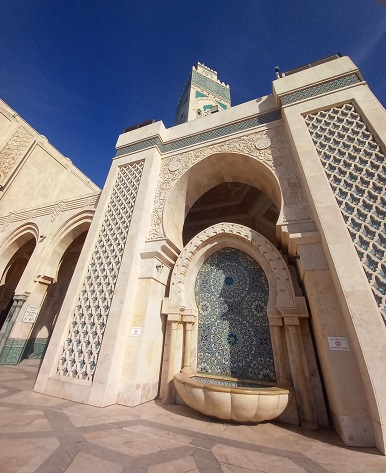
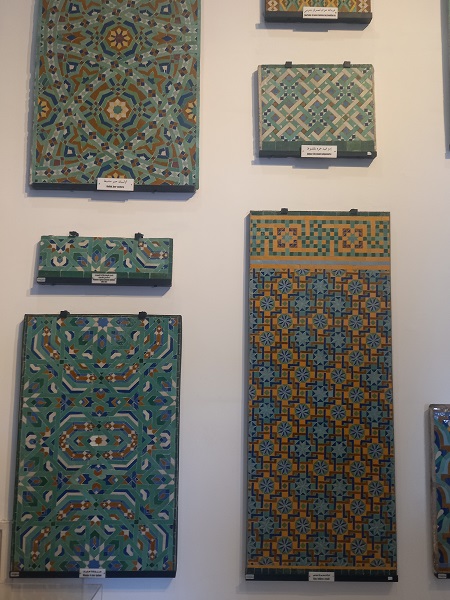
The tour starts with a small exhibition about the crafts, which is great. The tessellation technique used on the panels is known as zellige (or zellij) and there is a really useful Wikipedia page that tells you more about the technique. I have seen so many of these types of mosaic in Spain, and I really wanted to learn more about it here. There are going to be other amazing examples in Fes as well, which I am excited to see.

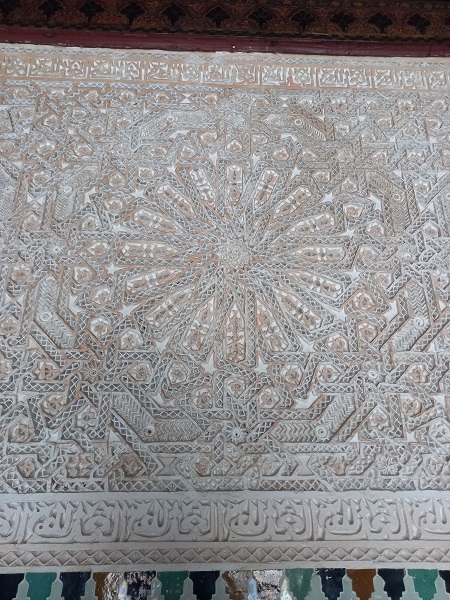
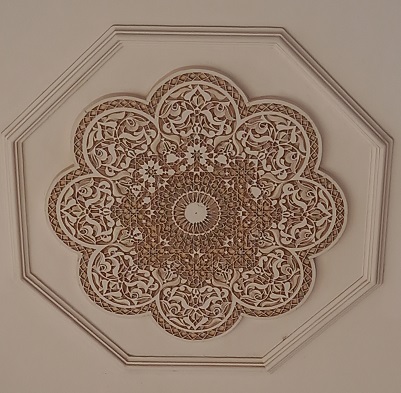
Inside the prayer hall is just breath taking. The skills of the mosaic makers, wood carvers and gypsum craftspeople combine together into the most stunning works or art. The tour also answered some of my other questions about the plaster work. I have seen many examples and always wondered whether is was carved or not. It is moulded, from wet gypsum, and then painted. The ceilings are made of cedar wood and are carved and painted.

Most of the materials come from Morocco, with the exception of some of the white marble from Italy and the crystal chandeliers, which are from Murano, the glass making island I visited with Mum last year as part of our Venice trip.

There are the most stunning brass decorations and lamps everywhere. I have a few small ones Moroccan lamps at home, and love the patterns they give with candles in.

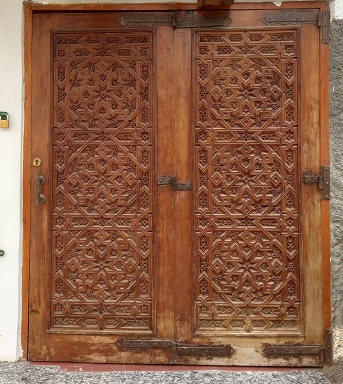
The second half of the tour takes you downstairs to the washing rooms, past some amazing doors.

As well as the beautiful tiles and pillars, there are all these flower shaped fountains for the ritual washing before prayer. The water comes from the centre of the flowers and falls into the drains below.

The mosque cost $800 million, and a third of this was paid for by the king, the rest by public donation and subscription. It is a truly amazing place, and such a testament to the skills of the people who made it and look after it. The tours finance the running costs of the place, so it is self supporting now.

Whenever I visit a religious monument, be it cathedral, or mosque, and look at the amazing work inside, I can’t help thinking about the costs of all that gold, marble, and labour, and wonder about the needs of the people that live in the communities around these wonderful places.

Although I love visiting them, and truly appreciate them, they represent an investment that is often not reflected in the practical lives of the people who live near them. You could argue that an investment in a spiritual place is just as important to people as investment in housing, education or healthcare. Or that places like this, and all of the cathedrals I recently visited, bring tourists to the place, and that benefits the local economy. It is always a difficult question to answer.

It really is an exceptionally beautiful place though. The mosque is partly built over the sea, and it was a windy day yesterday so there were really high waves. It was lovely to see all the children watching them, from the walkways near the mosque, daring each other to go nearer the wall and get splashed.

I have a couple more days here, and then it is my first trip on a Moroccan train. If the bus experience is anything to go by, it will be a very comfortable and efficient service. It is just a short trip this time of a couple of hours, but I am very excited!

Until next time, have fun, take care, stay safe and thanks for visiting.
Architectural gems

As you may have gathered I love architecture and interior design. I find it endlessly fascinating the way that we build differently in different places, how e make use of local material, and how and why we decorate. I wonder about where our influences come from, and how those travel across time and countries. Part of the reason for coming to Morocco was to see more of the very distinctive architecture here, which is such a feature of so many wonderful places in Spain as well.

I chose my current hotel in Casablanca almost exclusively on it decorative style. I did also look at budget and location, but it was too good to pass up the opportunity of staying somewhere that looks like a combination of all of the lovely places that I have visited.

The Moroccan House Hotel does not look like an architectural gem from the outside. Especially as today Casablanca is 14 degrees, dull and wet, such a contrast to all the blue sky pictures I have been posting.

So, I have taken the opportunity to have a relaxing day in, reading and writing, and hopefully will resume adventures tomorrow. Yesterday was a long day of travelling, through some amazing countryside.

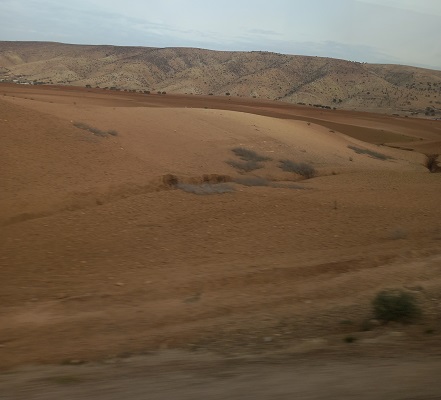
It had me wondering whether the incredible decoration in countries like Morocco, and many others that have quite harsh landscapes, is a direct contrast to what is outside. I know that not all of Morocco is desert, but yesterday there were miles of the same colours, pale browns, oranges and yellows of the earth with the little bits of green of the trees and crops.

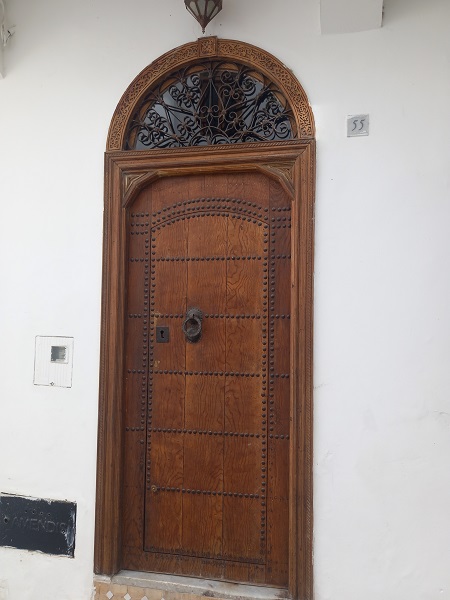
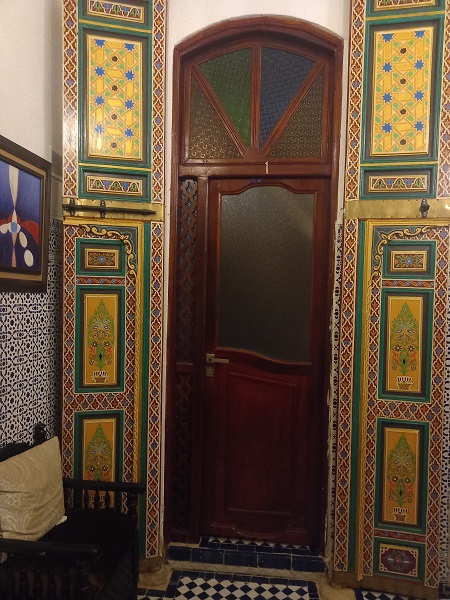
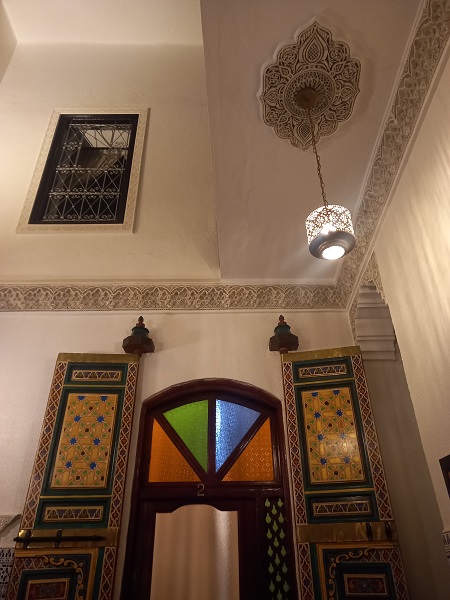
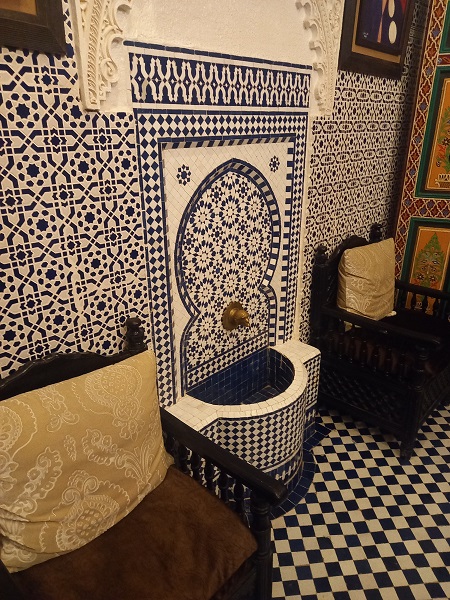
You come into the hotel through an impressive door though, straight into the extravagantly tiled lobby.

The middle of the upper floors has a central courtyard, as traditional riads do, with the rooms arranged around this. Suspended in this is a huge hanging lamp, and all around are plasterwork friezes.

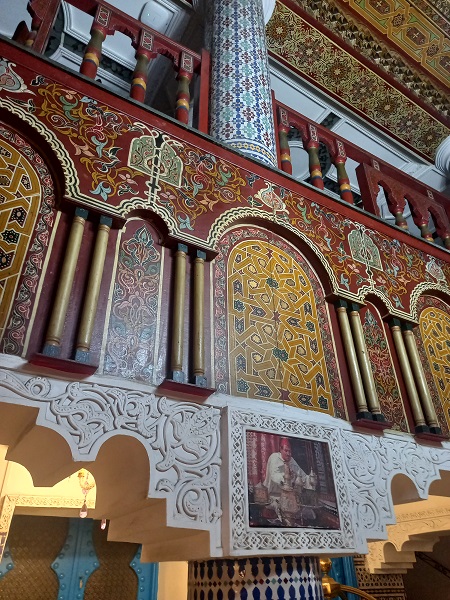
I had breakfast here today, this is the mezzanine restaurant, overlooking the hotel lobby. I can’t get over the detail that is in every part of the place, the pillars, the ceilings, such an amazing work of art.

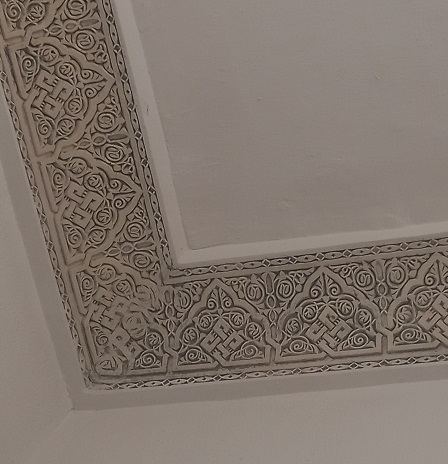
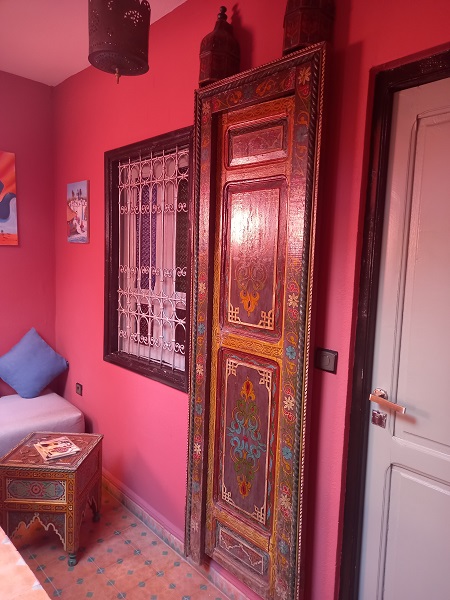
Even my room has the same level of detail, with a stunning plasterwork frieze, so much nicer than boring British coving! I love the room doors as well.

Sadly I only have a very ordinary bathroom, no fully tiled hamman, though there is one in the hotel. That would have been amazing.

Part of the reason for choosing Casablanca as one of my stops was that it has a lot of wonderful Art Deco architecture, so that is on the itinerary for when the sun comes back out.

People often ask me what I do when I travel for so long. It depends on the location, rural ones I spend way too long looking at the clouds 😉 and city ones I spend so much time just wandering, and looking up. It is very important to look up as otherwise you miss so much amazing architecture.

Fingers crossed the forecast will be right, and I will return in a few days with lots of 1920s loveliness for you. Until then have fun, take care, stay safe and thanks for visiting.

Exploring Essouria

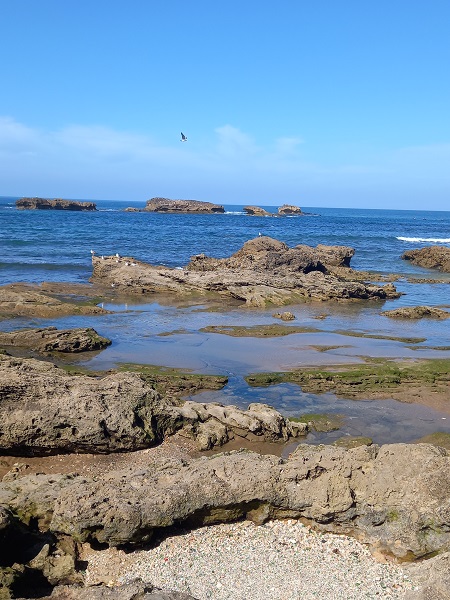
Essouria is a city people visit for lots of reasons, for me it was reading about it as a laid back seaside resort, and I thought it would be lovely to spend some time at a smaller place before going on to the bigger cities.

I will end my time in Morocco in Marrakesh, so am appreciating the calm of this little city. As I mentioned in my last post, it is very quiet compared to Agadir, and very small. I walked from the medina to the other end of the beach, almost at the edge of the city, in about 45 minutes the other day.

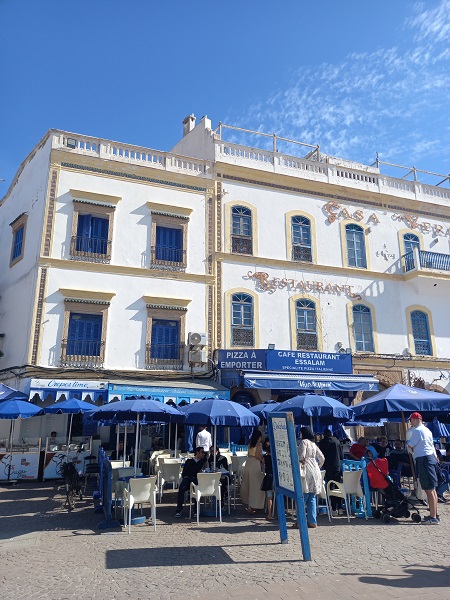
The medina is also a good one for novice explorers to Morocco, as it is small and easy to navigate, being more of a grid layout than others. I remember getting very lost in the one in Marrakesh when I visited 13 years ago, whereas this is easy to find your way around, probably as the medina is right next to the port. You know you can’t go wrong if you follow the seagulls! There are lots of open areas and gardens, showing the French influence on the architecture.

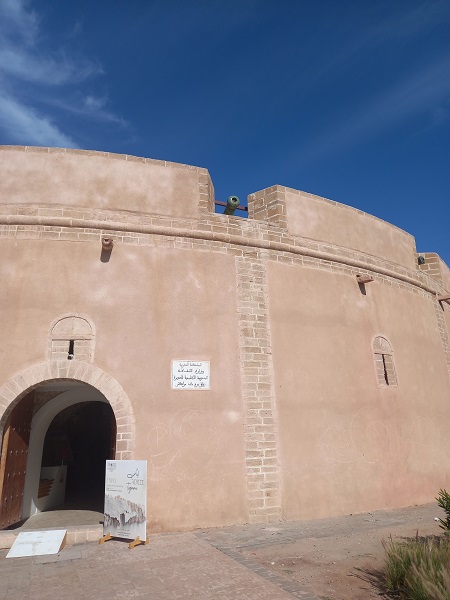
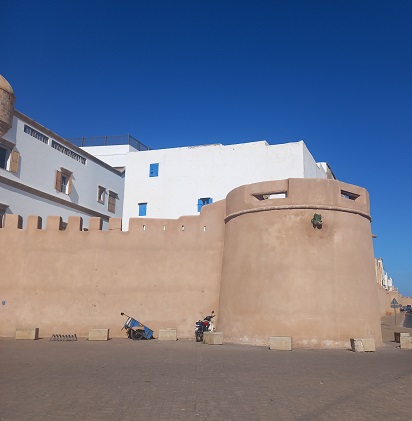
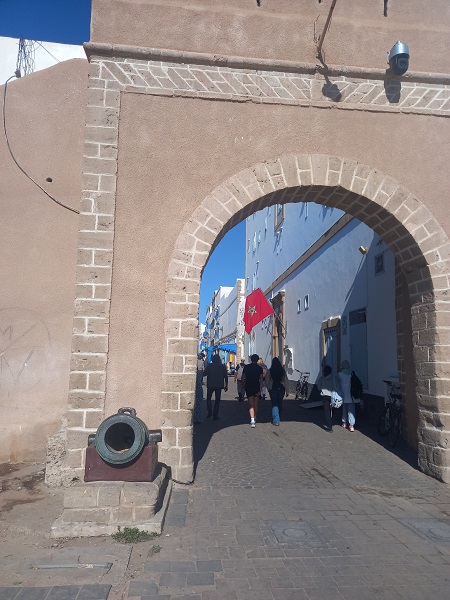
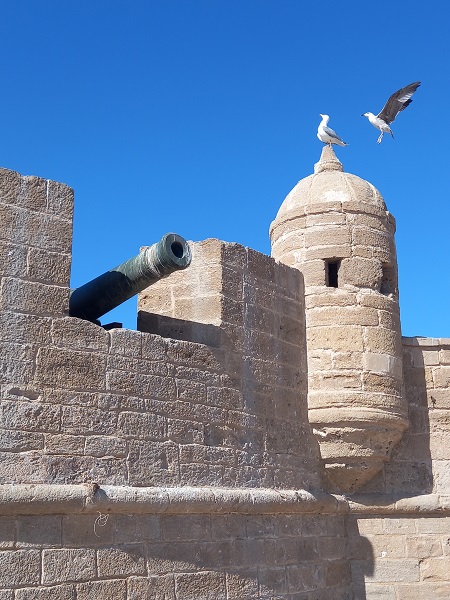
As I mentioned in my last post, the medina is surrounded by high walls, which have been restored, with gates or Babs. Most have their cannons still situated with them, from when Essouria, or Mogador as it was formerly known, had to defend itself.

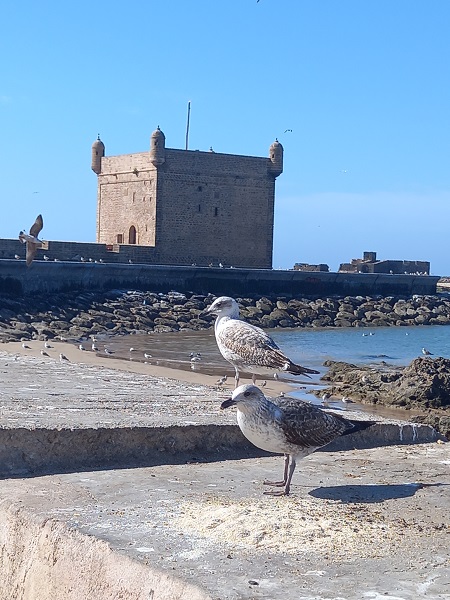
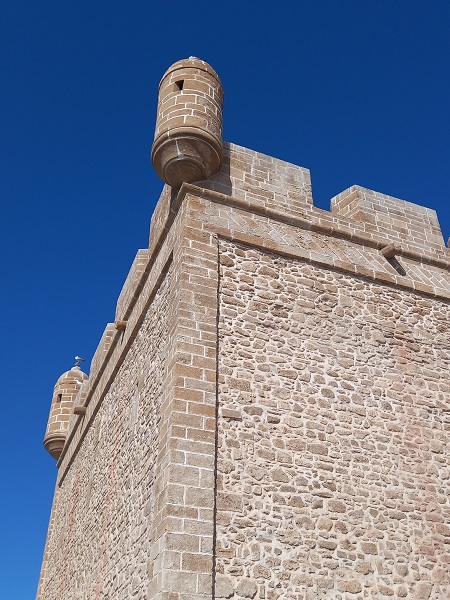
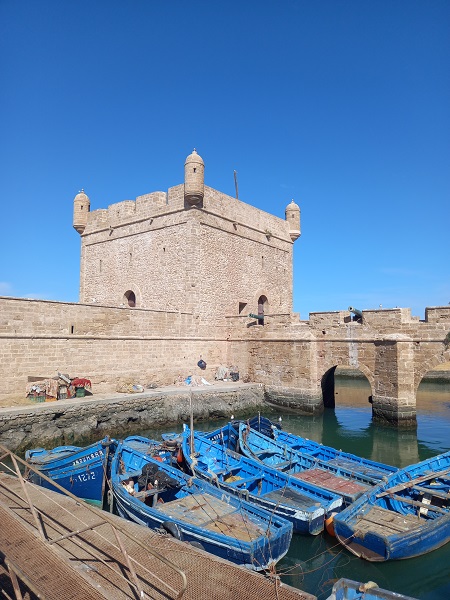
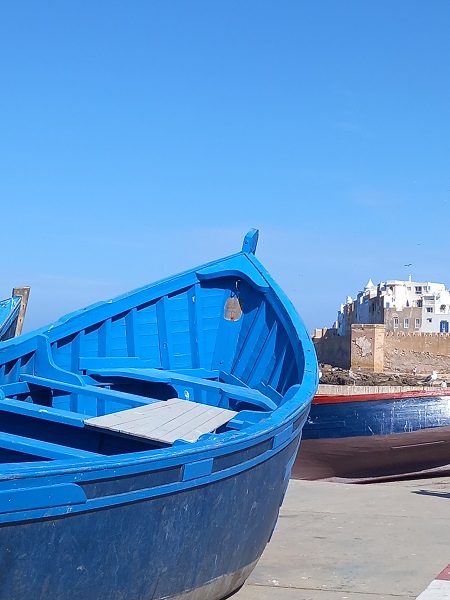
I went down to the port area one day, the fish market is really fascinating to see, so many varieties caught locally. There is also the fortified tower with Spanish guns, used against the French in the late 1700s, and the wall ramparts which have been used in the Game of Thrones series.

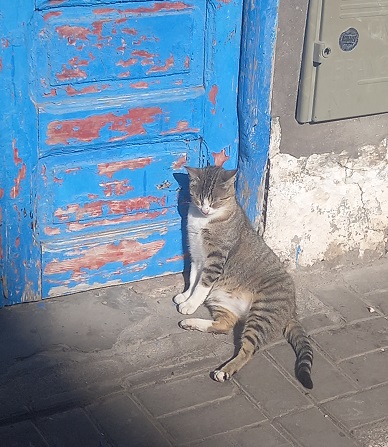
As well as the seagulls hoping for scraps from the fish market, there are lots of cats. I know people often worry about stray animals in Morocco, but the ones that I have seen here in the cities look very well fed and healthy, lots seem to live at shops or in restaurants. This little cat was having a lovely sleep in the sun in the medina yesterday.

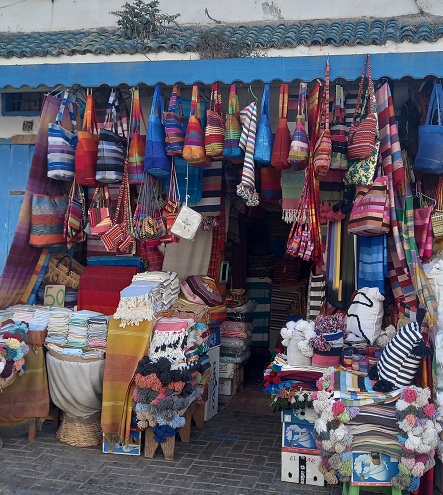
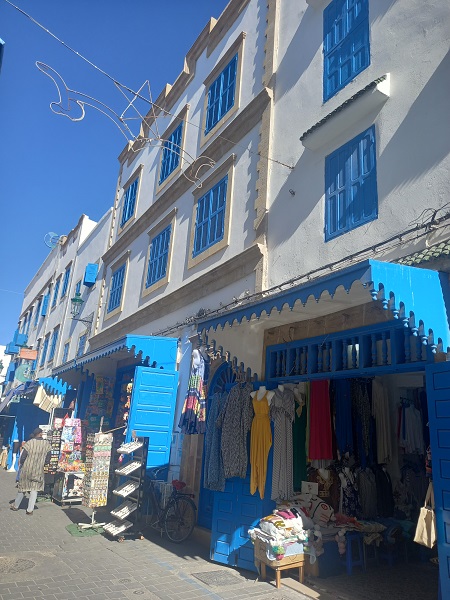
There are lots of tourist shops and stalls in the medina, but also just lots of ordinary market areas, particularly at the back where I am staying, which is a less touristy area. There is so much fresh fruit here, and loads of lovely bread and sweet things. I have been very good and resisted the temptation to buy any textiles, although there are some gorgeous bags. There are also beautiful ceramics, and lots of leather items.

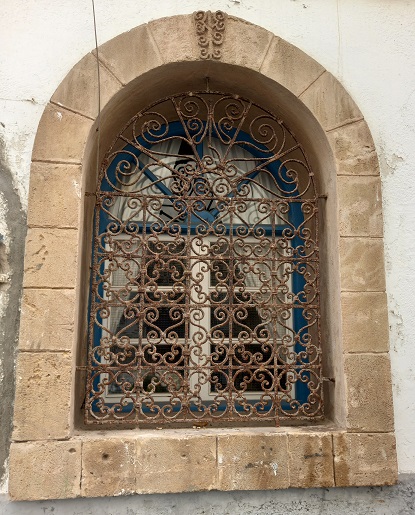
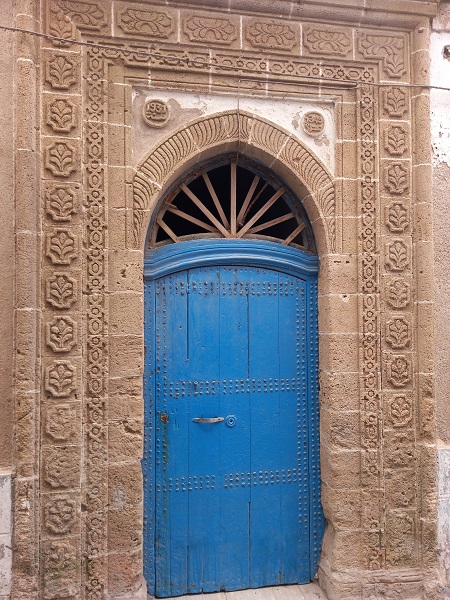
I have allowed myself unlimited photos of doors, and windows, though, as they take up no space in the luggage 😉 As in Cyprus last year, blue is the top choice of door colour here.

The area that I am staying in is the textile district, and there are still some traditional weavers here in the street where the dar is. They stretch their threads along the length of the street, which is really interesting to watch.

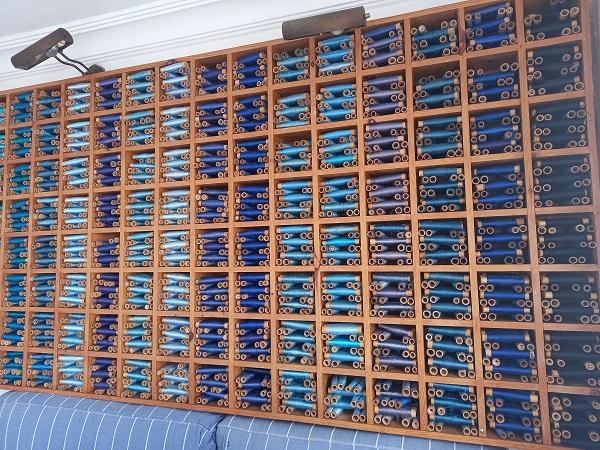
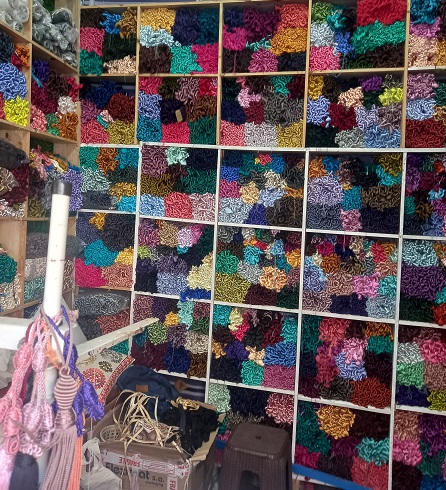
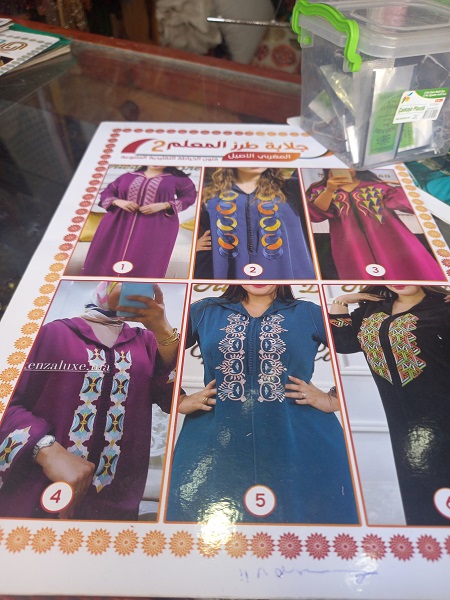
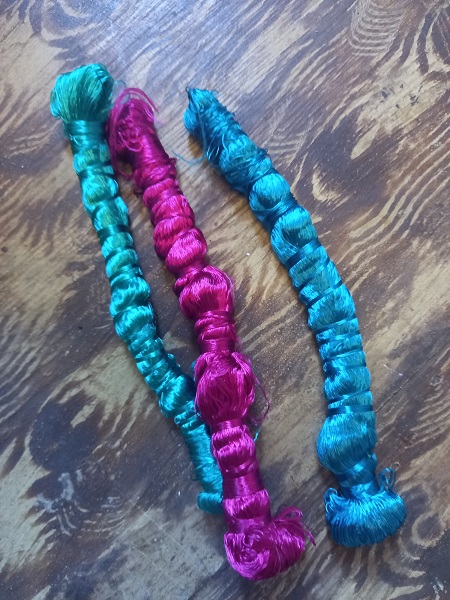
I was very excited today as, diverting off to take another door photo, I found an embroidery shop! I managed to have a conversation with the owner in French and he explained that these are rayon threads used in machine embroidery. I had to buy three in my favourite colours and have plans for another Moroccan inspired stitchery for Katy. It was hard to chose from all the gorgeousness here.

The part of the medina at the back, nearest the ramparts is undergoing extensive renovation, they are demolishing many of the old buildings so it will be interesting to see what replaces them. I met my host yesterday morning, Paolo, the owner of Dar 91, and we had a really interesting talk about Essouria as a tourist resort.

He told me that government are helping with renovation, hoping to bring more tourists into the town, which links with what I said in the last post. The house next door will be renovated soon, and the local owner has moved out while that is done, but she will move back into her house afterwards.

Fun fact about Morocco, most of the, I assume phone towers, have been decorated to look like palm trees. I noticed this firstly in Agadir, and here are some right outside the medina.

I am spending time every day writing my novel as well, I am determined to finish it this year. It will have taken three years, but I have been really enjoying the research and the writing courses that I have taken in that time as well. I am in no real hurry but I have so many ideas for more books, I need to get this one done before I can move on. I am loving having the intellectual challenge, especially as this half of the book has involved much more research about unknown topics.

I am off to Casablanca tomorrow, which will be very different. Another bus ride ahead, this time for 6 hours, so am really looking forward to that. So I will see you in a few days. Have fun, take care, stay safe and thanks for visiting.
Travelling with teabags

Although I do love travelling, and trying out new and exotic things, I must confess to having brought some English teabags with me on this trip to Morocco. I really love mint tea, which of course the country is famous for, and drink it a lot in Spain, but knew that I would have self catering facilities in Essouria, so thought I would treat myself.

It’s funny what we find comforting isn’t it. Although so much of Morocco is very different, increasing globalisation means that the food in the supermarkets here is very much the same, especially as in Spain. Even the smaller shops have familiar brands.

I have yet to visit any country where there has been no unfamiliar food or drink. I still remember the amazement at finding Coke, Mars Bars, and Pringles in the little village shop high in the Nepalese mountains when I went on my visit there some years ago.

If you would like to read about that trip I have a page linked from my main page, for some reason it won’t let me link it into this post.

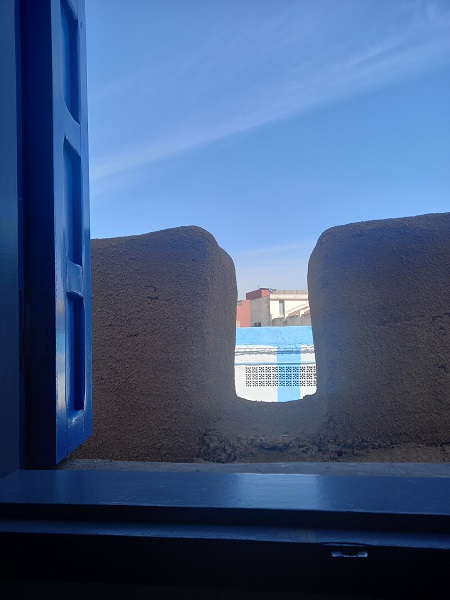
My accommodation in Essouria is very different though, especially from the modern hotel in Agadir. It is in the medina, in the walled city, in fact you couldn’t get much nearer than this. Below is my view from the window of the studio.

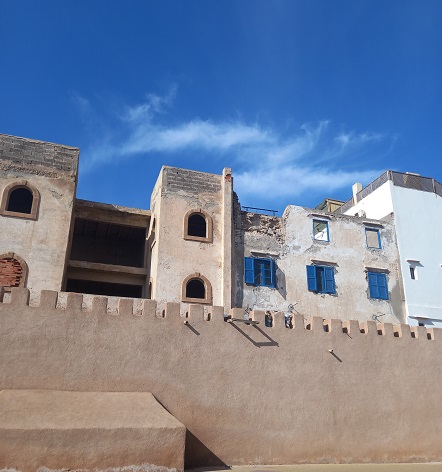
This is it from the other side of the walls.

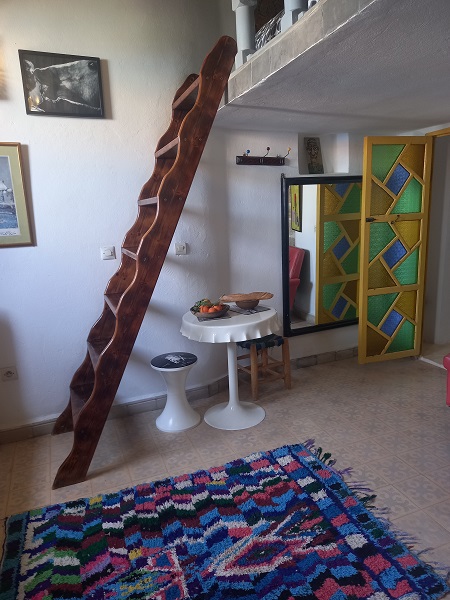
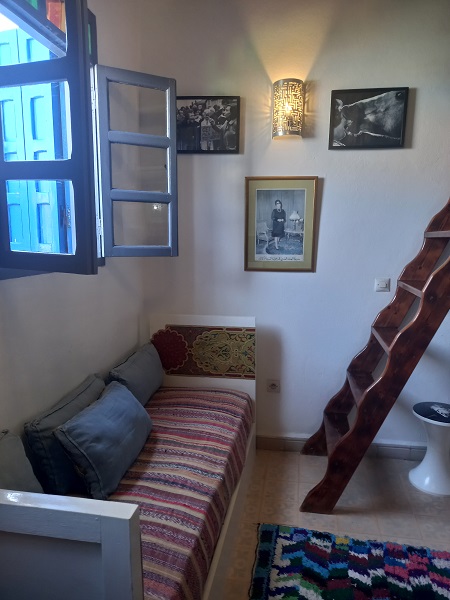
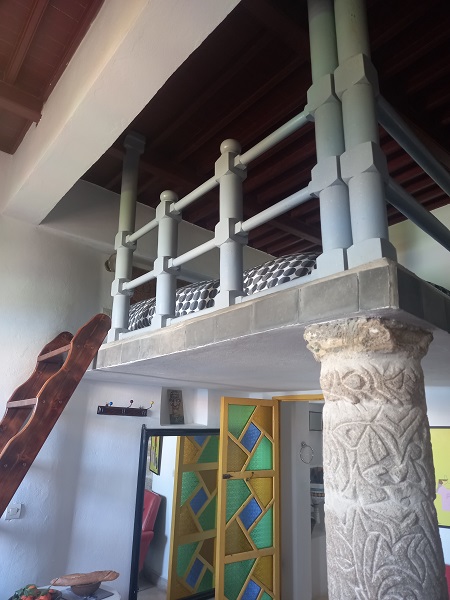
I am staying in Dar 91, which is an old watchtower built into the medina walls. I was attracted by the sheer gorgeousness of this little studio, isn’t it amazing?

I didn’t have too much trouble finding it 😉 I have become quite good at navigating my way around old walled places after medieval Caceres in Spain, and the warren that is Venice earlier this year. Google maps helps a lot as well, I have got a Moroccan sim card for my time here, invaluable as I have now learnt to pin everything I need.

As you can see the building has been restored. Many of the medina buildings have, or are being, usually into tourist accommodation like these below.

I am very aware that this is a dilemma that all places such as this have. As with Venice tourism brings money to be able to restore buildings that are historic and badly need it. However, that brings more tourism, which can cause more problems, such as crowds, pricing locals out of the environment. As I mentioned in my Venice posts, there is always an ethical dilemma about where you chose to spend your tourist money.

Part of the reason that I chose this accommodation, was that the owners, who are not Moroccans, have made a commitment to employ local people, use local craftspeople, and contribute part of their profits back to the local economy.

There are still many unrestored properties, that are crumbling on the upper floors, but many still have their beautiful doors intact.

The journey here from Agadir was really good, my first by bus in Morocco, and it was a very comfortable and interesting journey, along the coastline and through the mountains on very winding roads. I saw a few herds of camel, and many sheep and goats, alongside many, many motorhomes. Morocco is a very popular van life destination, and there are lots of, mainly French it seems, vans here.

Essouria is a very different type of city to Agadir, small and very laid back, famous for its kite surfing and water sports. I am here for another few days, so will post again later in the week. WordPress is acting up, and keeps losing posts, or not letting me save, so I will post this now, and update you again later.

In the meantime, have fun, take care, stay safe and thanks for visiting.

Travel broadens the mind, and widens the vocabulary

One of the things that I love about travel is getting to know more about other languages. On my visits to China with work some years ago I attempted to learn some Chinese, both written and spoken. It was one of the most difficult languages I have encountered, as it is so different to English, in structure and in the way sounds are represented. I used to use Chinese as an example with my language and literacy students when I was teaching, as they often worked with Chinese speakers who were trying to learn English.

Since I retired I have been learning Spanish, and am really enjoying my new confidence with the language after two and half years of formal learning, and talking to Spanish friends. I was lucky enough to learn French from the age of 7 to 16, and although I haven’t used it much, I could remember enough to hold short conversations on my recent trip through France.

I am now here in Morocco, at Agadir to be exact, at the start of an exciting month in this beautiful country. I have visited before, 13 years ago, when I spent February half term with my Mum and Jake in Marrakesh and loved it. Although much of Moroccan culture is very familiar to me because of the Moorish influences in Spain, and they even have the same company running the buses, I have been excited to see signs in three languages everywhere here.

I am familiar with Arabic, as Yorkshire is very multicultural, and there were many signs written in Arabic in local towns. Many of my students spoke Arabic as well, or could read it, as it is the language of the Koran/Quran. I thought this third language must be Berber, and it is. This is Tifnagh, the Berber alphabet, and according to this website, there are over 300 Berber dialects.

I find this alphabet absolutely fascinating, it looks so different to other scripts that I have come across. It reminds me a little of the sorts of things that you see as created languages in Sci fi media, yet is thousands of years old. I have spent my couple of days in Agadir trying to relate this new language to what I know, not that I am attempting to speak it!

My French is also coming in very useful, as will my Spanish as I travel further north, as both countries had influence over Morocco at various times. Morocco is one of the most multi-lingual countries in the world, discounting others who are multilingual through migration, and I am really enjoying talking to people here in both of my other languages. I try and avoid English as much as possible when travelling if I can as I think it is nice to be able to talk to people in their languages, and it’s great practise for me!

The city is a popular tourist resort, with miles of beautiful beaches with gorgeous, and expensive looking hotels. I had a lovely wander down to the beach on the first day, it was 26 degrees that day, on the 1st February, so a paddle was very welcome.

I am staying at a hotel about 20 minutes walk from the beach, the Hotel Sindibad, which overlooks one of the city squares. There are lots of hotels and restaurants in this area, and I have a little balcony where I have been sitting watching people below, which is especially nice at night . I have a choice of two lovely comfy beds 😉

The city is mostly modern, as the result of devastating earthquake in 1960, when most of the city was destroyed, and 1/3 of the citizens killed. The area where I am staying, Talborjt, was very badly hit. It is very sobering to read about the destruction of the city, walking around it now, you would not realise that there had been this level of trauma here.

Although the city is new, there is lots of evidence of traditional architectural influences, as well as modern, especially at the mosques. If you are a regular here you will know how much I love Islamic art and decoration, and I’m sure I’m going to see so many lovely things during my time here in Morocco.

I visited this lovely cool garden today, the entrance is clearly inspired by Berber architecture, although it was only opened in 1992. The stonework is just beautiful.

I move on tomorrow, just a couple of hours up the coast, to Essouria for 5 nights, which will be my first experience of Moroccan bus travel. I flew into Agadir, which is in the south of the country, from Manchester, as I wanted to explore as much of the country as possible in my time here. In total I will be visiting 6 cities, so look forward to sharing them all with you. I am really looking forward to the train travel as well, even though I love driving, I still get so excited using trains 😉

I hope you are all enjoying your week, have fun, take care, stay safe and thanks for visiting.
Amazing Avila

My very last stop was a short drive from Segovia, along very quiet country roads and through the city itself, not quite as challenging as Segovia, to my park up just outside the city. On the map below it is just to the left of Madrid, partly covered by my little pin! It is at the foot of the mountains, so in a gorgeous location.

I had booked the park up online, before I left Spain. It was a fantastic location, as you can see from the pictures below, with great facilities including shower and toilets, as well as the usual water and waste, and cost 12 euros.

The second photo is taken from the city walls looking back, the park up is just behind the trees, and helpfully next to the police station. There is also a very large car park next to it with seemingly no restrictions on overnight stays, though I didn’t see any campervans using that.

I was so excited to go and explore, I had seen some pictures of Avila beforehand but was not prepared for the scale of the city walls.

They are incredible, and are the reason that the town is a World, and National, Heritage site. The walls date from the 13th century and run for 2516 metres, enclosing the old town. There are 87 turrets and 9 gates, some of which are accessible to cars. Some of the buildings within the old town form part of the walls, such as the Bishop’s Palace.

The area of Avila within the walls contains so many beautiful palaces, most of which are now hotels, and the cathedral. There are a number of different building styles within the old town, and some newer areas such as the town square, where the flower market was being held.

I also got the chance to visit the church dedicated to St Theresa of Avila. In my medieval re-enactment role I portray an early Carmelite nun. The order was reformed by St Theresa in the mid 1400s, so it was great to visit her birthplace. I love the fact that someone has put a flower in her hand.

I left early the next morning, heading over the mountains, and past reservoirs, with some brilliant Top Gear challenge roads winding down the other side. I was heading for a park up which is below a castle and set of windmills, at Consuegra.

I had decided that if I was making good time I would just stop there for lunch, which I did. This park up is being enhanced with a toilet block, and I think it would be brilliant in the summer as it has picnic tables and great views.

As I was doing really well for time, and really enjoying the driving I decided to head for home, as it was only 3 and a half hours away, with a couple of rest stops for petrol and coffee. A brilliant drive with many more windmills on the horizon, then down the A31 motorway, which has castles along it every through miles, and I was back home by 6pm, much to the surprise of my mother, who wasn’t expecting me for three more days.

Here Katy, having a well earned rest the next day, although we did go on lots more little adventures over the next two months, which I will tell you about in the next post.

I still can’t quite believe that I did it, when I look at the overall route that I drove, with all my little park ups.

This doesn’t even show the first or last parts as I couldn’t fit them on, but is most of it. I forgot to check how many miles I did but think it was about 1800. A lot of people on the van life forums ask what it costs, so thought that might be helpful for others to itemise it. In total I spent £250 on petrol, £90 on the Shuttle and £158 on campsites, park ups and tolls, a total of £498 for 17 nights on the road. I could have done it more cheaply without the campsites, which came to £65, but really appreciated the luxury of showers every once in a while 😉

The charges that I paid for aires also included electric in most cases, although it was not available at every space. I didn’t use that at all as I just charge up my portable power banks when driving. If you like roughing it a little, this is a great way to see Europe, the driving alone was so interesting, mostly in a good way :-), and I can’t wait for the return trip at the end of April.

I am spending the time when I’m not blogging, writing and researching my novel, and frantically trying to finish two knitted unicorns. I have been having trouble with the horns but think I’ve sorted it now. They will hopefully be finished in time for the crafting post next week.

Until next time have fun, take care, stay safe and thanks for visiting.

Apologies to all of the other amazing Spanish cities ….

I have visited so many beautiful and amazing cities in Spain, Seville and Granada being two of the most famous, and completely stunning. There are so many others as well, almost too numerous to mention. However, the next stop on my trip, Segovia, might just be my favourite city yet. I had added it to the list partly as the location was good, being on a route back to La Marina. There are many other cities in that area that I could have visited, and it wasn’t until the last minute that I decided I would definitely go there and I am so glad that I did.

The journey there from Burgos was brilliant, so sunny and the clouds on the top of the mountains were beautiful. I had to stop at a café for breakfast so I could take some pictures, and they really don’t do the scenery justice. This was one of my favourite drives, so stunning.

I was aiming for a free park up near the bullring, but sometimes I get a little confused with Sat Nav instructions, and a wrong turn at a roundabout meant that I actually drove right into the city centre, up the cobbled road, past all the tourist coaches, and back out again, which was a little nerve wracking 😉 However I found the park up shortly after, and it was all good. This park up was another car park, with water, bins and waste, and can be used every day except Saturday, when the market takes place here.

It was only a short walk into the city, and I was following what I thought were the city walls, until it turned into the aqueduct! This marvel of Roman engineering is 14km long, was built without mortar, and the city was built around it. It was truly incredible, one of the most impressive things that I have ever seen. I think that is part of what made Segovia so special.

The other thing was the very unique decoration on the houses here. It is also used in some other Northern cities and is known as sgrafitto. It originates in Italy and is made up of layers of plaster. It was amazing to see all of the different designs.

There was also a very unusual building with points all over it, that now houses the School of Art.

I had a slow wander up through the city with the views getting more and more amazing, until I reached the city square.

There were lots of shops selling regional produce, the area is known for its meat products and pork crackling is very popular here.

The cathedral was very beautiful, not as ornate as the one at Burgos inside, but with wonderful painted ceilings in all of the side chapels.

I love the shapes that are carved into the ceilings, and the contrast of the bare and painted stone.

As with all Spanish cathedrals, there was a lot of ecclesiastical goldwork. I particularly like the red and gold combinations on these vestments.

After the cathedral I made my way through the narrow streets to visit the castle, which stands at the edge of the old city, overlooking the valley. This was another reason that Segovia is so different to other cities, this castle, which dates from the 12th century, looks like something from a fairy tale. It has the same kind of plasterwork on the exterior as the other buildings.

Inside it is full of the most gorgeous Islamic inspired architecture, rivalling the Alhambra in the complexity of the ceiling designs. Although it has always been a Catholic stronghold, the decoration reflects the Muslim conquest of the south of Spain, with their ornate carved ceilings. One of the rooms, the picture top right, has a ceiling made of 392 carved wooden pine cones, and was built to celebrate the birth of the King John the second’s first son in 1452.

Another incredible room has an English connection. The Gallery, or Ambassadors Room, was created by Catherine of Lancaster. She was the daughter of John of Gaunt, who was son of Edward 3rd, and became Queen of Castile when she married Henry 3rd in 1388. At the time she was 15 and her husband was 9, it was very much a political alliance, as her father wanted to secure his alliances in Spain.

I found this painting of Catherine at this website. I don’t know if it was painted during her lifetime but it is a beautiful depiction of her. Her great-granddaughter, Catherine of Aragon, one of my all time favourite historical people, was named after her. As I have mentioned before I love filling in the gaps in my historical knowledge and making links with English and Spanish history.

The room was deigned to impress visiting ambassadors, as there are statues of all of the kings and queens of all the different regions of Spain placed underneath the very beautiful ceiling.

I think it was the combination of the aqueduct, the unusual buildings and the fairy tale castle that combined to make Segovia one of the most fascinating places that I have visited. You could really get a sense of what it was like in the 14th century, a real piece of time travel.

I ended my visit sat in the city square near the cathedral, with a glass of wine and some tapas, thinking about all of the amazing places that I had been. A magical day and one I will remember forever. That was to be almost my last visit on the European tour, and the next city was equally amazing for very different reasons.

We have had some sunny days here, which is good as I went to the nearby town of Chesterfield to get currency and supplies for the next adventure. I have less than a week now until I leave here, so am on a mission to get the last few posts done before I leave. I shall see you again here very soon hopefully. Until then have fun, take care, stay safe and thanks for visiting.

Carved in stone

Leaving San Sebastian meant negotiating rush hour traffic on the ring road which was good experience for the next part of the trip, as the Spain part involved mainly city visits. It was only a 10 minute drive out to the motorway though, and on to Burgos.

By this point I was really confident with motorway driving, and as Spain doesn’t have many tolls I didn’t have to stop and do my convoluted yoga to pay at the booths! Sadly the weather was poor driving though the mountains, the views were good, but would have been spectacular if I could have seen more.

Burgos was another one of my pre-planned stays, but again I altered what I was doing, this time due to the weather. I will tell you more about accommodation later but first on to the beautiful bits. I had come to Burgos to see the cathedral, and to this particular campsite on the outskirts of the city, to see the monastery of the Carthusian monks, the Cartuja Miraflores, just a short walk from the campsite. It was one of the most beautiful, and incredible religious places that I have ever visited, and if you are a regular reader you’ll know that I visit a lot of religious places.

Not only was the monastery itself very beautiful, it is still a working community and there was a lovely video about the monks’ life which ended with the blessing, ‘God be with you on your travels’, which I felt was very appropriate for me. Making this visit, and hearing that just made me so very grateful to be able to now drive, for the trip to have gone well, and for me to have had the opportunity to leave work and spend my time travelling.

There was a very interesting insight into monastic life. This board dates from the 15th century and shows which duties each of the principal monks had during the services of each day.

The little museum there also had some beautiful paintings. Some of which related to the quest of Queen Helena, mother of Constantine, the first Holy Roman Emperor, to find the true cross used in Jesus’s crucifixion. I cam across stories of Helena last year in Cyprus, and of the relics of the cross she left at a monastery there. The detail in the paintings was incredible, I loved her robes. There was also a beautiful version of The Annunciation, one of my favourite religious paintings.

An amazing surprise was the tomb of Isabella of Castile’s parents, John and Isabella of Portugal, and of her brother Alfonso. Because they were buried there Isabella became a patron of the monastery and that helped it survive some very turbulent years, including being ransacked by Napoleon’s army.

This tomb was amazing, the detail in the marble was incredible. All around the tomb were heraldic emblems, including these amazing lions. I couldn’t get close enough to get many good pictures of the clothing they were wearing but the carving was stunning.

There is a large photo of an arial view of the tomb next to it, so you can see more of the detail.

I was able to get closer to Alfonso’s tomb, which has the most wonderful detail on his robes and hat.

As the weather was really bad the first day in Burgos I had stayed in my lovely warm cabin, just watching the rain lash down. The campsite, Fuentes Blancas, was situated near the river in a country park, so my original plan had been to visit the monastery on the first afternoon, then walk the 4km into the city the following day. I had a brilliant time at the campsite, the cabin was very luxurious after all that living in Katy for months. I also had a very nice evening at the restaurant where I shared a bottle of wine and travel stories with an Irish couple.

This very much relates to what I said in the last post about solo travels. They said they would not have talked to me if I’d have been with someone, but were intrigued as to what I was doing travelling alone. The cabin would have cost about £90 for the two nights, but thanks to my rewards from Booking.com for all of my travels in Cyprus I only paid £35.

I still really wanted to visit the city, and the weather forecast was better for the following day, so decided to look for a park up, found a free one just outside the city on a bus route, and went there for a third night in Burgos. I set off early morning on the Saturday so that traffic would be less, and after a few wrong turns found the space. It is basically a very large car park, next to a sports centre, with water, waste disposal and bins, and there were lots of vans there.

There is a dedicated van area, but people were also parked all over the car park, again police patrol regularly. Here I had very nice chats, (in Spanish), with a Spanish woman who was travelling full-time, and, (in English), with a Frenchman named Pascal, who insisted on me taking a photo of him with my van to send to his friend as he said it was so cute! There were such a variety of vans there, I was parked opposite fab yellow overland truck. Generally I didn’t see much variety in the types of vans on this trip, they were all mostly standard motorhomes, so Katy did always stand out.

The bus to the city was only a short walk away and thanks to Google maps I found it easily. Buses in Spain are really cheap, this was just over a euro each way and drops you right in the centre. Just a short walk over the river and I was at the cathedral.

This really was a stunning one, I had wanted to visit particularly to see the tower, which is incredible. the stone work on the ceiling is just breath taking. It is a UNESCO world heritage site, and one of my wish lists is to visit all of Spain’s world and national heritage sites. I am doing quite well so far 😉

The carvings all the way round the cathedral have such incredible detail. Whenever I visit places like this I just think of the thousands of craftsmen who worked on these places, and how their work has, hopefully, been so appreciated by everyone who has seen it. They are true geniuses to have been able to make this beauty out of stone.

There were also beautiful wooden carvings, intricately done, and painted and guilded.

I came across some unusual reliquaries as well, these are in the form of female saints, which I’ve not seen before.

This very large reliquary was decorated with squares of enamel, which I’ve not seen much of before in this kind of floral design.

There were also some more stunningly detailed effigies on the tombs, the first set of these pictures is from the cathedral, they are of Pedro Hernandez de Velasco, Constable of Castile, and his wife, Maria de Mendoza. He died in 1492 so I assume the effigy is from around that time.

The two pictures above are from the Burgos museum that I visited later, and are of Don Gomez Manrique and Dona Sancha de Rojas, dating from the mid 15th century.

The cloisters were quite plain, though with some interesting statues and lovely stained glass, so I took some arty pictures of the cathedral through the windows.

I had a quick wander around the city after visiting the museum, which had an inner courtyard laid out like a Roman villa. The city square was pretty, and the city gate was amazing, with again wonderful carving.

I came across this gorgeous bronze statue in one of the streets, the woman is crocheting, so I had to take a few close up pictures. I have been crocheting with Ellen while she was in Spain and have been improving, thanks to her excellent tuition, so will show the results when I do a catch up crafting post next week.

And of course there were beautiful doors, I had missed my Spanish doors. They are always so gorgeous.

A really amazing few days. There are so many cities in this area that I want to visit so it was hard to choose but I’m very glad I included Burgos. In the next post I will be moving further south, through more amazing countryside, and some of the best cities I have ever been to. Come back soon for more stunning architecture! Until then have fun, take care, stay safe and thanks for visiting.