Exploring Andalucía

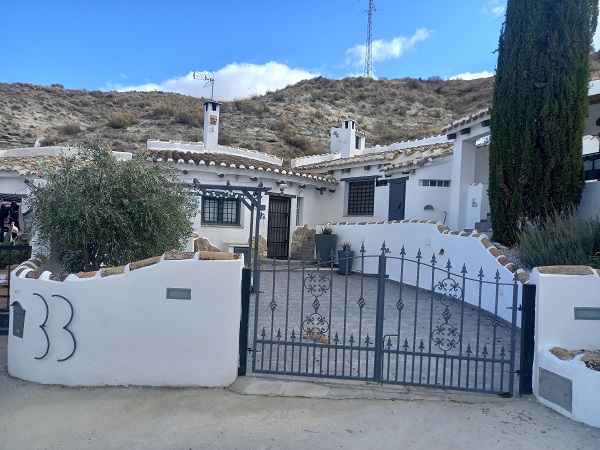
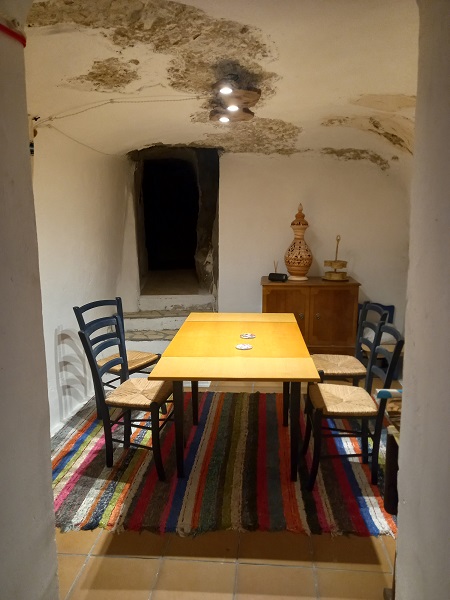
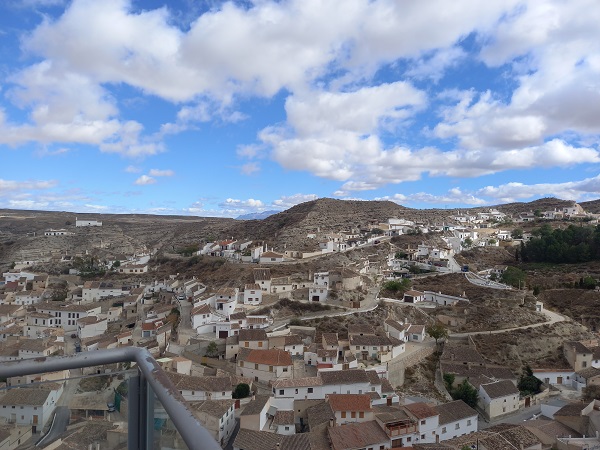
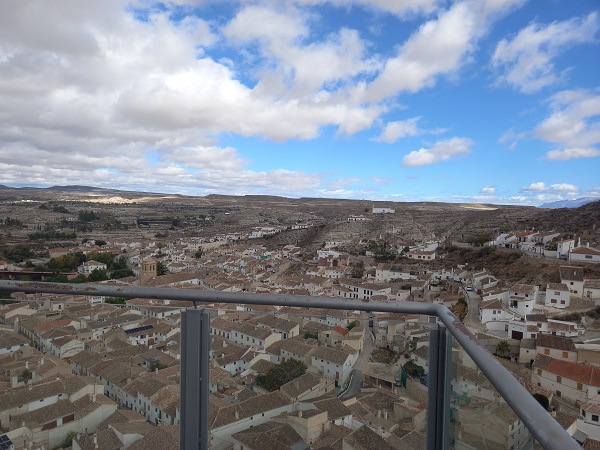
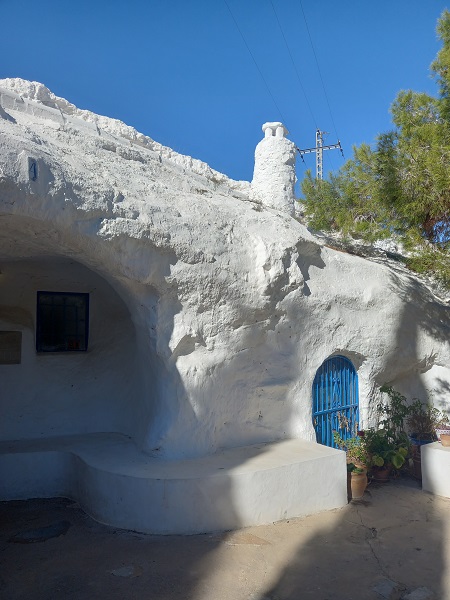
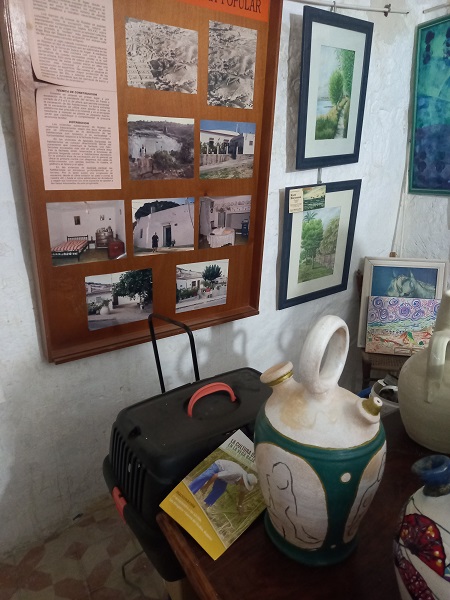
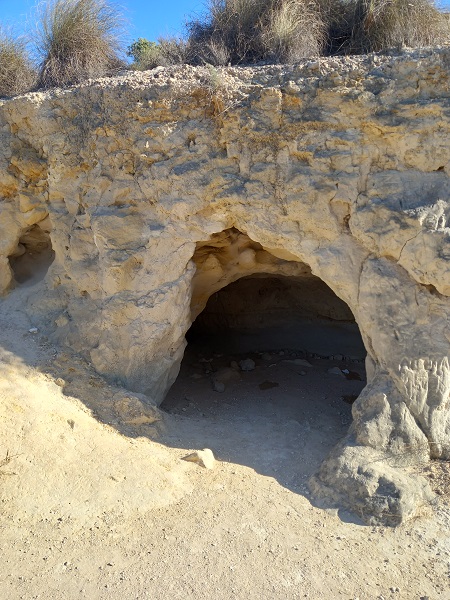
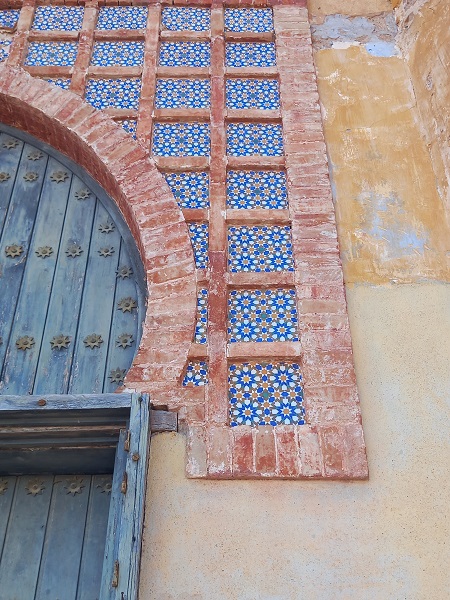
On my return to Spain in October I had two trips to Andalucía in the first two weeks, firstly to visit my brother Ben, and sister-in-law Amanda, at their cave house in Galera. I have been to visit once before, three years ago when I first retired, but they have done a lot to the house since, literally creating new rooms at the back of the cave. Their dining room is now just about completed, and they have some steps up to the first floor, which is still a work in progress. The first two pictures below show some of the other cave houses in the town.

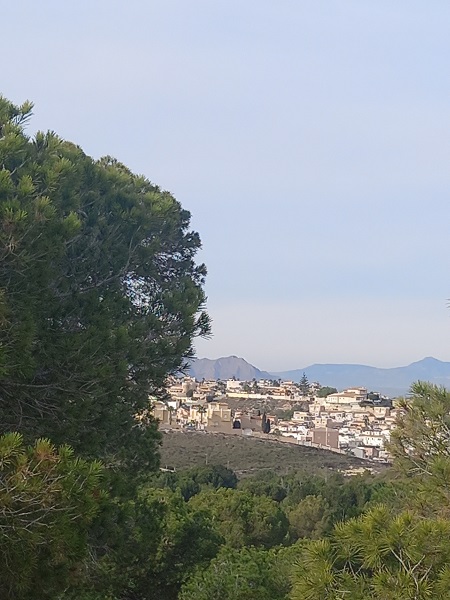
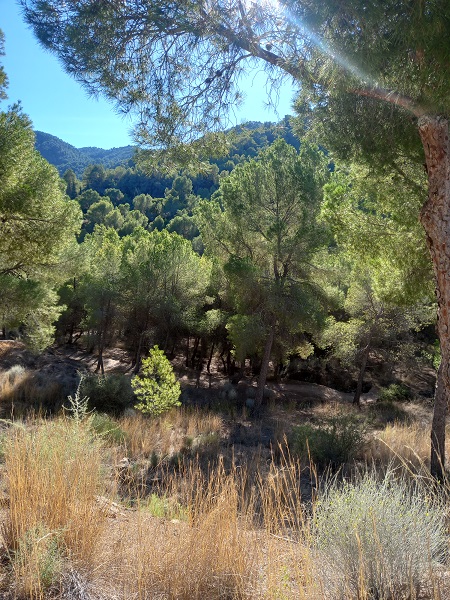
The town is so beautiful, with its houses snaking up the ravines of the valley. There are so many cave houses here, due to the rock being soft enough to dig into, and so many different varieties of house to admire. This visit the mirador, or look out point, had been completed, so Ben drove us up the winding tracks to the start of the path. Such amazing views, like looking at a living map of the centre of the town, and the stunning mountains and cloud formations all around.

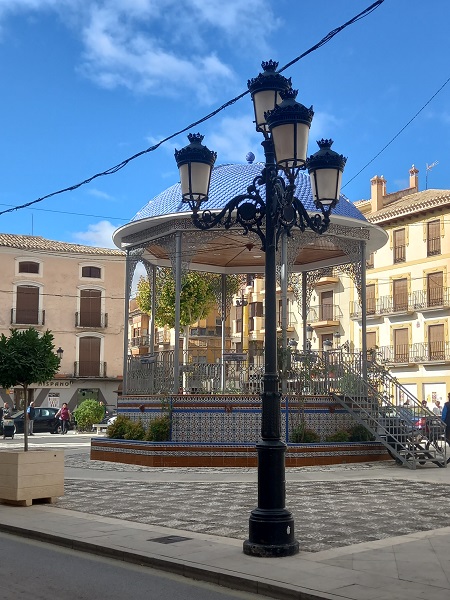
We had a visit to the nearby town of Huescar, for the weekly market. This is still a very traditional area of Spain, although there are quite a lot of people of different nationalities in Galera who have bought cave houses, the surrounding towns are very much rural Spain, with tiny traditional shops, and most of the weekly shopping done at the market. It is a gorgeous place.

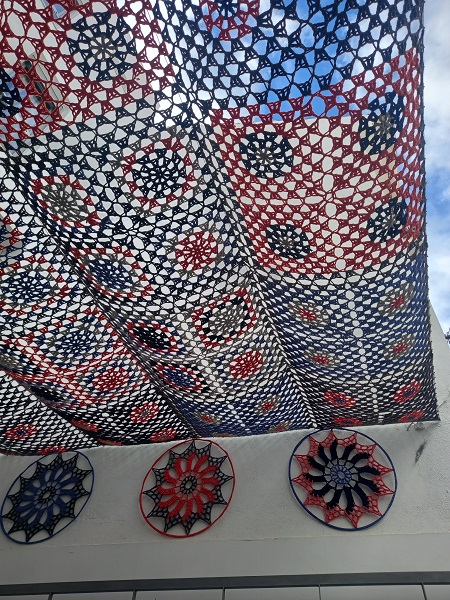
There was one area, next to a wool shop that I was very good and didn’t go into 😉 that was decorated, both with a crochet sunshade, and a painted wall, celebrating local women in different occupations.

Lots of lovely food, and one of my brother’s famous bbqs, as well as drinks at the bar and hotel, and we were back to La Marina, four hours on the coach for a week at home before our next trip.

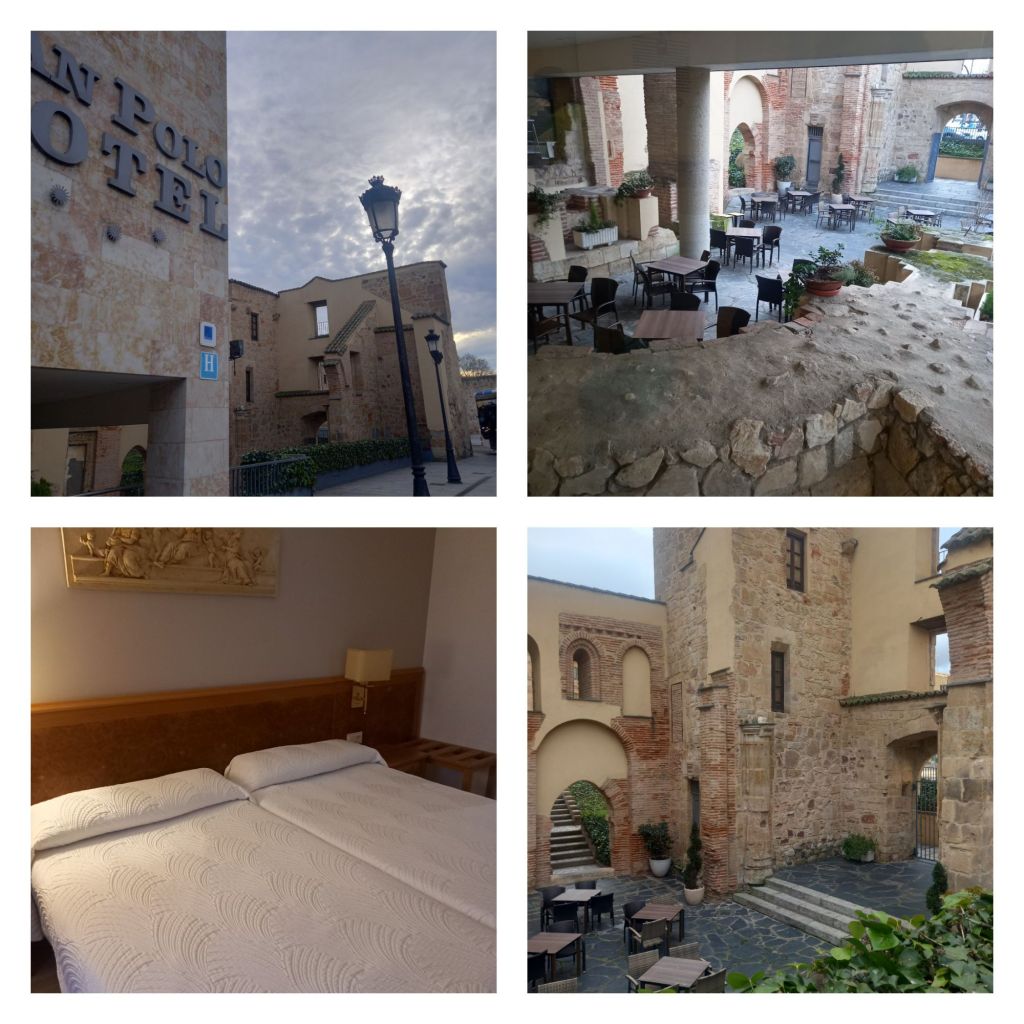
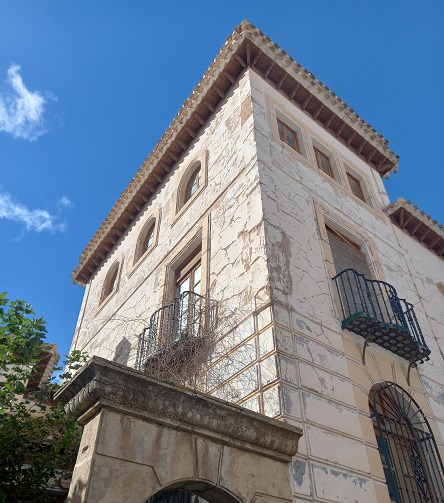
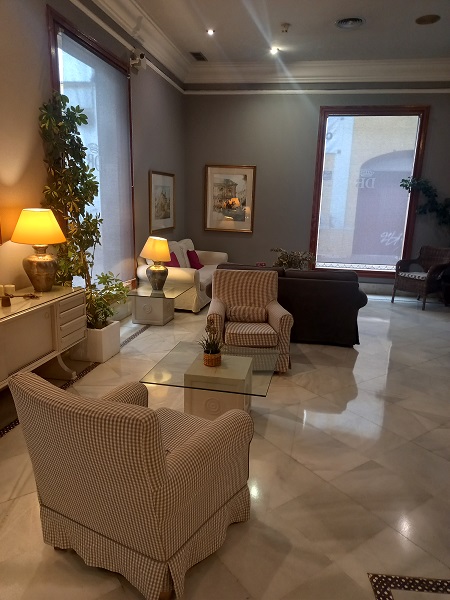
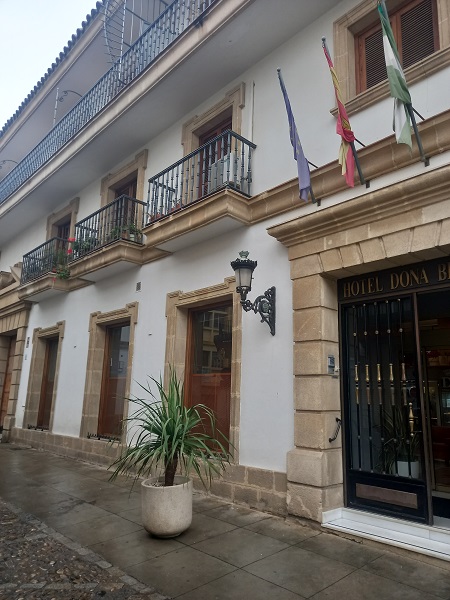
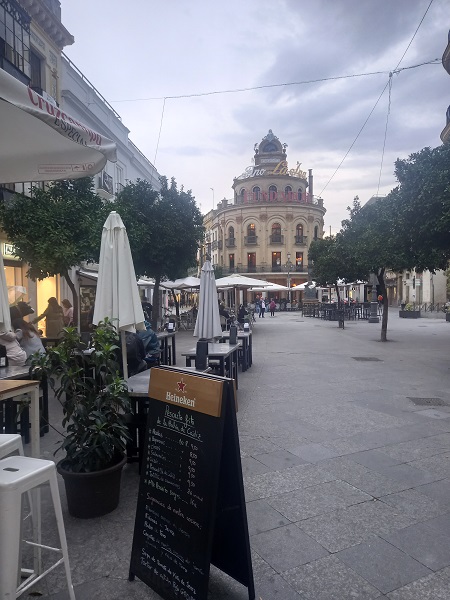
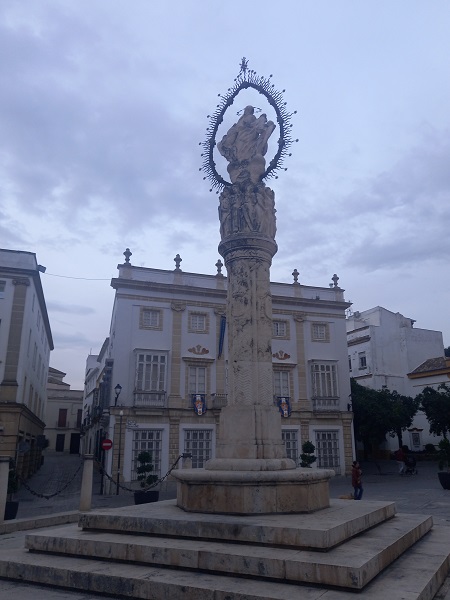
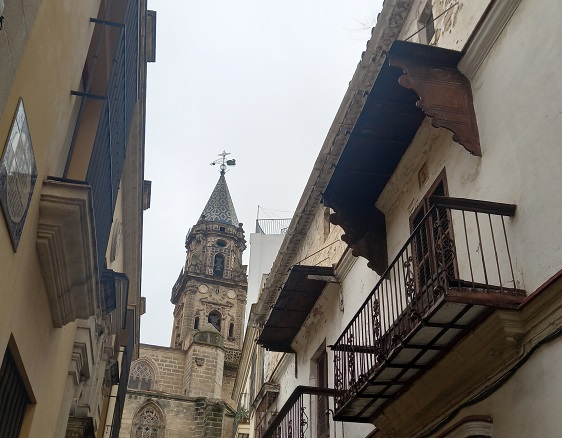
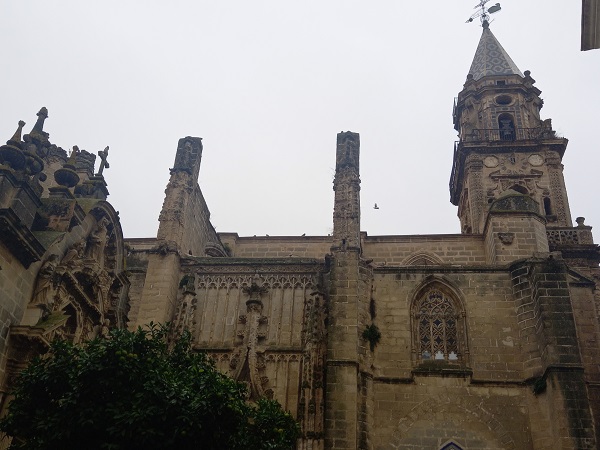
Jerez and Cadiz have been on my wishlist for a long time, to complete my exploration of the southern cities of Spain. This time we went on an organised coach trip, which meant another ten hours there, through the gorgeous Sierra Neveda, to Jerez where we were based for the three nights. The hotel Dona Blanca was beautiful, and situated right in the middle of Jerez.

We spent the first day visiting Jerez on our own, while the rest of the group went to Seville, as we had been there a few years ago. It was quite wet, but luckily we were able to see most of the things that we wanted to see.

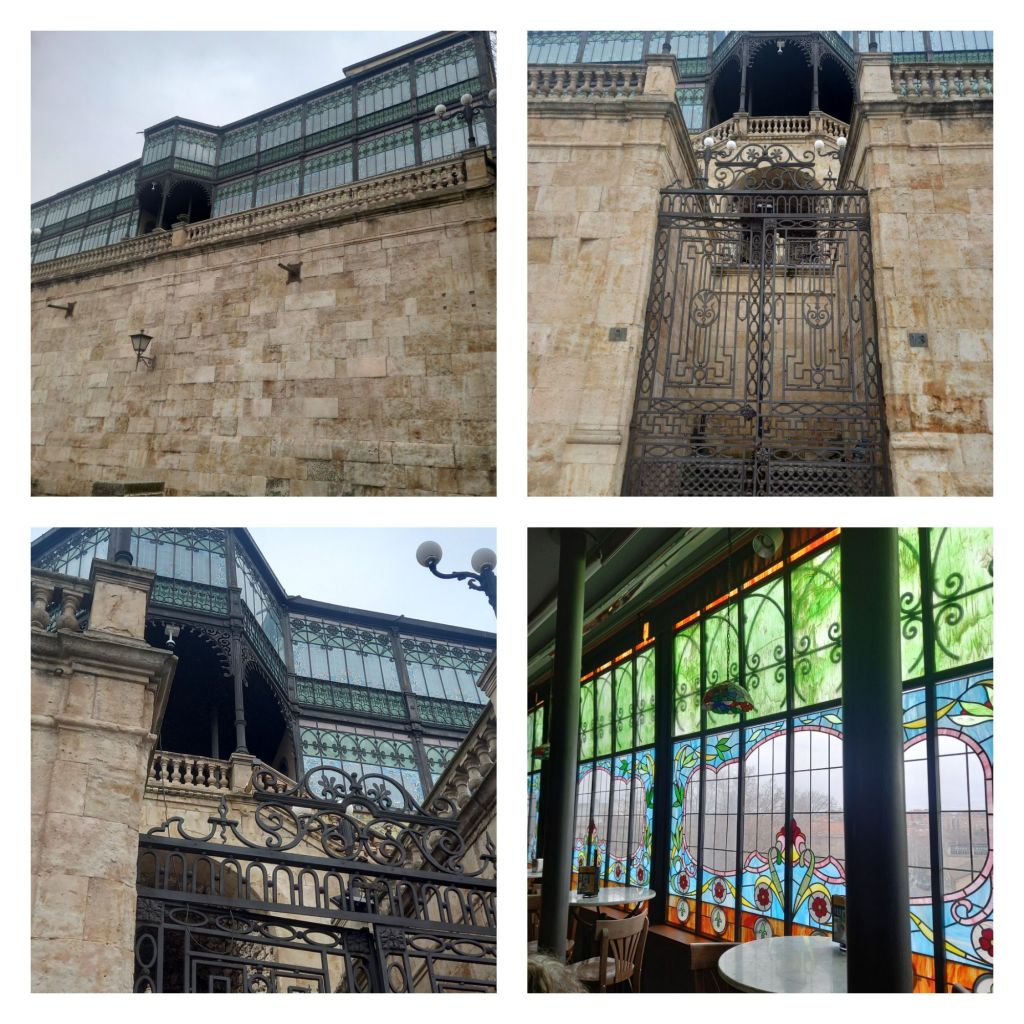
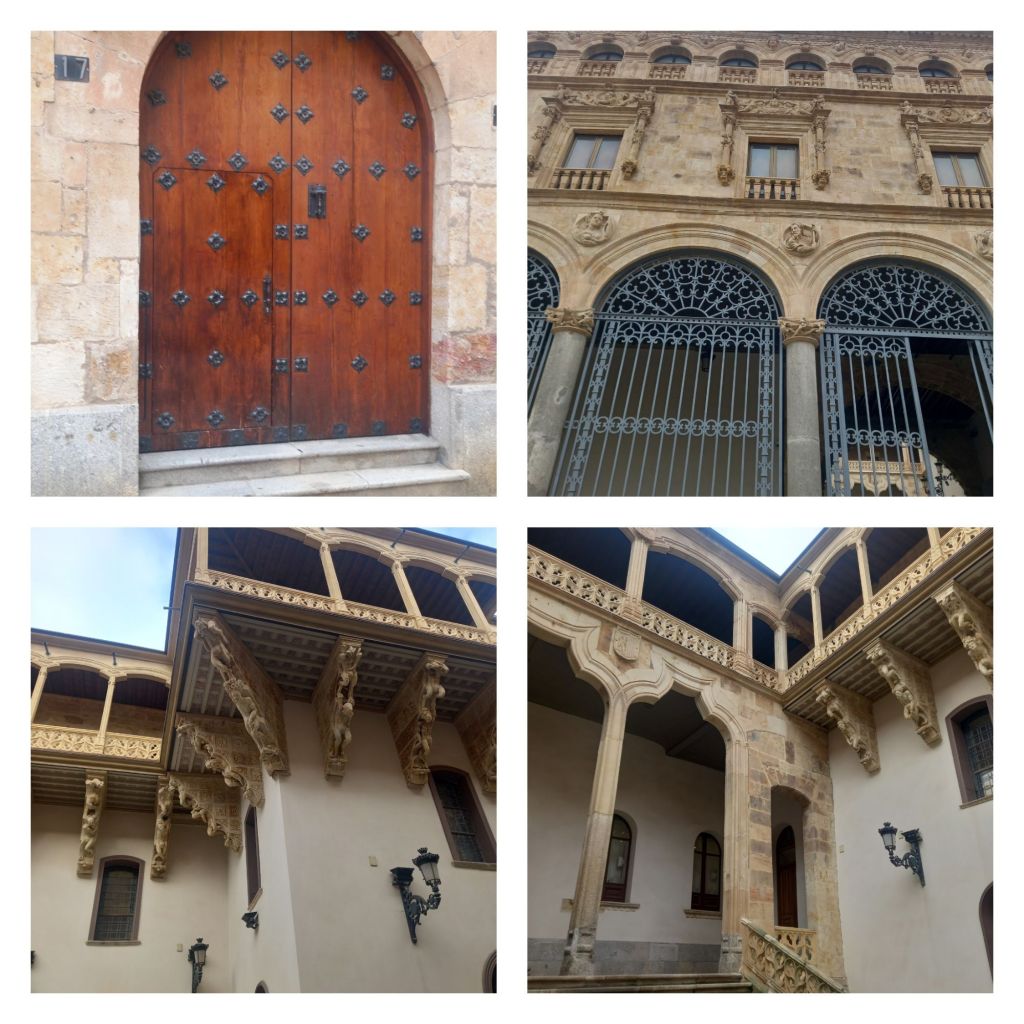
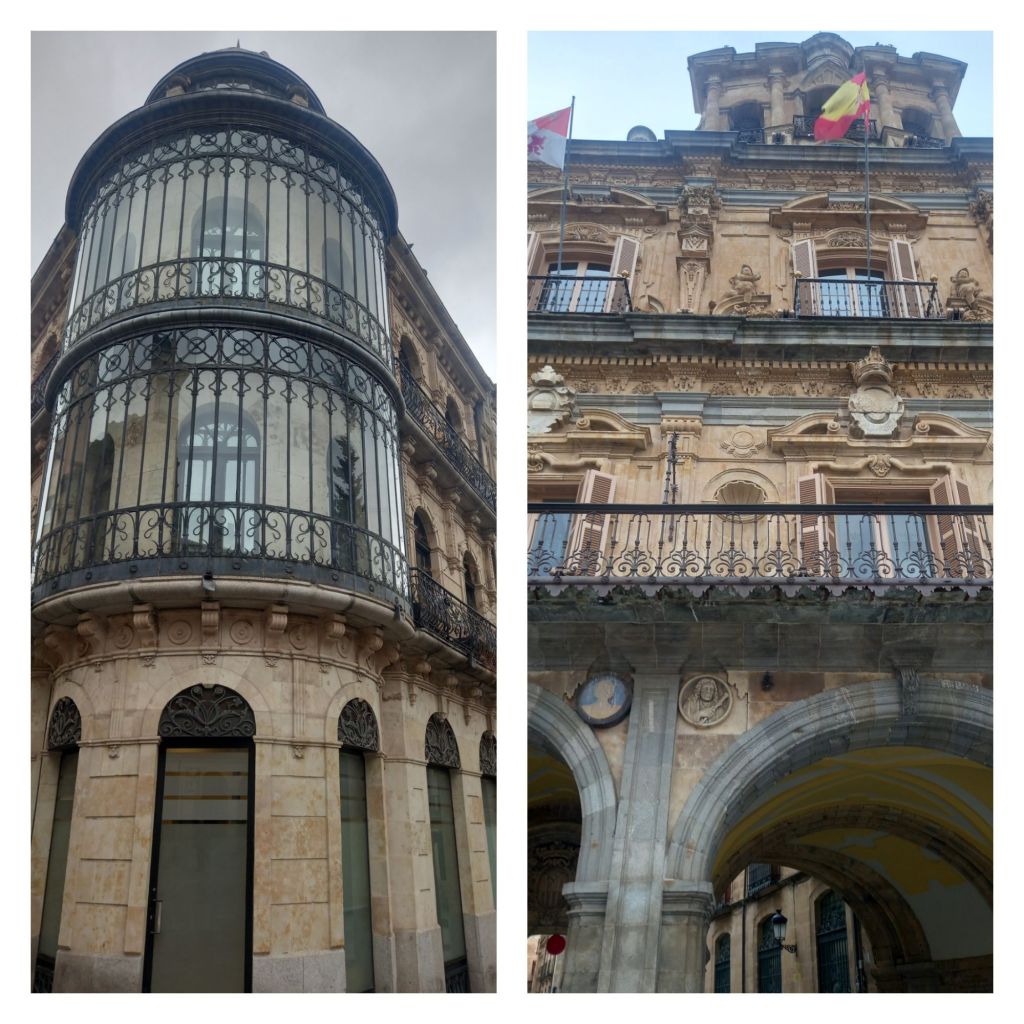
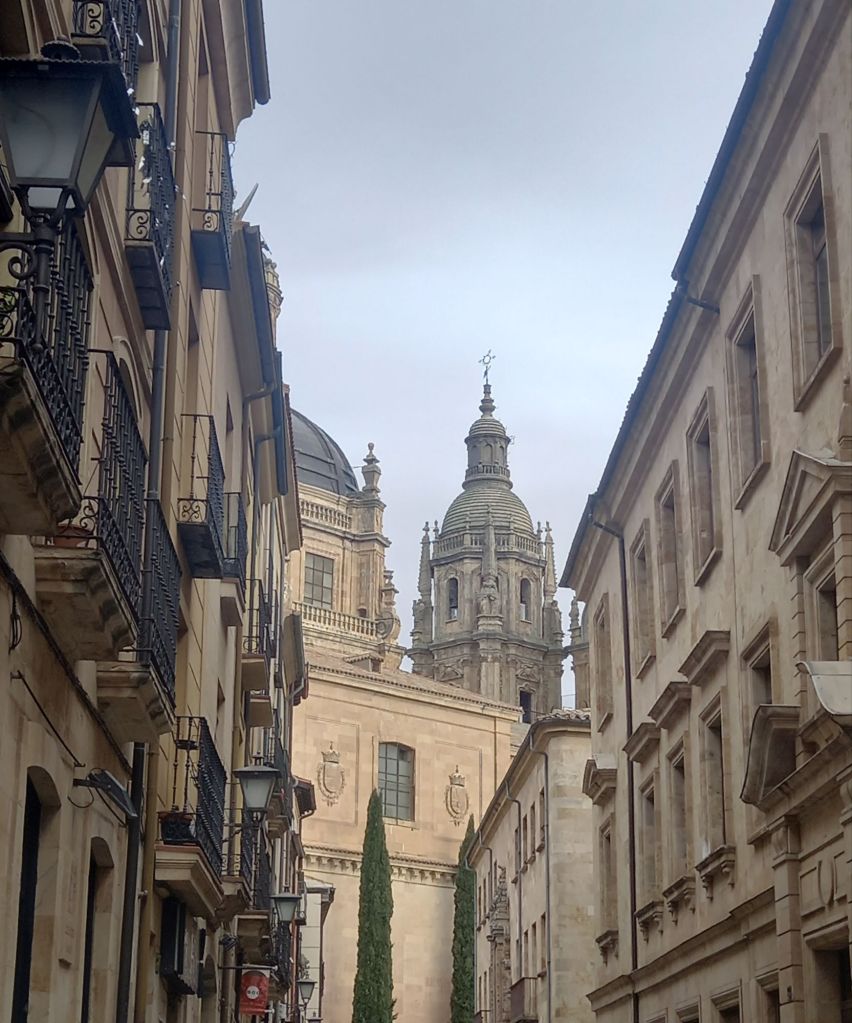
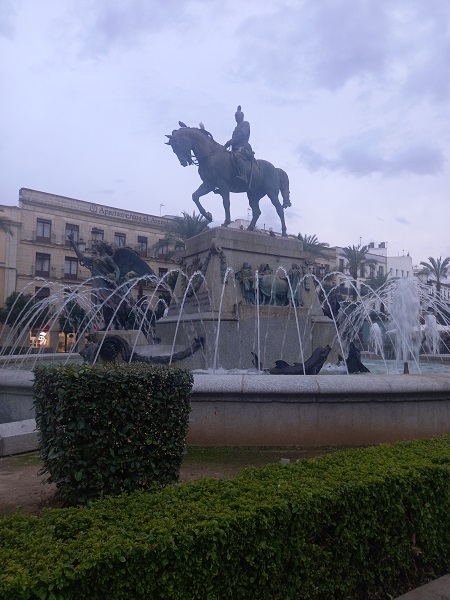
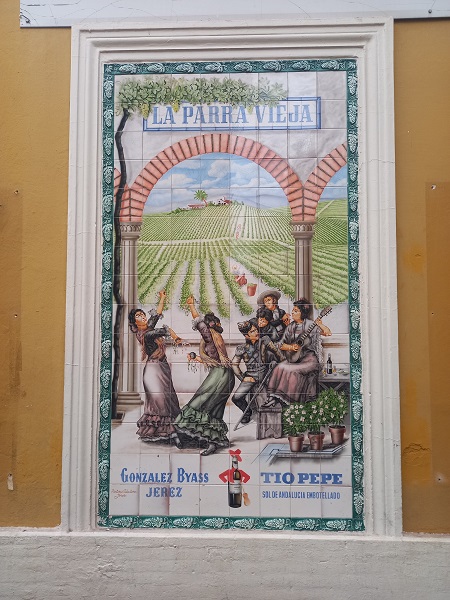
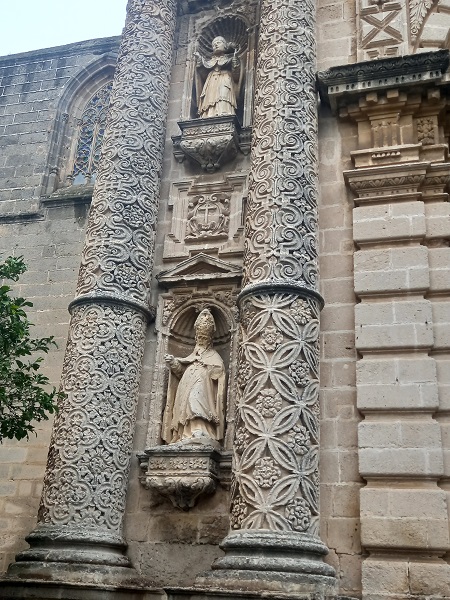
It has such grace as a city, very small, but famous for the production of sherry. I loved the old tiled adverts that were still on many of the buildings. We did end our day sipping sherry at that gorgeous bar that you can see in the photos in the middle of the top row above, while people watching in the main square.

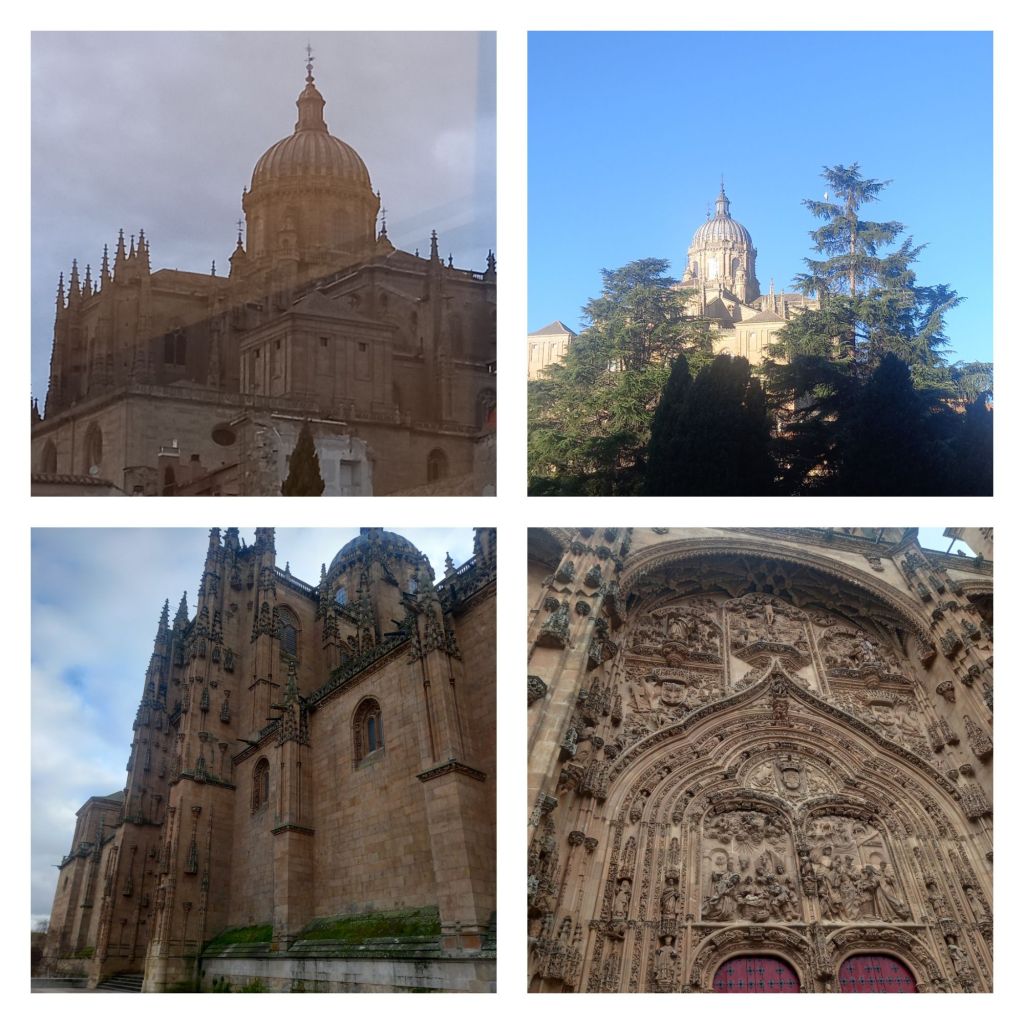
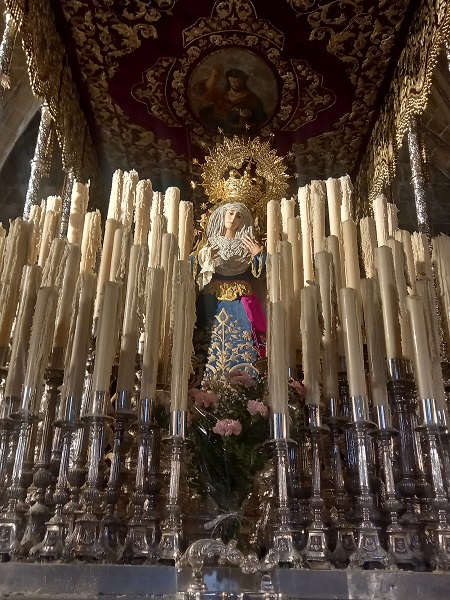
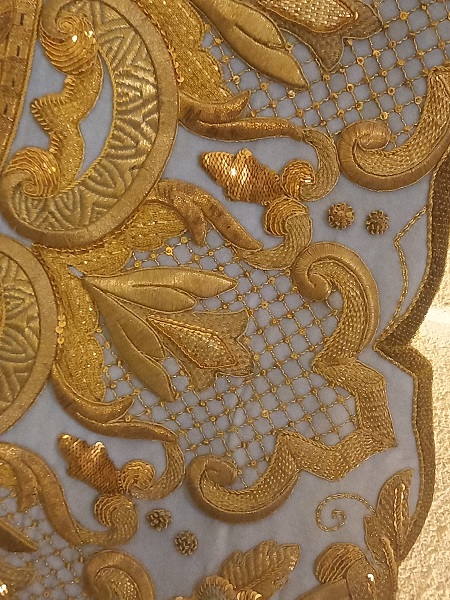
I have never seen as many candles surrounding an icon as the one in the cathedral, and there was some exceptional goldwork as well.

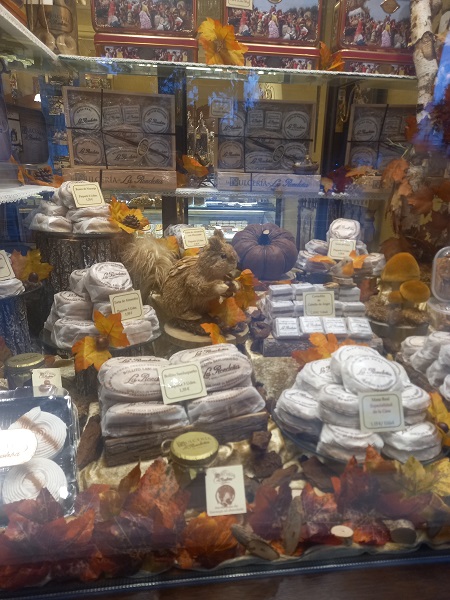
Another notable aspect was the number of speciality shops for sweets and biscuits, this one had the best autumn themed display.

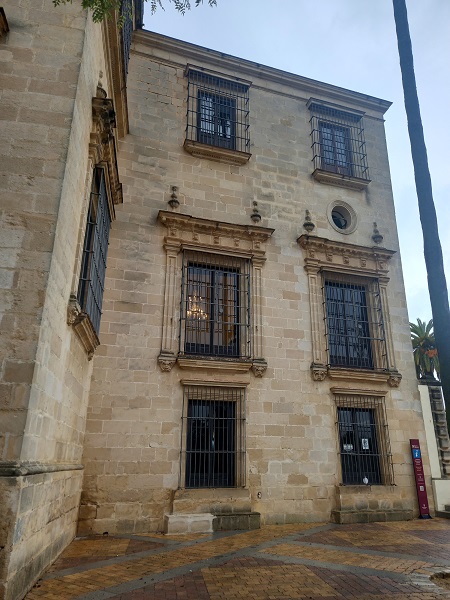
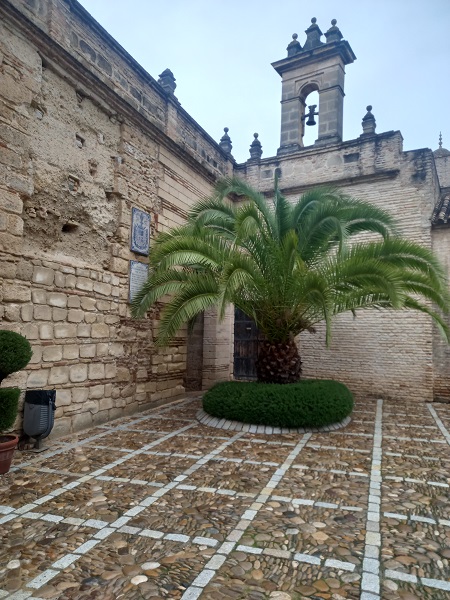
The Alcazar, the Moorish fort with added 17th century palace, was beautiful. The original mosque has been restored, and it is a brilliant blend of the different cultures that have lived in the city. There was an olive press there that must have been at least thirty feet long, it was incredible.

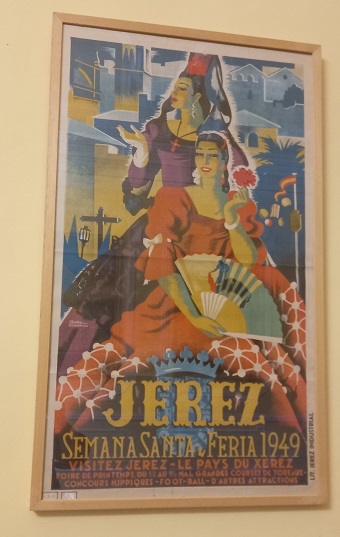
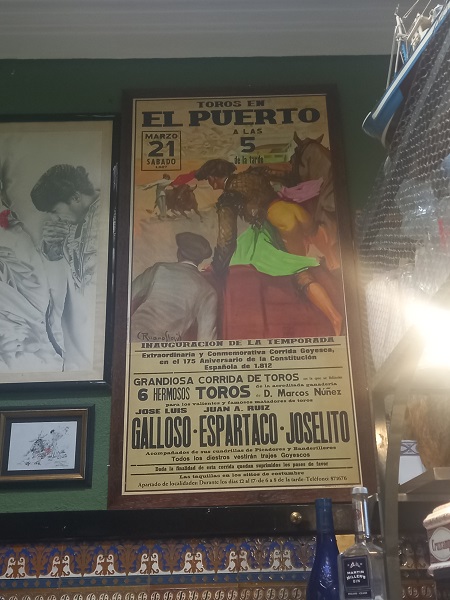
One of my favourite things was the display of fiesta posters in the palace, such wonderful examples of the development of graphic design and art.

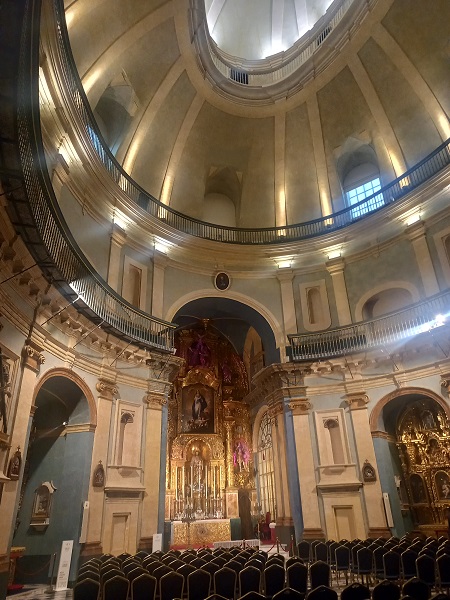
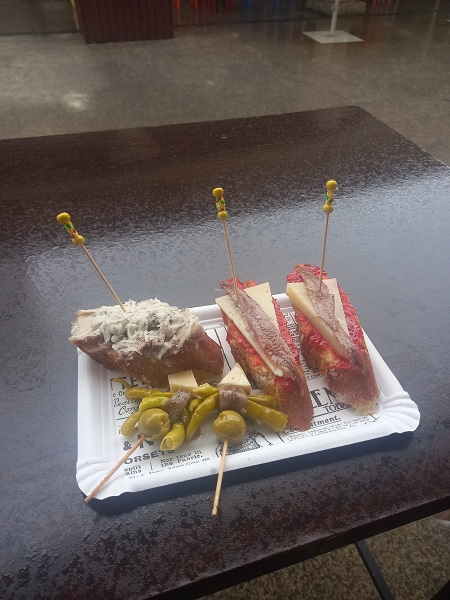
Sadly the second day, the trip to Cadiz, was very, very wet. We weren’t able to do much sightseeing, as the rain was torrential, but we did see the cathedral, a beautiful chapel, and have a lovely tapas at the market, which has now become a food hall.

We didn’t realise at the time, but this was the edge of the terrible Storm Dana, which killed so many people in our region of Valencia. While we were in Cadiz, the centre of Jerez flooded, and on our return the city centre was closed. We cut the trip short the next day, due to flooding and more storm warnings, and came straight back rather than visit a mountain village as intended. We were very, very lucky as our area avoided severe damage, and were able to help with fundraising efforts through our local charities when we got back.

I would love to return to Cadiz one day. I am already provisionally planning a return to Spain in Katy, and possibly to Portugal as well, inspired by so many You Tube and Instagram accounts that I follow that are there now. I loved the previous trip I did, and have collected so many more pins on my Google map of places to visit. It won’t be this year though but 2026 is looking promising!

For now though I will concentrate on this year’s adventures, but it doesn’t hurt to plan, it is half the fun if not more, and I have spent some of this week doing the final planning for the next two months. Hopefully there will be one more blog post before I can share that, as I need to show you all of the things I spent the rest of my three months in Spain doing. It was a lovely quiet time, and there was actual crafting going on, a miracle!

Until then, have fun, take care, stay safe and thanks for visiting.

29 years later …..

I left Cahors for a short drive into the Dordogne. One of the reasons for choosing this particular route, aside from seeing the beautiful countryside and towns of this area, is that my friend Cate has lived here for many years. Cate is another friend from Huddersfield Polytechnic days, in fact she was the very first person I met, in my halls of residence, the day I moved in.

We have kept in touch for nearly 42 years, but haven’t seen each other since her wedding in Ireland, 29 years ago. As I have mentioned before, one of the best things about retirement is the time to go and re-connect with people face to face, last year Dave in Cyprus, and Helen in Devon, and Ange and Sue over the past couple of years in Scotland and Yorkshire, and now in Spain!

It was another stunning drive, as you can see from the map above I was driving into the heart of the natural park of the Perigord- Limousin region, and it is the most amazing countryside. I am definitely going to see about getting a dash cam for my next European trip, so that I can capture more of the scenery as I drive. France is especially beautiful at this time of year, although the weather was not brilliant, the wisteria was in bloom everywhere and the clouds just added to the drama of the rivers and wooded valleys.

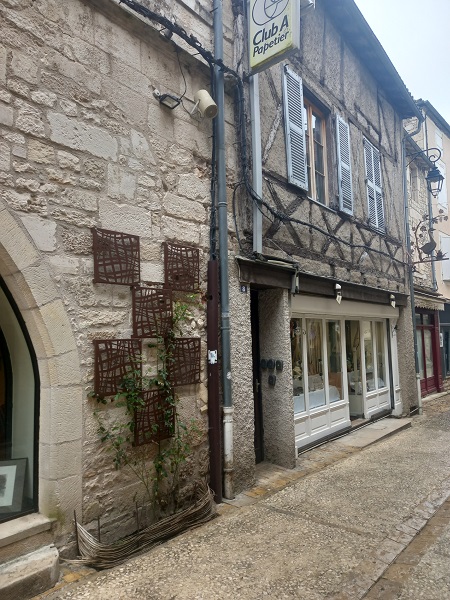
I stopped in Souillac, a little town on the Dordogne, for coffee and a wander. At this point I had decided not to use motorways for the middle of the trip, excellent though they are in Europe I was keen to do more small roads, and this little town was a lovely break in the journey.

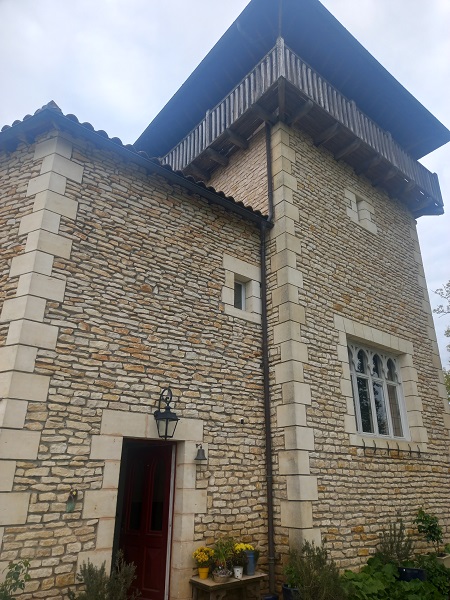
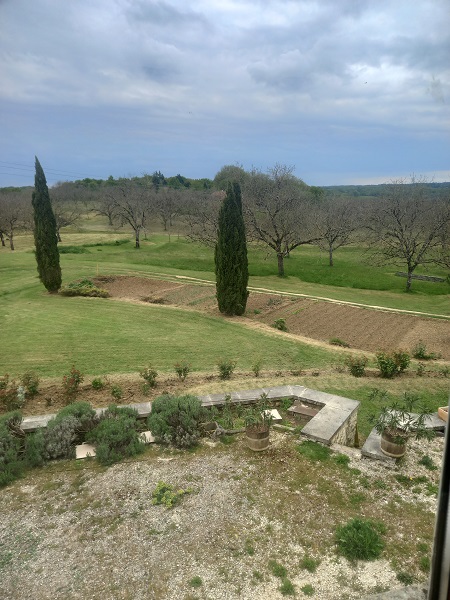
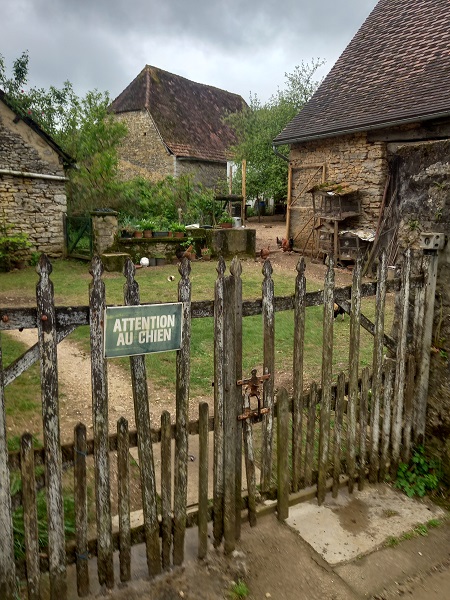
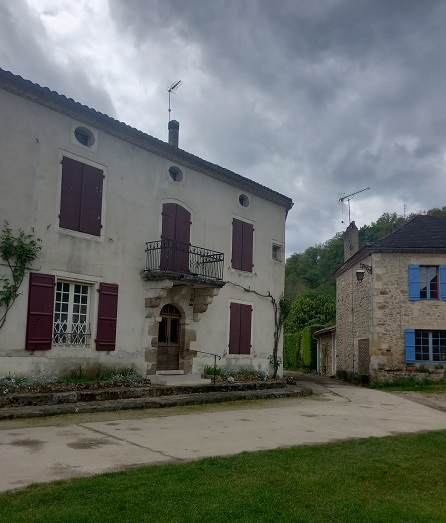
Cate, and her husband Billy, bought a derelict farmhouse and barn in a tiny village in the Dordogne, and have spent the last twenty years rebuilding it. The views are amazing, and they grow most of their own food.

We had a lovely, if a little damp, walk with her two dogs, though the country lanes here. It really is a completely idyllic place to live, and I can see why so many British people have chosen to move here.

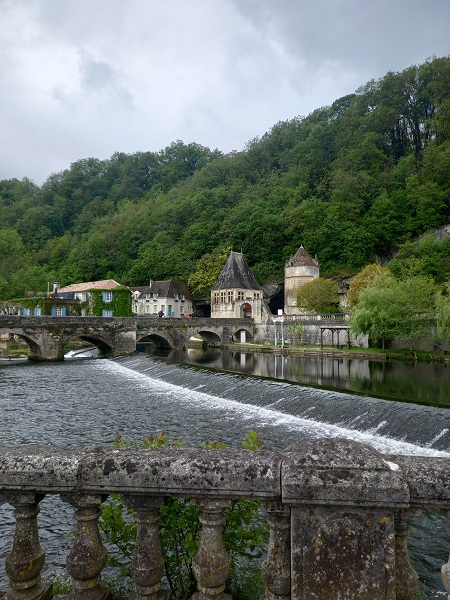
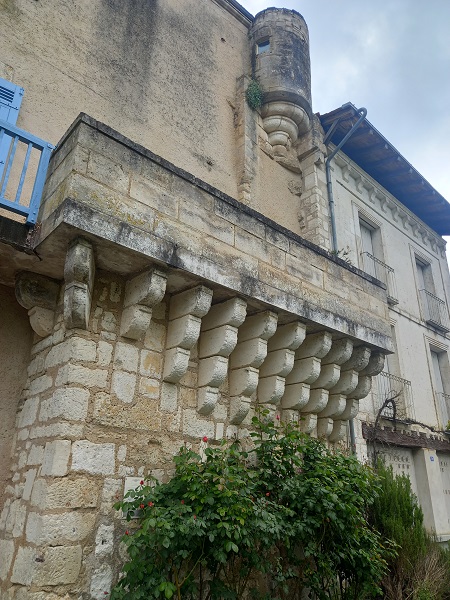
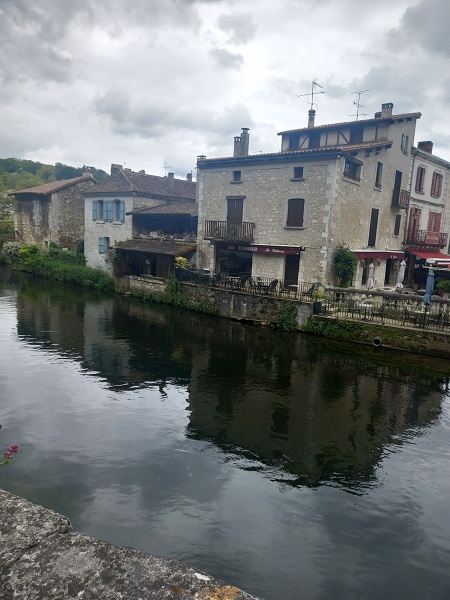
Cate was an estate agent before she retired so she knows the area very well, and took me to see some of the most beautiful places in the area. We went to the little town of Brantome for lunch, which has some gorgeous houses around the abbey and the river.

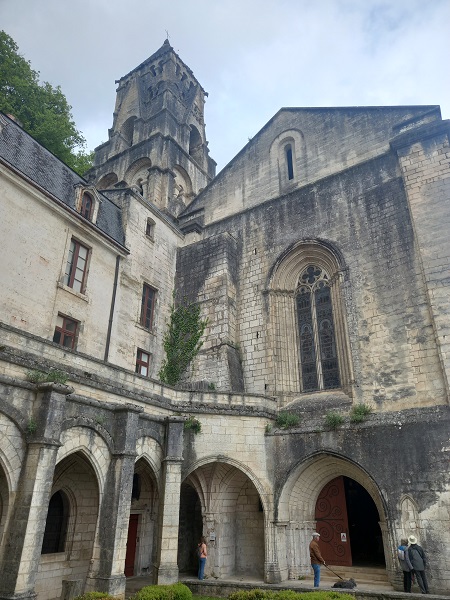
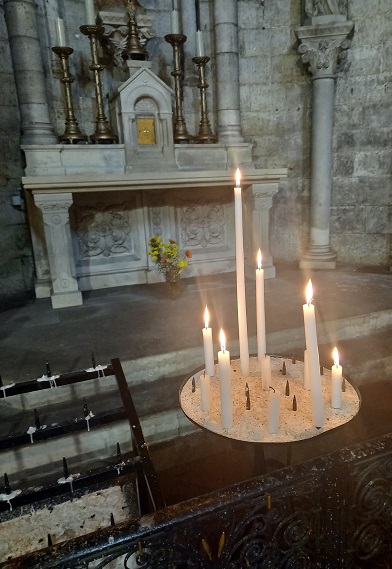
The abbey had the longest candles that I have ever seen. I always light two wherever I visit, one for the living, and one for all my friends and family no longer here.

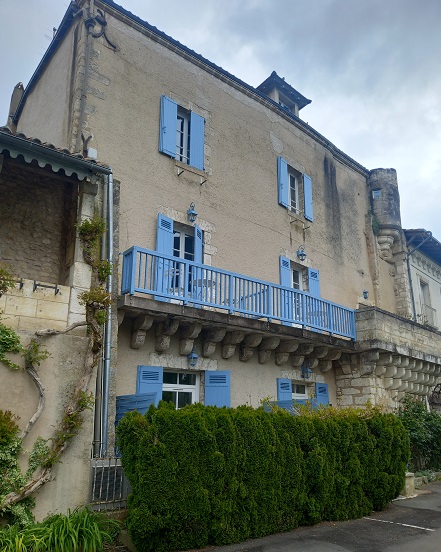
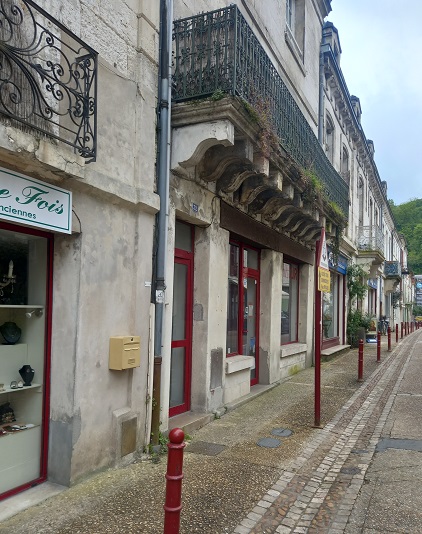
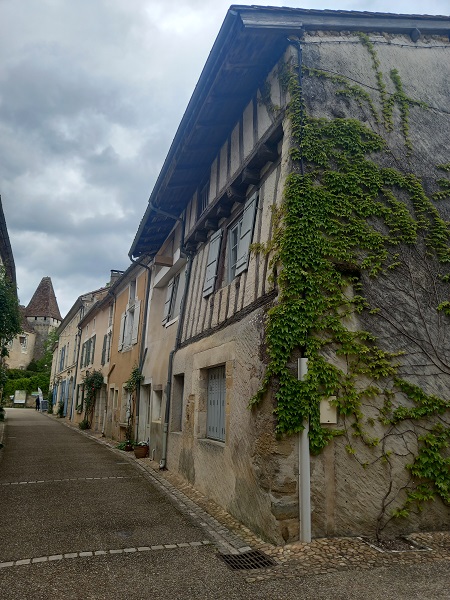
We then went on to St Jean de Cole, one of the prettiest villages in the area, complete with a privately owned chateau. Cate had sold most of the houses in the village, and was based here during her career, what a gorgeous place to work!

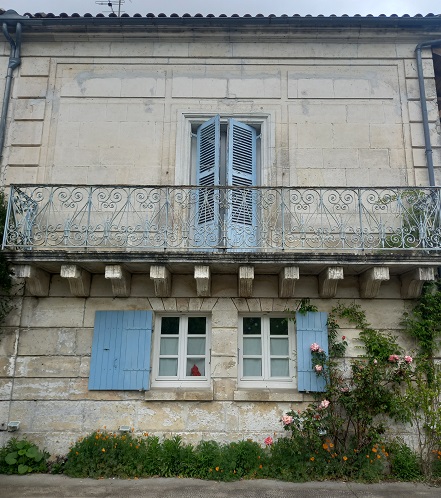
I love the contrast of the blue shutters with the pale stone, and the wisteria on the houses here.

As well as the sightseeing, we had a brilliant catch up, and lots of lovely food. It was so nice to see her, and hopefully it won’t be 29 years until we see each other again! I know that I have said this many times before, but I am so lucky to be able to do this, and live this wonderful life.

My poor colleagues at the university went through a dreadful time last summer, with the closure of the department, and losing about half the staff to redundancy, and the same is happening again this year, with a further round of course closures and job losses. I feel so sorry for them, as I know how hard they have all worked, and it seems so unfair, especially after the stresses of the Covid years. I am eternally grateful to have been able to leave at a time of my choosing, and to have the life that I have now.

I will be back again later in the week, to share a surprise textile treasure, that meant a slight alteration to the route, that led to a wonderful extra visit to somewhere very special. More details in the next post. Until then, have fun, take care, stay safe, and thanks for visiting.

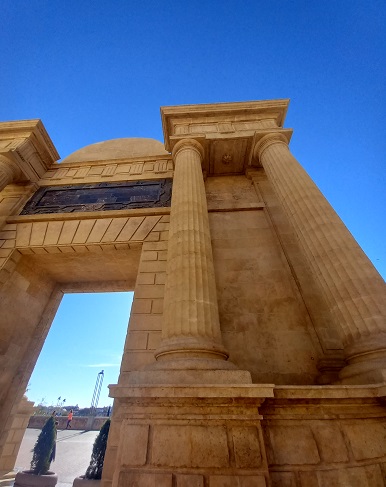
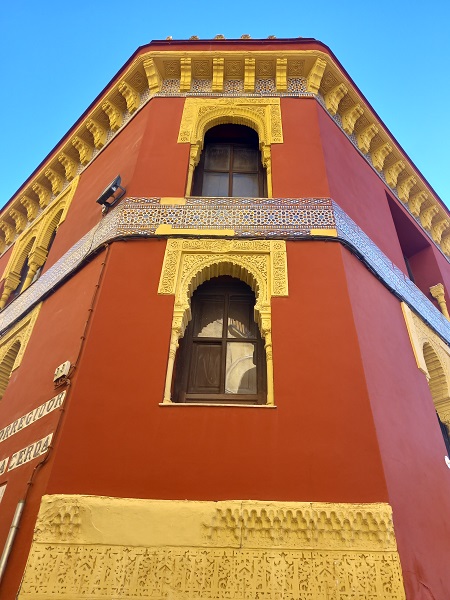
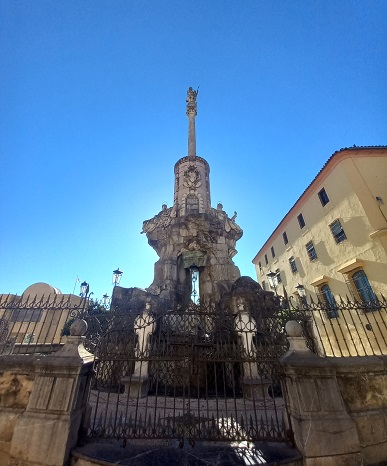
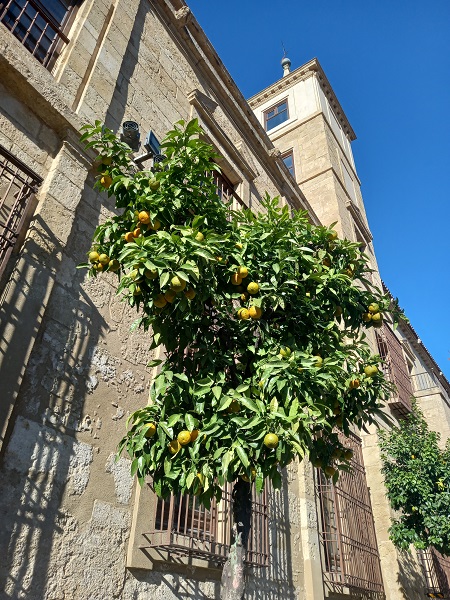
Cordoba – architectural harmony

Our trip to Cordoba had been long awaited. Mum had been briefly years ago, as part of a coach trip including other cities. We had planned to go back last year, however, life intervened. After visiting Seville some years ago, and Granada again a couple of years ago, I really wanted to go and see this third, very Islamic inspired city.

We stayed in a very well located little apartment, La Casa del Rio, part of a traditional courtyard house, just near the Roman Bridge, within walking distance of the old part of the city. They had a very clever little kitchenette in the cupboard and plenty of space for four people as the sofa turned into a double bed.

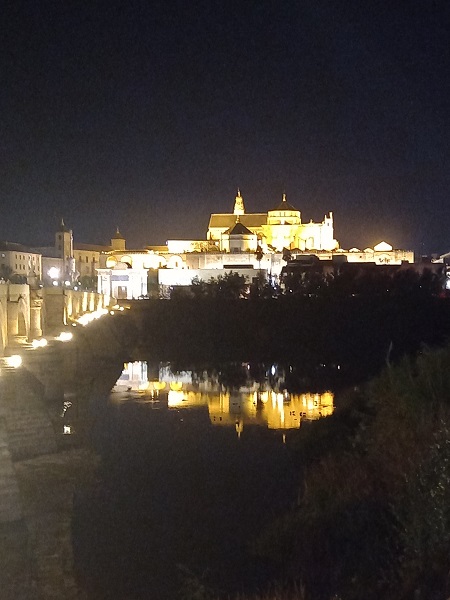
The views on the first night were stunning. This was a trip that we put together ourselves, so we went by train from Alicante, and arrived about 6pm. Train travel in Spain can often be a little longer as we had to go north to Madrid to get the train for Cordoba.

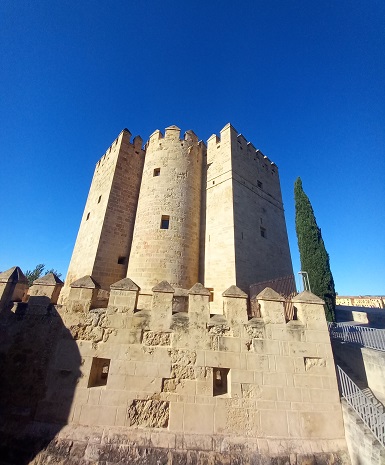
The first day was beautiful and we went straight over the bridge, past the defensive tower, over to the square just below the cathedral.

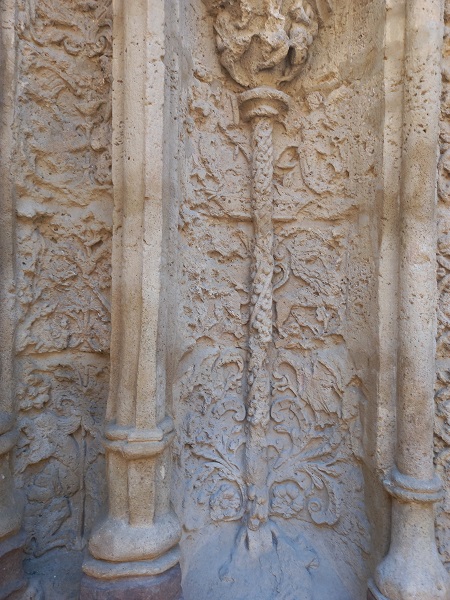
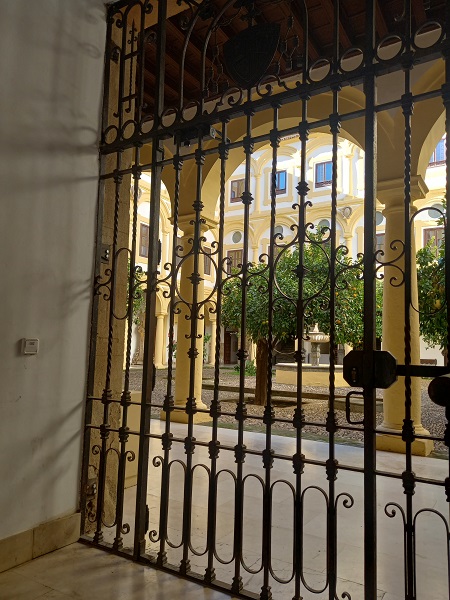
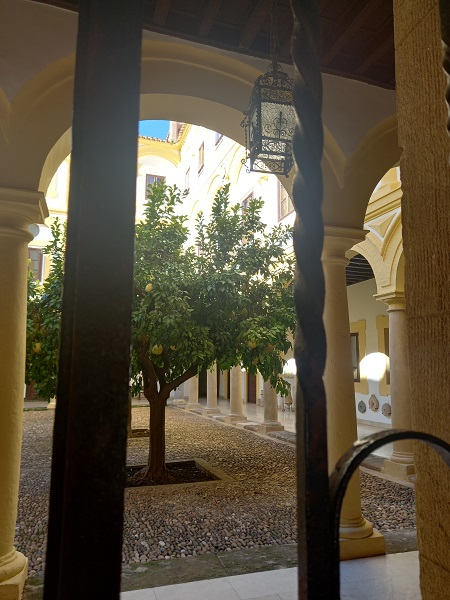
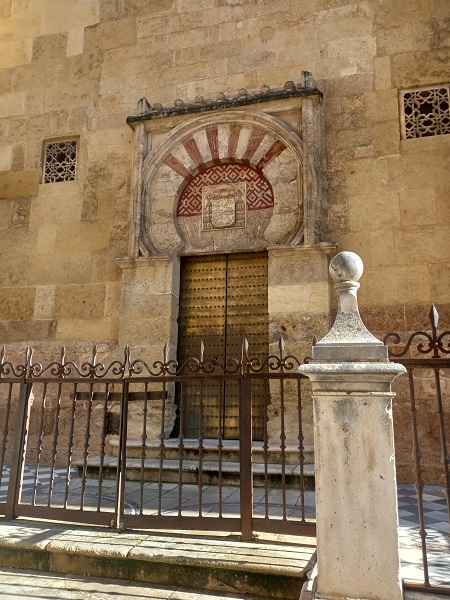
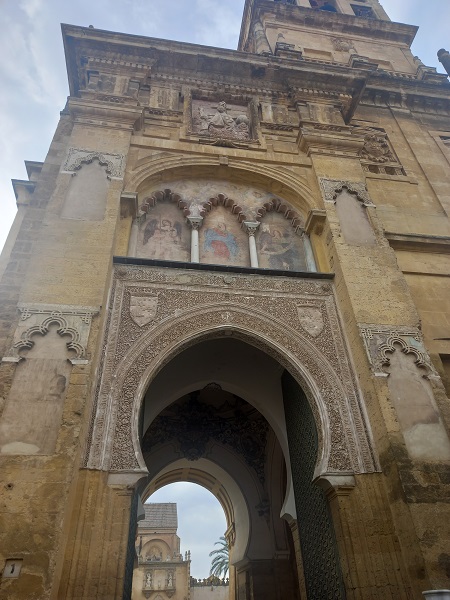
Cordoba is such a beautiful place, and as always with Spanish cities there were amazing doorways, and a little glimpse into the Bishop’s Palace.

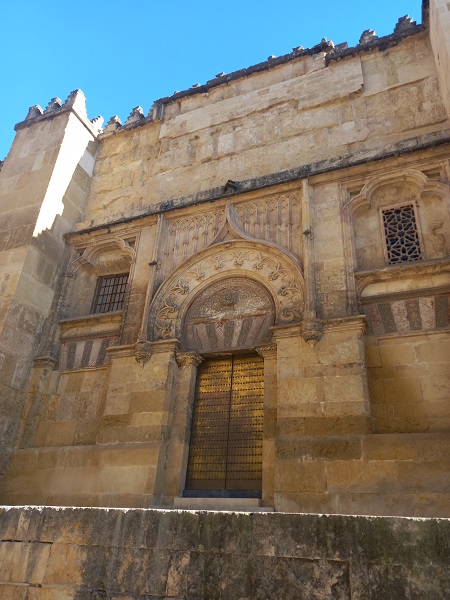
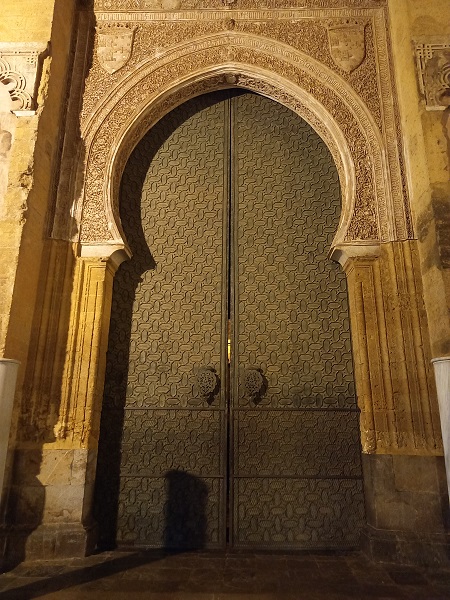
I think the doors of the mosque / cathedral are possibly my favourite of any building yet. They are amazing.

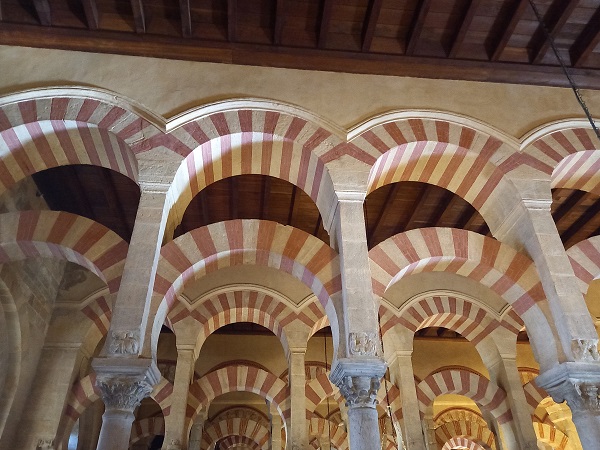
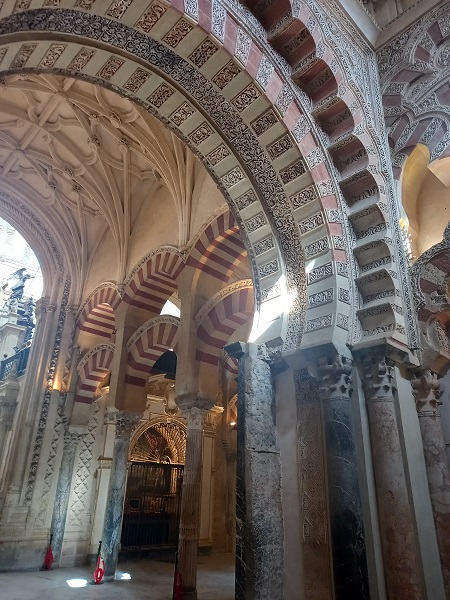
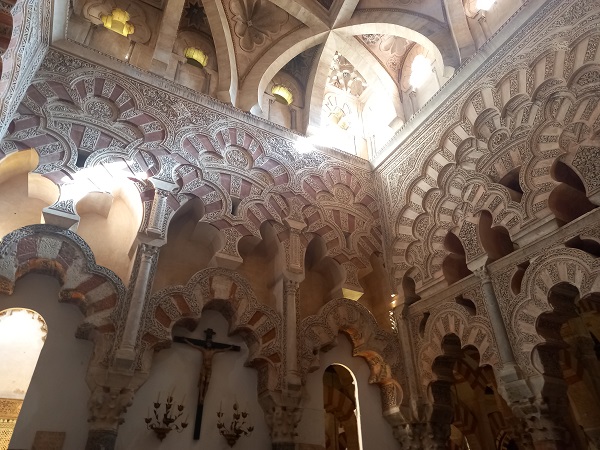
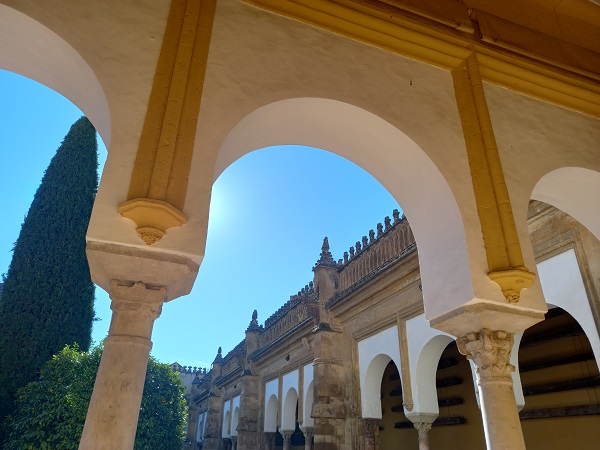
The real joy for me was seeing how the original structure of the mosque has been incorporated into the cathedral. The arches that form the original part of the mosque are so iconic, this is another national heritage site so I have seen this image many times before. When you first enter you see these amazing, yet quite simple red and white arches that seem to just go off endlessly in the distance, like some kind of hall of mirrors in stone.

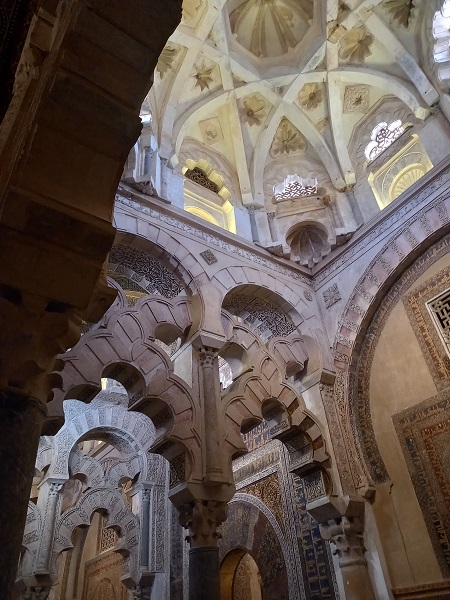
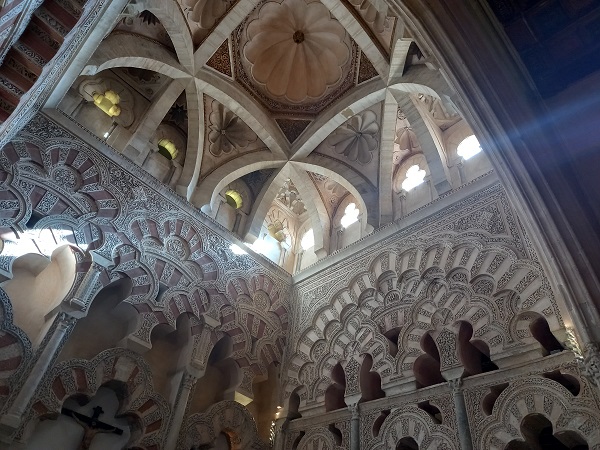
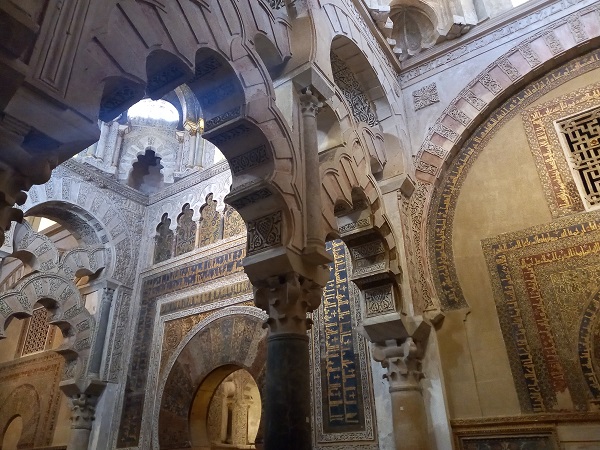
The original mosque was built in 785, and was a very small section, which is now in the centre of the building. Later developments as the Muslim population grew led to expansion, including this stunning ceiling, and the highly decorated doors around the mihrab, the alcove that shows the direction of Mecca. The decoration here is just breath-taking.

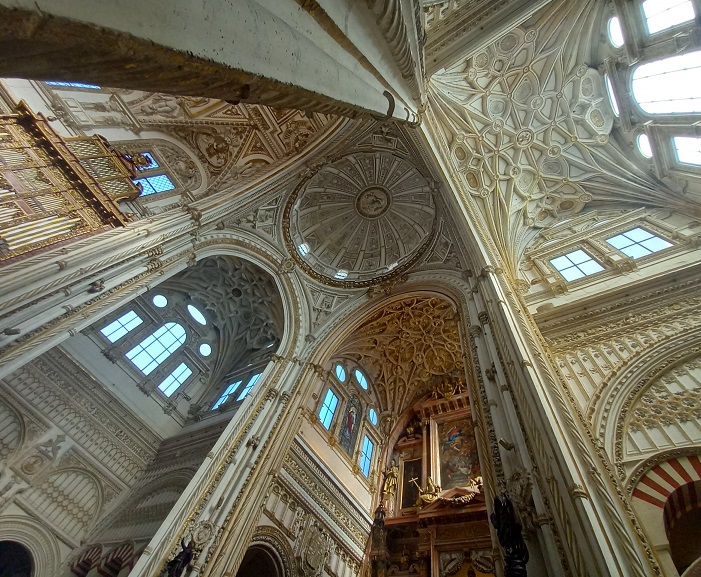
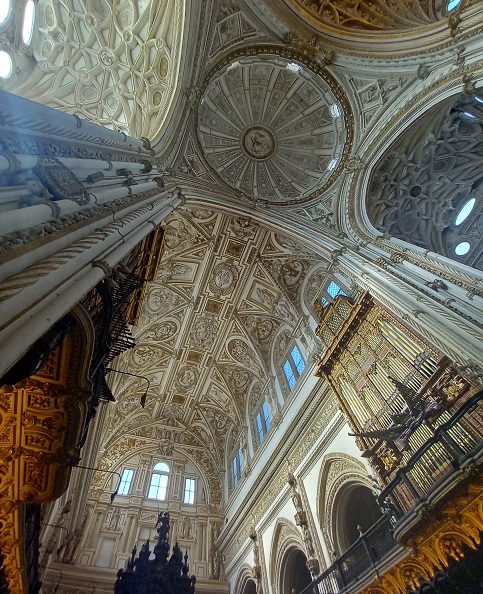
Further on is where the original part of the cathedral was first added, and you can see how clearly the lines of the arches have been used as the basis for the design. This then becomes an area with the classic Gothic cathedral architecture on the ceiling.

Towards the centre of the cathedral is the specifically Catholic part, added in the early 1500s, and this has been blended with the original pillars to form a unique religious space.

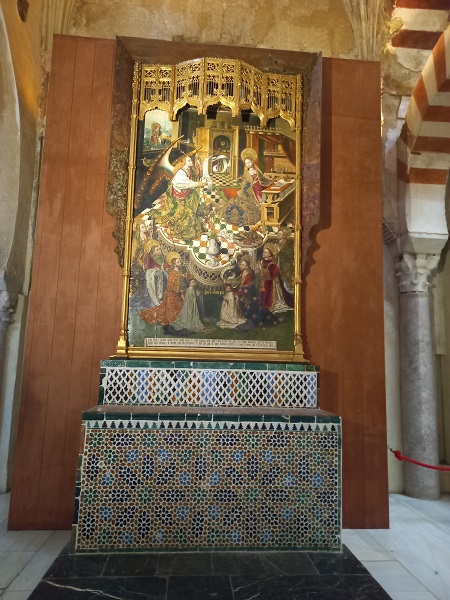
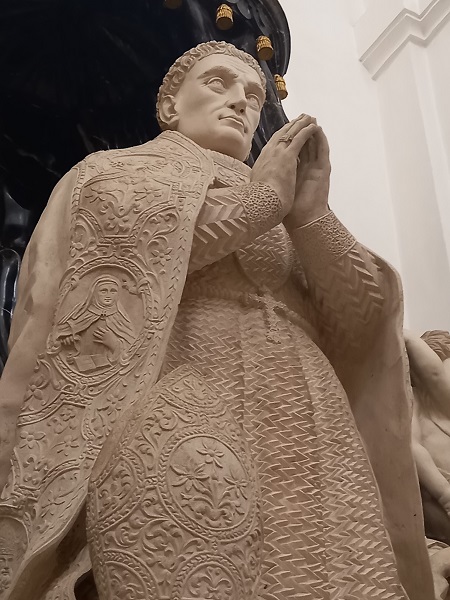
All around are places where the Islamic and the Catholic come together, such as this wonderful painting, on top of a zelige tiled plinth.

As well, there are the more traditional Catholic artworks.

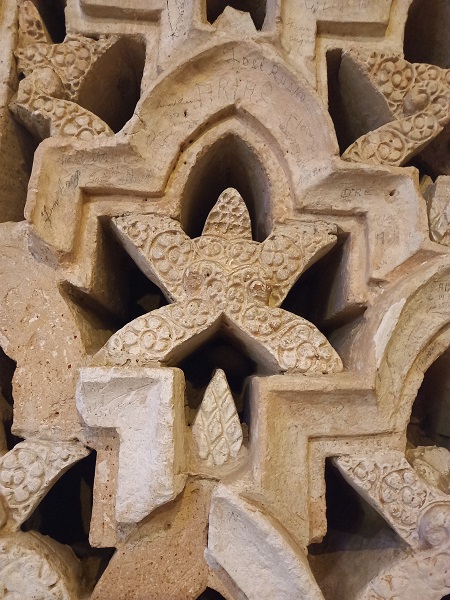
The plaster work is all of different ages, from the original works, to the Royal Chapel in the second photo, finished in 1371, which used the Mudejar style of decoration.

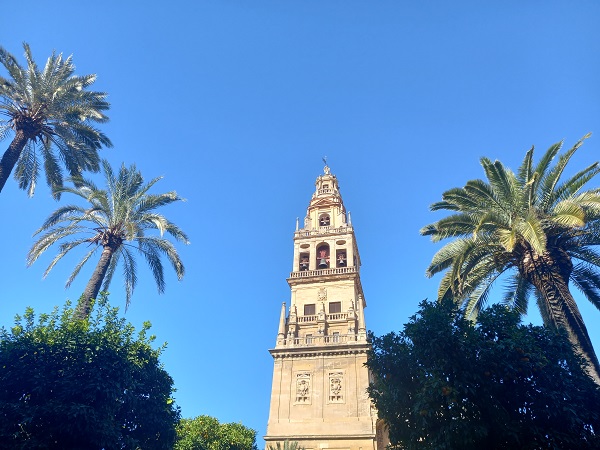
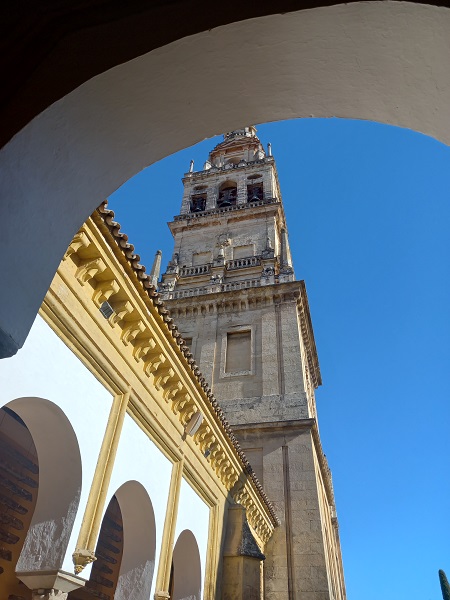
Outside the main mosque the courtyard has the original minaret, now a bell tower, or giralda.

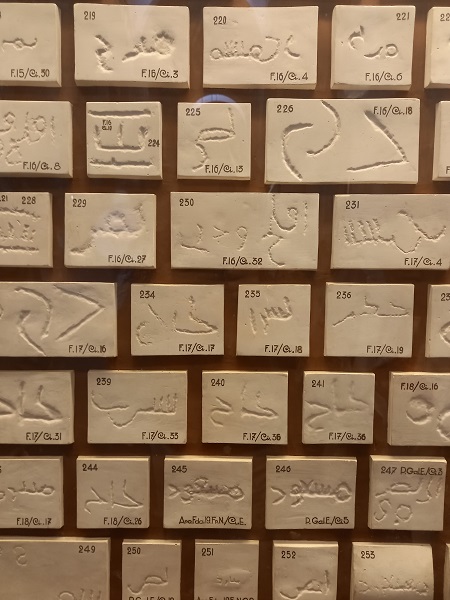
Tucked away on one side is a display of masons’ marks, some in Arabic, that have been copied by the teams that look after the building.

I loved this, as I said in my Burgos post, I always wonder who built these places, so it was brilliant to see this evidence, and imagine them making these marks throughout the centuries.

It really is one of the most wonderful places that I have ever been to, although there were lots of visitors it didn’t feel crowded, there is so much space to wander and to reflect on all of the changes this building, and this country has seen.

We spent a further two days in Cordoba so will be back next time with more beauty. The city has a very unique character and it was so nice to just wander around all the small streets. There was also plenty of my favourite tapas!

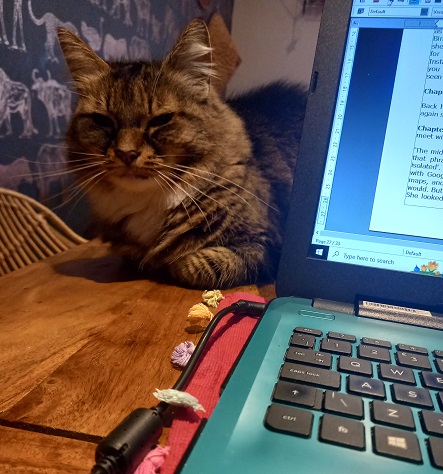
I am having a lovely time here in Marsden. I have been working on my writing and Frankie has been helping. She’s sitting watching me type now, I think she might be checking my punctuation!

Until next time, have fun, take care, stay safe and thanks for visiting.

A land of lochs

I spent last week in Scotland, a wonderful place and one that I am so looking forward to returning to this summer. My Instagram feed is full of beautiful views of the country, and it was amazing to be there, especially after a month in Morocco. There is such a huge contrast between the two places, and it was strange being surrounded by so much water, after a month of desert views and palm trees.

I was visiting one of my closest friends. Sue and I met over forty years ago, in the first week at Huddersfield Polytechnic. We have survived motherhood, teaching, and now retirement together and it was brilliant to be able to spend time catching up with her.

She came out to Spain last May to see me, and will be coming again this May with another friend from Polytechnic. Aside from the wonders of travel, the best bit of retirement is being able to spend time with my friends all over the world 😉

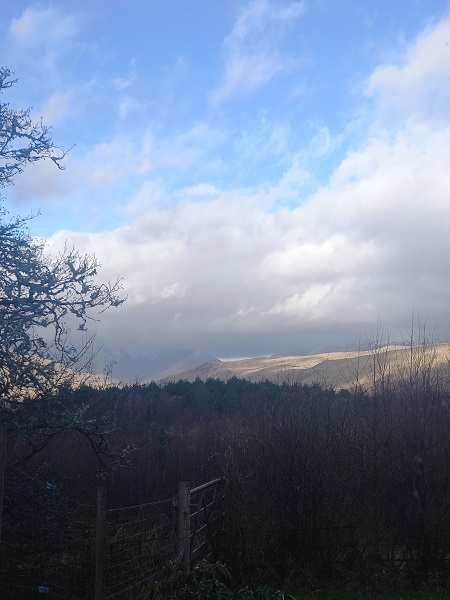
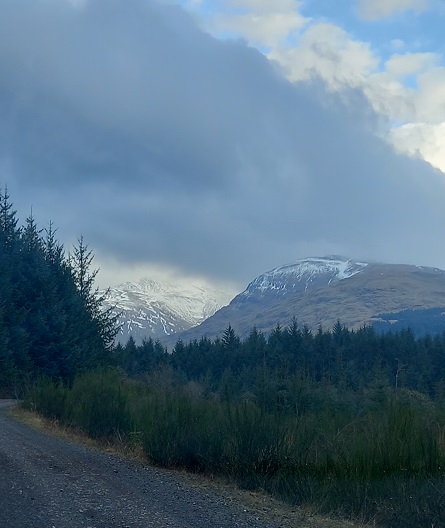
Sue has lived in Scotland for the past few years, after many years in Yorkshire, and she has the most gorgeous cottage with views of the mountains. Just look at these! I spent so much time just sitting watching the sun and the clouds from the lounge windows.

There were amazing sunsets as well. I have missed my Spanish sunsets.

We had quite a busy week, even though I was only there for three full days, and I met lots of her friends and neighbours as well as exploring the area a bit more. She lives not far from Loch Lomond and so the countryside is stunning.

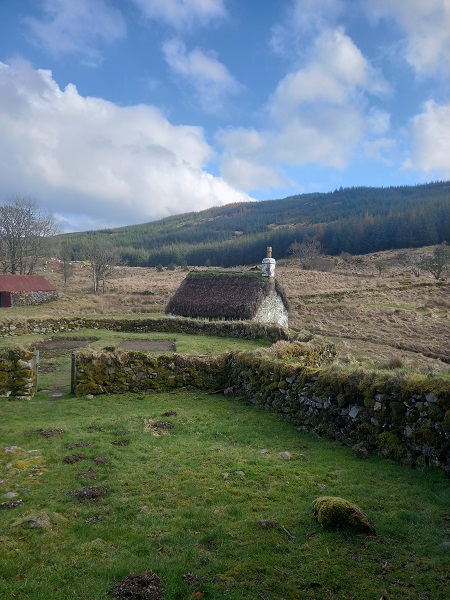
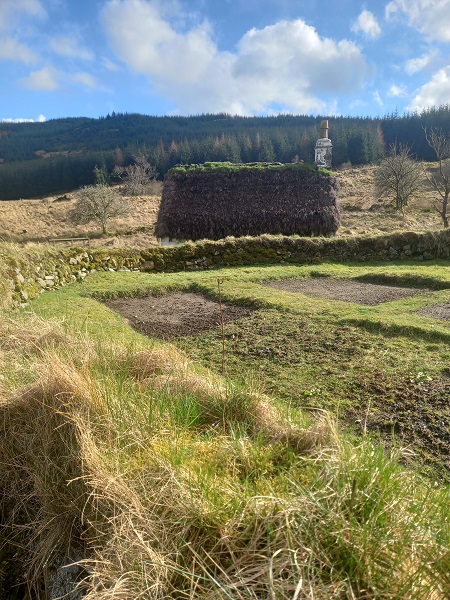
We went to Inverarary for lunch one day, and then on to a heritage property, the Auchindrain township.

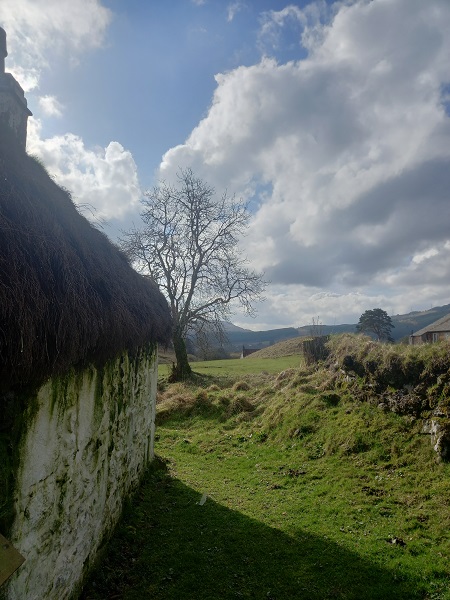
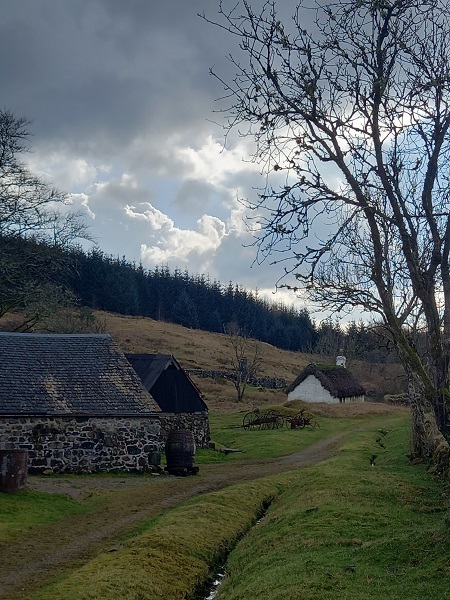
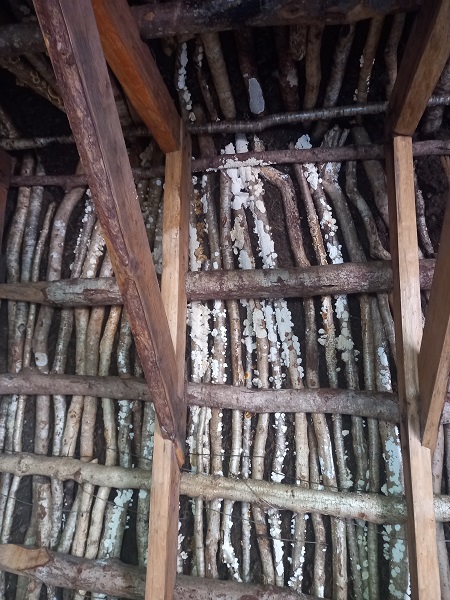
This is a set of smallholdings, set in the valley just up from Inverary, and it has such a beautiful feel to it. You can really get a sense of what life was like there, getting water from the small burn that runs through it, and the farming that sustained the inhabitants. The township was inhabited from the late 1700s until the 1940s, and although restoration work is ongoing, nature is reclaiming some of the buildings.

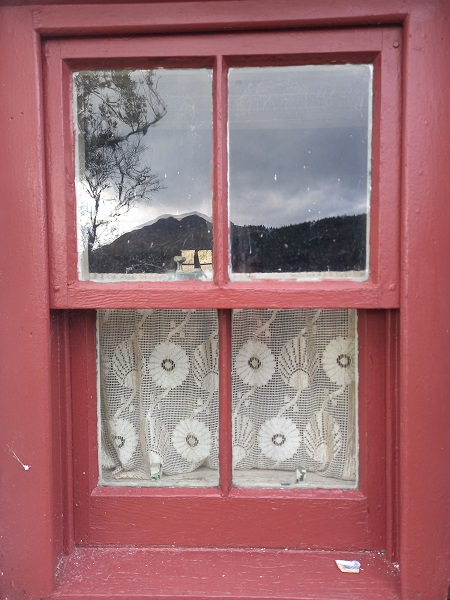
It seems very fitting that the local wood, stone and heather was used to build these dwellings, and they are now decaying in a very beautiful way, being covered in mosses and lichens.

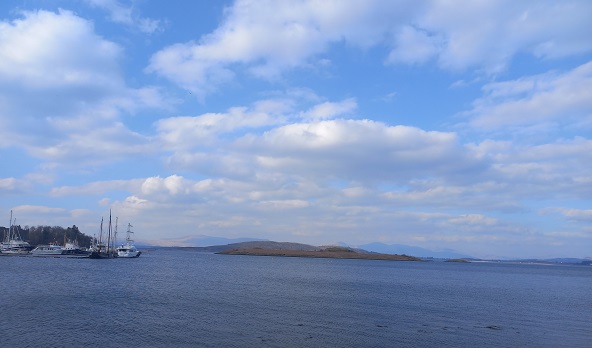
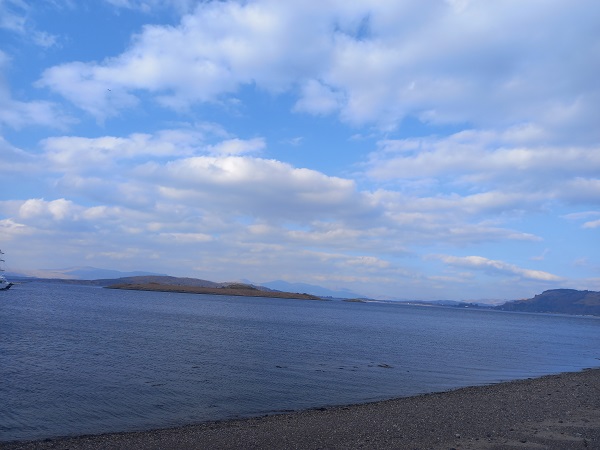
We also had a quick visit to Oban, stopping off at Loch Etive on the way for lunch.

I plan to come back here for longer in the summer, as I have about six weeks in Scotland planned between the end of July and September. I can’t believe I will be driving Katy on these roads, so excited!

I loved Scotland when I went two years ago with my sister Jacky, and am going back to Skye as well as meeting with her in the border area early on in the trip.

I also visited St Conan’s Kirk, on the shores of Loch Awe. Although the church looks really old, it was only finally completed in 1930, and was a labour of love for Walter Douglas Campbell, who had bought an island and built a house nearby.

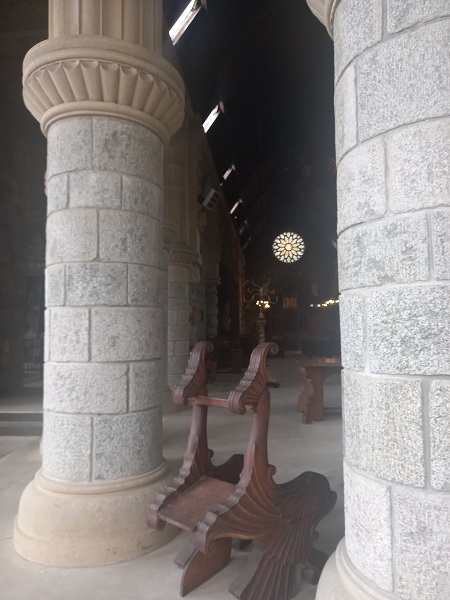
It is such a beautiful build, with its interior arches, mix of architectural styles and Gaelic inspired design everywhere.

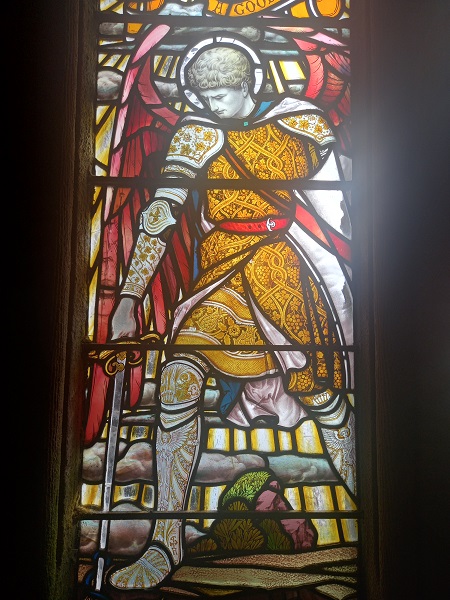
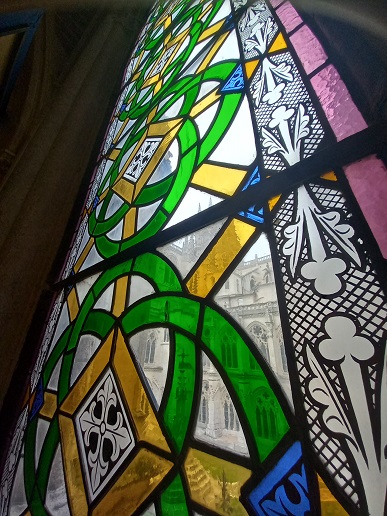
I love these two stained glass windows, with the beautifully Arts and Crafts inspired armour designs on the angels.

A quick trip back to Ellen’s, for a quiet weekend, and I am now in Marsden in Yorkshire, where I used to live. I am cat and house sitting again, as I did last year. This time thankfully without the heavy snow that meant Katy and I couldn’t leave the village and go camping as planned.

I will be here for the next two weeks with a very cute and furry cat Frankie. I am also spending time catching up with my friends and ex-colleagues here, cuddling new babies, and taking a few trips down memory lane on walks. I also will be finally posting about my visit to Cordoba in November so come back soon for that.

Until then I hope that you have fun, take care, stay safe and thanks for visiting.

Katy’s adventures in La Marina

I had already planned lots of places that I wanted to visit, mostly with Mum, in the two months that I was at home. Like me, Mum loves walking and the beach, and we were able to explore some new places, as well as revisiting old favourites. The weather was unseasonably warm, so we were lucky that we had stunning blue skies and sunshine all through November and December.

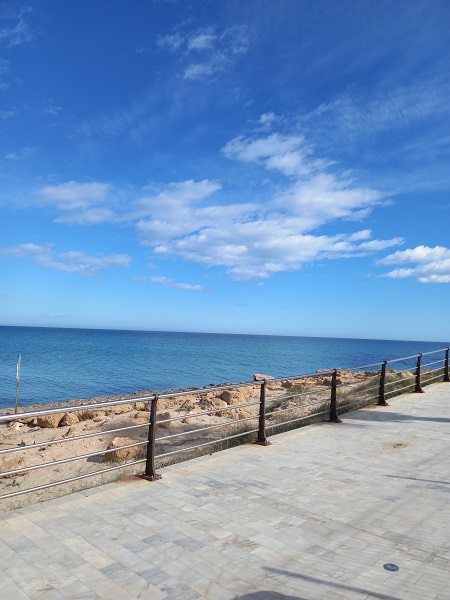
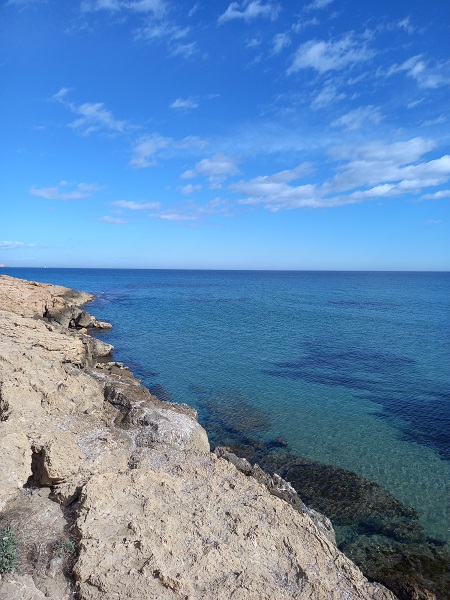
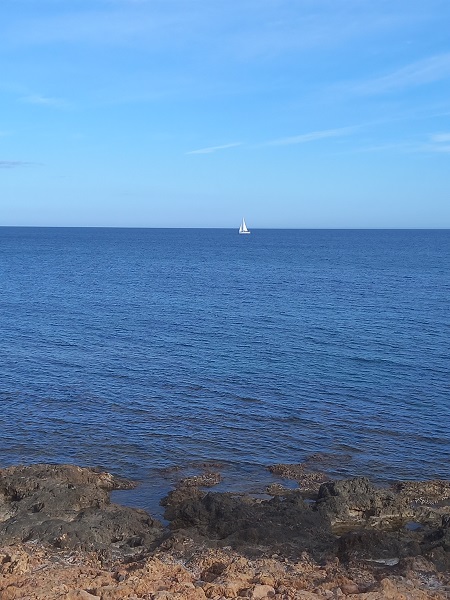
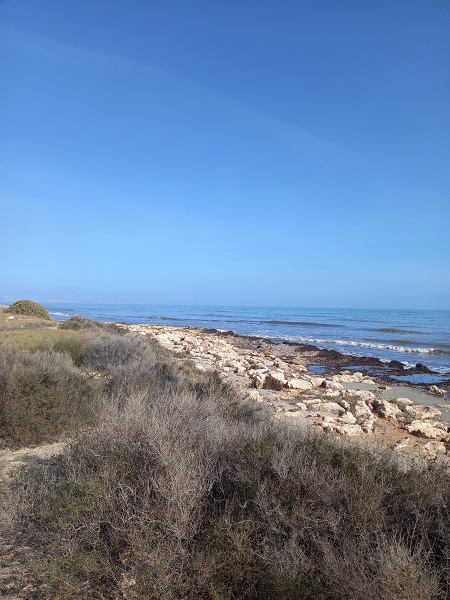
La Marina is situated between the mountains and the coast, and is an area with lots of wildlife sanctuaries, and hiking areas. Although there are sandy beaches, my favourite parts of the coast are the rocky ones.

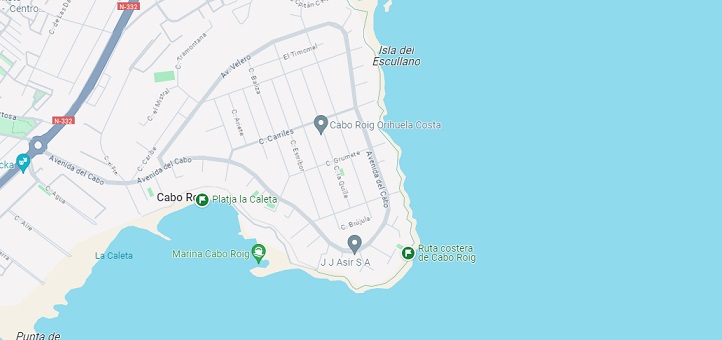
The first walk we did was along the coastal path from La Zenia to Cabo Roig. This very easy walking path goes underneath the cliffs, with gorgeous views. At the end of the 3/4 hour walk there is the harbour at Cabo Roig, with bars and restaurants for a quick coffee before setting back.

After our trip to Cordoba we went back to one of my Mum’s favourite spots, the coastal path below the cliffs and the lighthouse at Santa Pola. This is a beautiful stretch of rocky coast which is very popular with campervans. I went back later on just for the afternoon when Mum was busy, and sat parked up in Katy listening to the sea and reading, bliss!

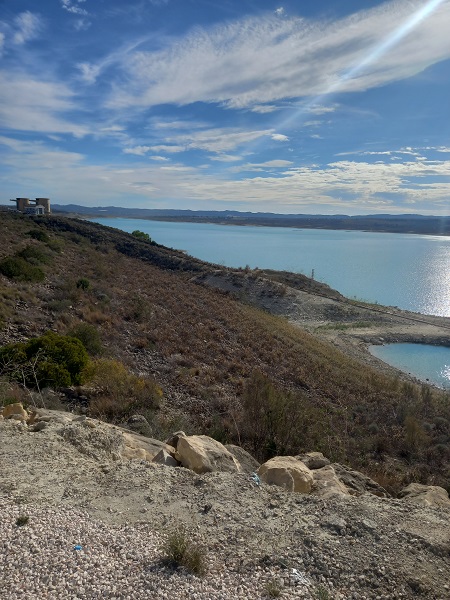
We also visited one of the area’s reservoirs. Although desalination plants are our main source of water, due to the lack of rain, we do have some very beautiful reservoirs. Unfortunately we couldn’t find our way down to the hiking area, that ended up being the off road experience that I mentioned earlier! At least the drive round was great and there are lots of viewpoints with parking and picnic benches.

I also did a couple of trips out on my own, one to the local bird reserves, El Hondo, that I have cycled to before. This time I went right to the other side, and parked up at the interpretation centre. There are walkways through all the different parts of the reserve from here. We have so many types of birds that nest here, and I was lucky enough to see a baby flamingo.

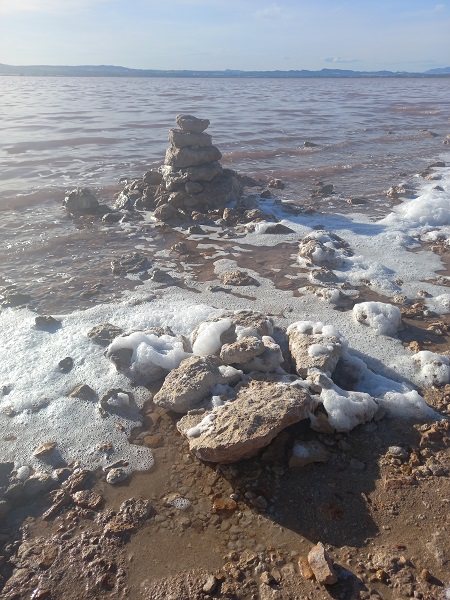
Many flocks of flamingos live on our salinas, or salt lakes. The lakes have been here since Roman times and are still in production. The salt is exported for use on roads across Northern Europe and Russia. The one nearest Torrevieja has a beautiful pink colour in the sunlight. It is a gorgeous place for a peaceful walk on a sunny day.

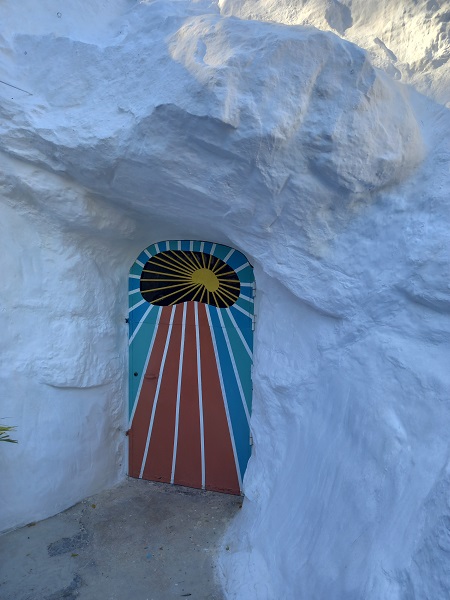
The nearby town of Rojales is famous for its cave houses, which have been turned into artist’s workshops and galleries. Once a month they have an arts and craft fair, and in the summer there is live music every Sunday in an outdoor stage area.

There is a little museum area inside one house showing how the original inhabitants lived. We haven’t been for fifteen years and it was great to see so many more of the caves have been restored, with gorgeous floor paintings.

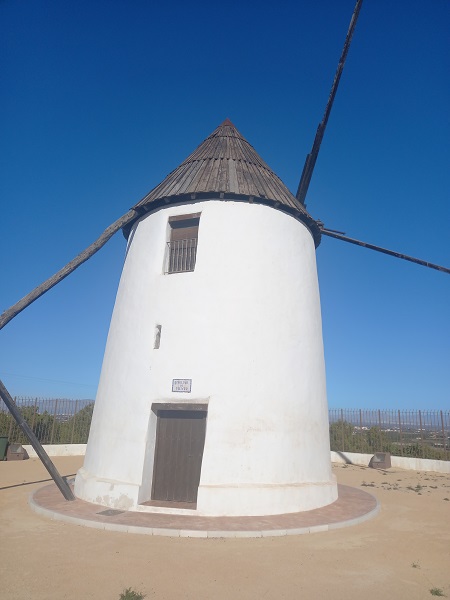
There is also an eighteenth century windmill just outside the town, very similar to those I saw at Conseugra on my journey home. This has been restored and events are held there sometimes.

Also in the mountains above Rojales, there is a country park. El Recorral is actually a water management scheme, designed to capture water from the mountains and stop it flooding the salinas, but rather than just build storage tanks they have created these beautiful wildlife ponds and a sculpture trail. We don’t often get rain, but when we do it can be very heavy and cause flooding so this is a great solution. There are lots of picnic and bbq areas, as well as hiking trails and playgrounds.

I went again with Ellen when she was visiting and we managed to find the caves further up in the park. I don’t think these were every occupied, but they do have stunning views of the mountains across the plain.

One of our Sunday excursions was to visit a monastery set in the mountains behind Murcia. This is the Santuario de Nuestra Señora de la Fuensanta, and dates from the 1600s.

There must at some point have also been an Islamic building here, judging by this architecture, but sadly it was in disrepair and there was no further information. We had a picnic in the grounds and then a walk in the mountains.

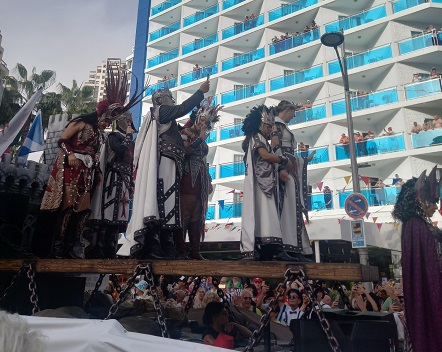
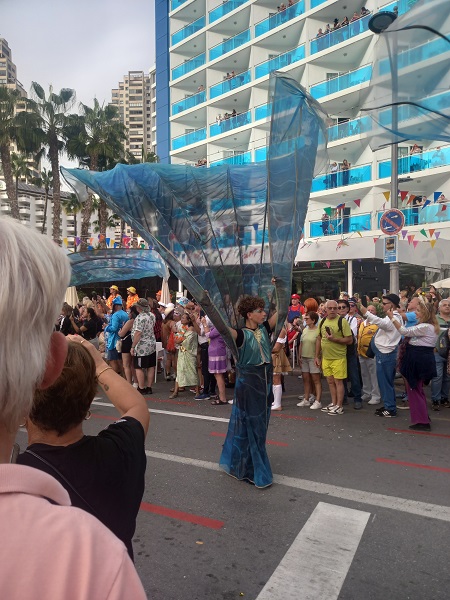
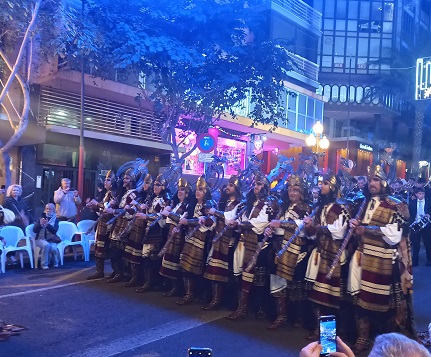
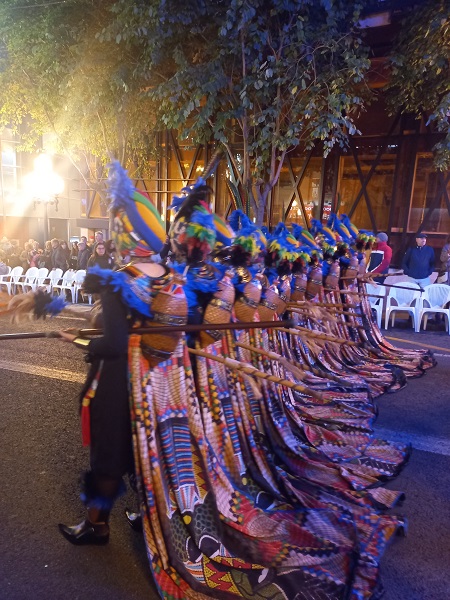
We also went on a couple of trips without Katy, one my favourite things in Spain is the fiestas, and on the feast of St Nicholas, on the 6th Dec, there was a parade of the Moors and Christians. These are some of my favourite events, they take place all over Spain and celebrate the reconquest, when Isabella and Ferdinand took back control of southern Spain from the Muslim settlers.

The parade was a wonderful hour and a half of proud armies in wonderful costume, interspersed with marching bands. The work that goes into these outfits is amazing, usually each village in the area will have its own association. There are many museums where you can see the costumes close up and they are well worth a visit if you come across them.

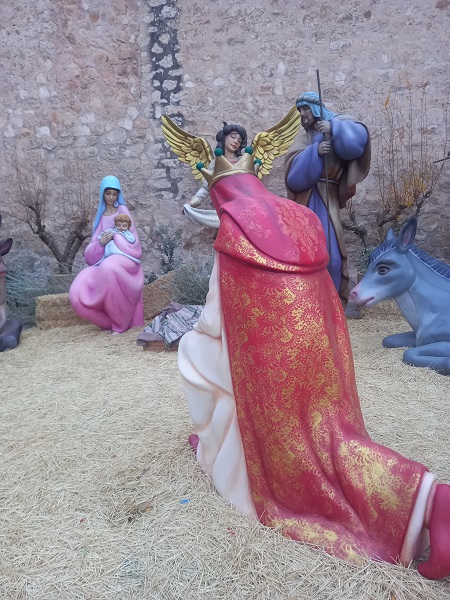
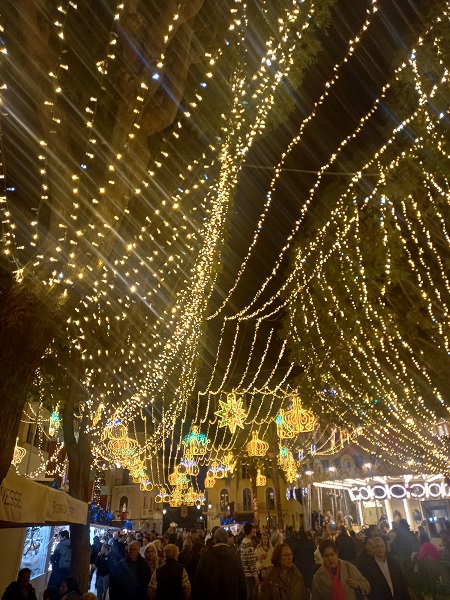
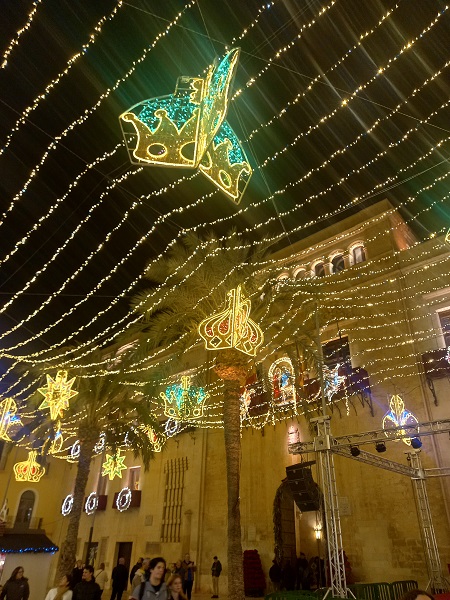
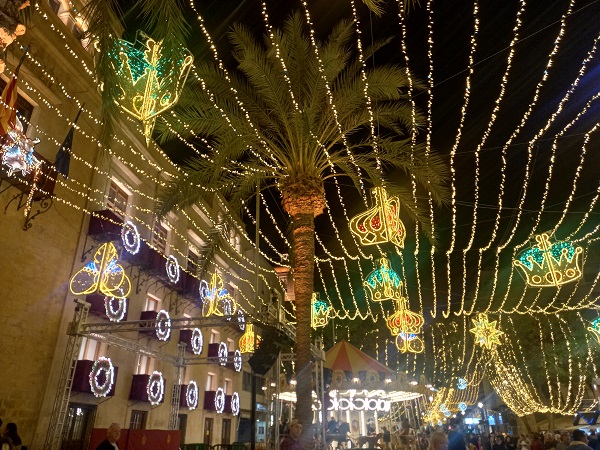
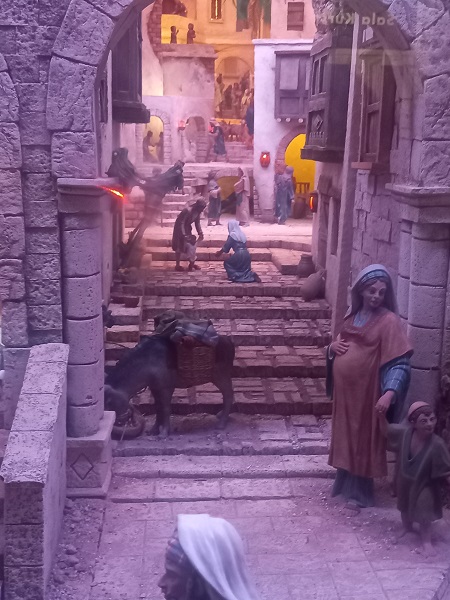
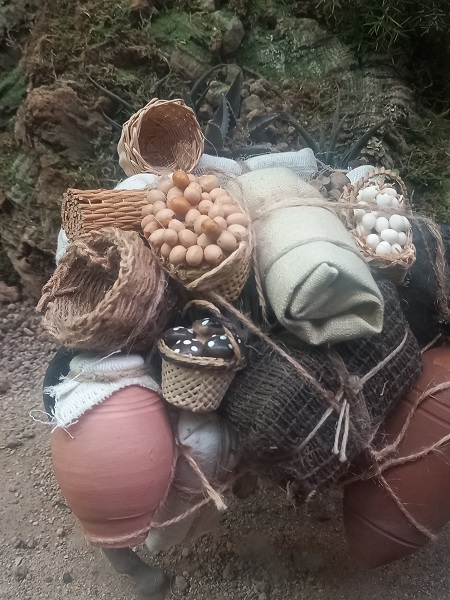
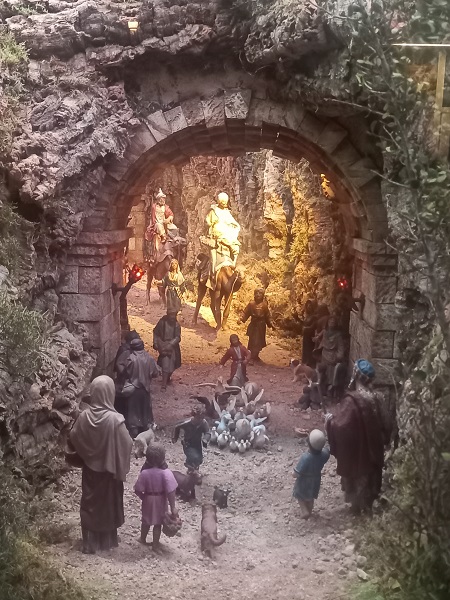
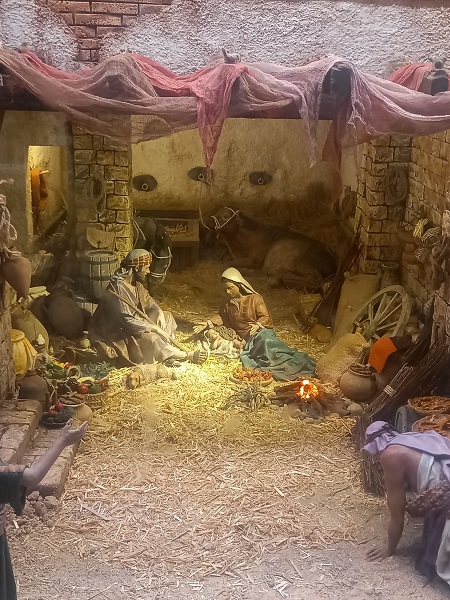
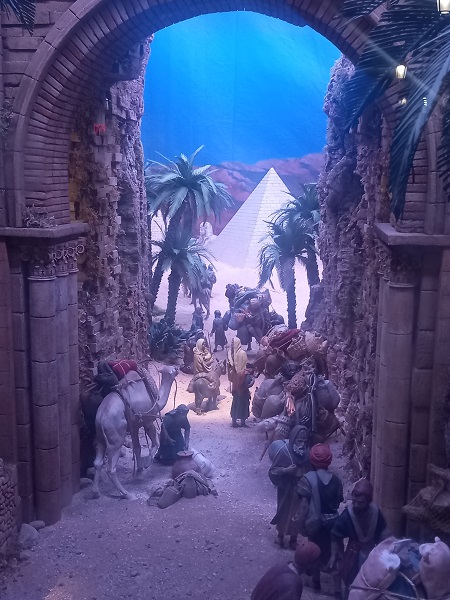
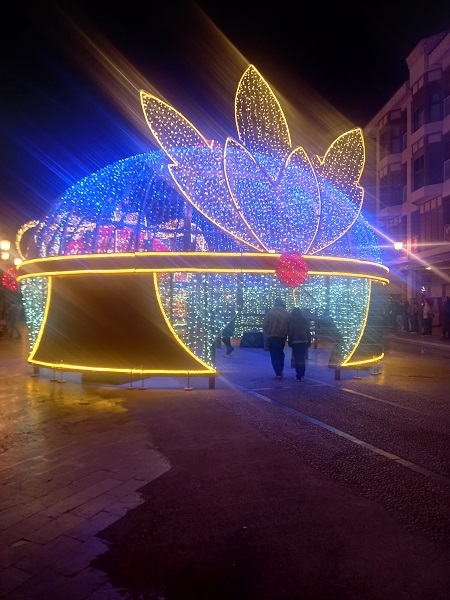
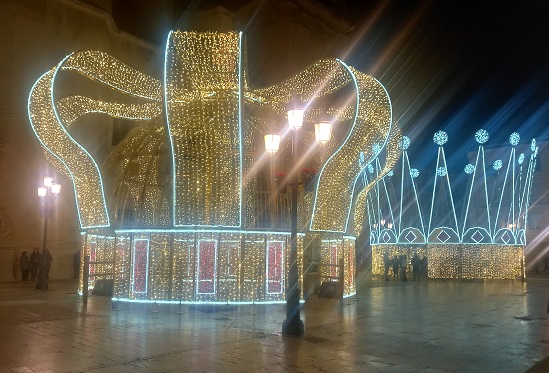
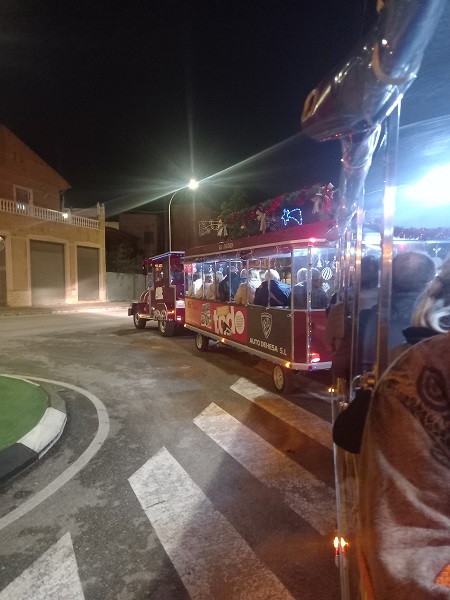
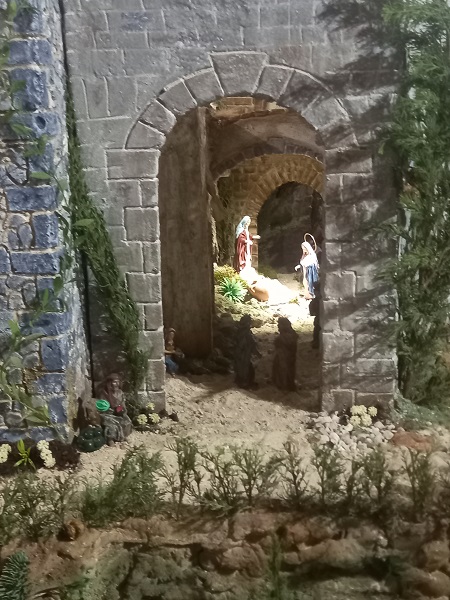
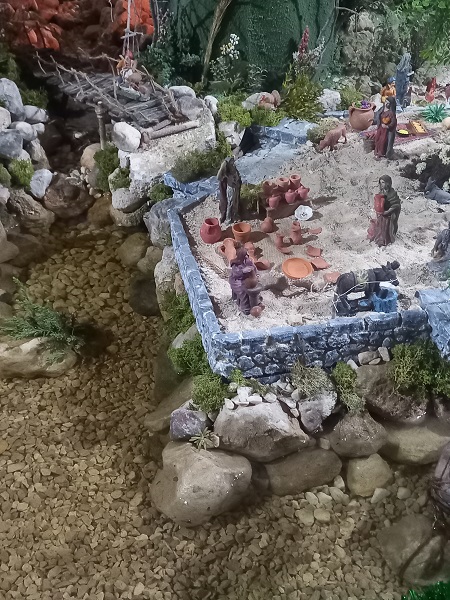
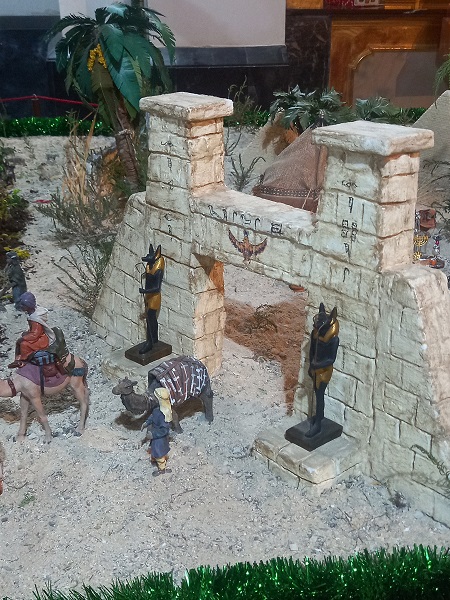
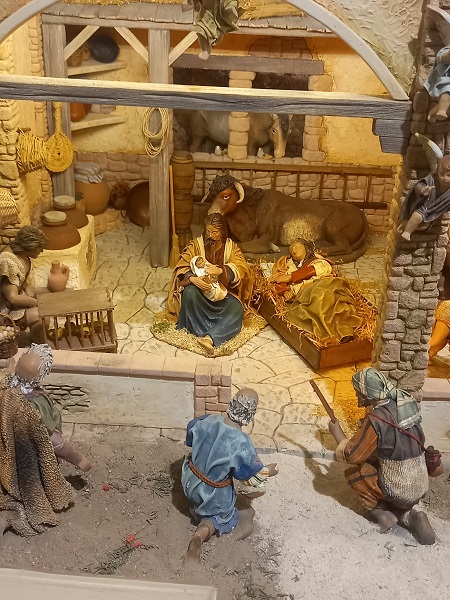
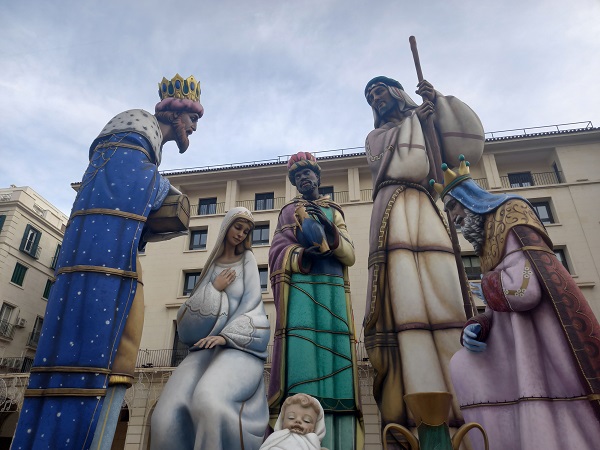
The lights, and the giant nativity were also very pretty, and we had a great wander around the city. This was one of the many excellent coach trips, the advantage of these for fiestas is that you get a local pick up and don’t have to worry about parking or traffic!

I hope that you have enjoyed this little overview of what there is to do in the area, it is a fantastic region for all sorts of outdoor activities, with mountain climbing, trekking and cycling being very popular, as well as all of the water related sports.

This will be the last of my travel posts for now, I will post about Cordoba as soon as I can but have so many pictures to sort, and not that much time before I leave again, so will wait to tell you all about that fantastic city. I am off now to do more unicorn fettling, the final bits of attaching heads and putting on clothes await, and then I can show them to you in the next post.

Until then have fun, take care, stay safe and thanks for visiting.

Apologies to all of the other amazing Spanish cities ….

I have visited so many beautiful and amazing cities in Spain, Seville and Granada being two of the most famous, and completely stunning. There are so many others as well, almost too numerous to mention. However, the next stop on my trip, Segovia, might just be my favourite city yet. I had added it to the list partly as the location was good, being on a route back to La Marina. There are many other cities in that area that I could have visited, and it wasn’t until the last minute that I decided I would definitely go there and I am so glad that I did.

The journey there from Burgos was brilliant, so sunny and the clouds on the top of the mountains were beautiful. I had to stop at a café for breakfast so I could take some pictures, and they really don’t do the scenery justice. This was one of my favourite drives, so stunning.

I was aiming for a free park up near the bullring, but sometimes I get a little confused with Sat Nav instructions, and a wrong turn at a roundabout meant that I actually drove right into the city centre, up the cobbled road, past all the tourist coaches, and back out again, which was a little nerve wracking 😉 However I found the park up shortly after, and it was all good. This park up was another car park, with water, bins and waste, and can be used every day except Saturday, when the market takes place here.

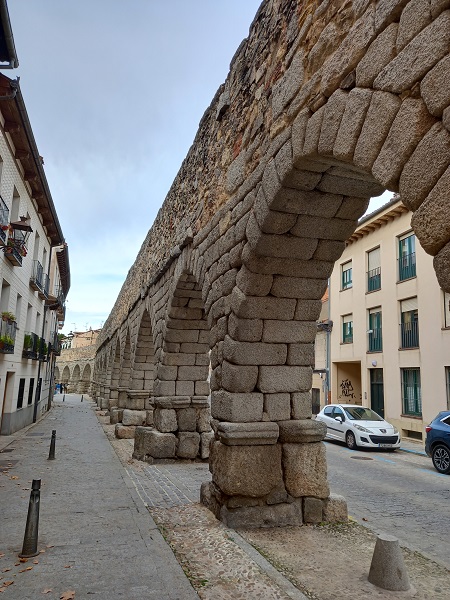
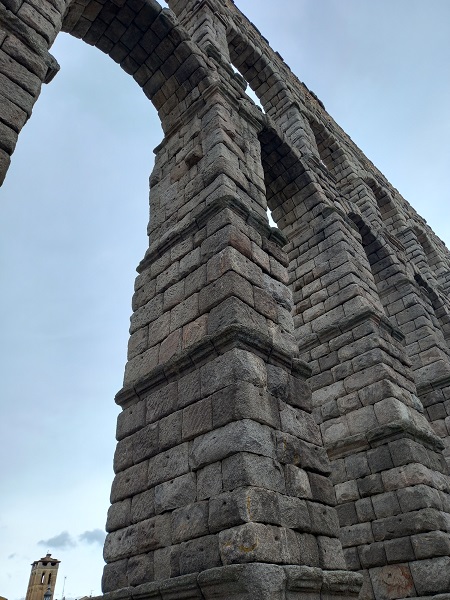
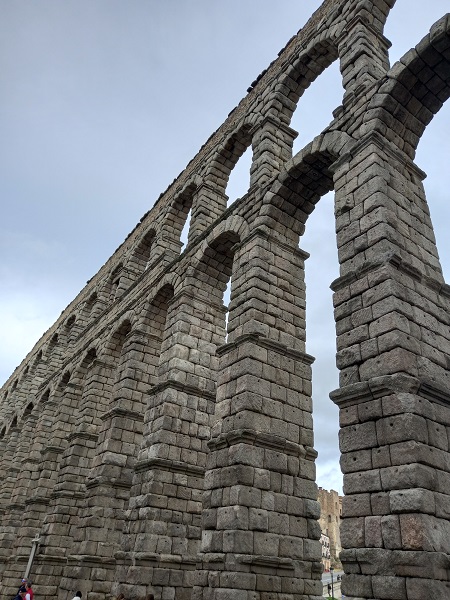
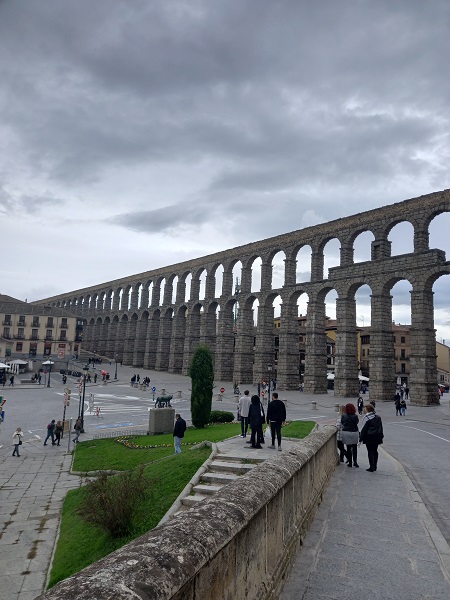
It was only a short walk into the city, and I was following what I thought were the city walls, until it turned into the aqueduct! This marvel of Roman engineering is 14km long, was built without mortar, and the city was built around it. It was truly incredible, one of the most impressive things that I have ever seen. I think that is part of what made Segovia so special.

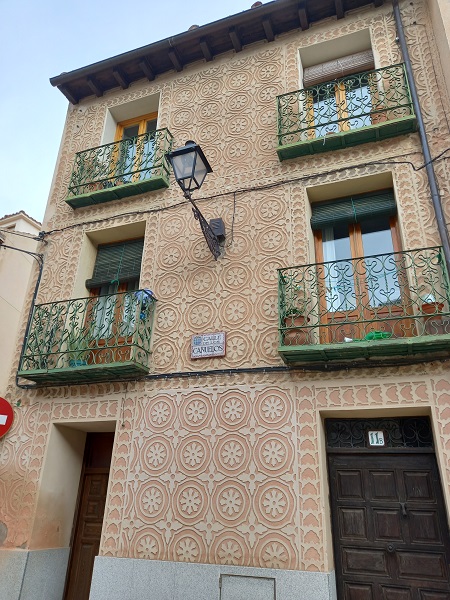
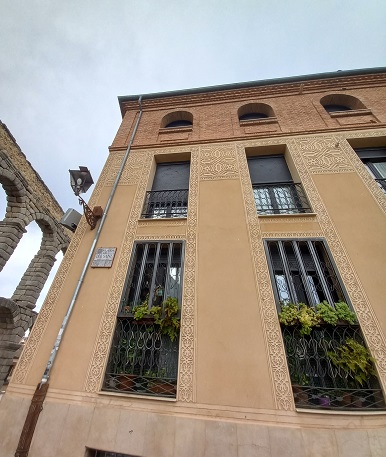
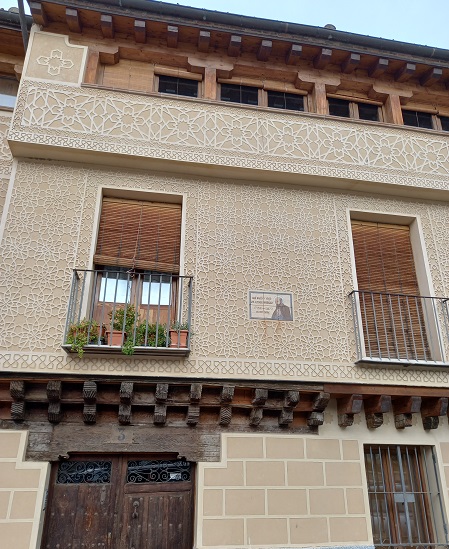
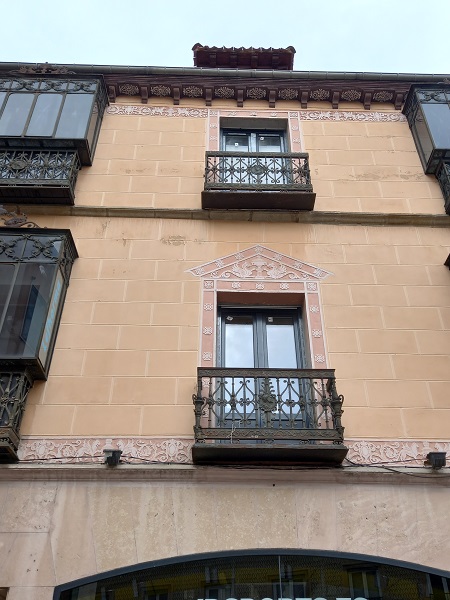
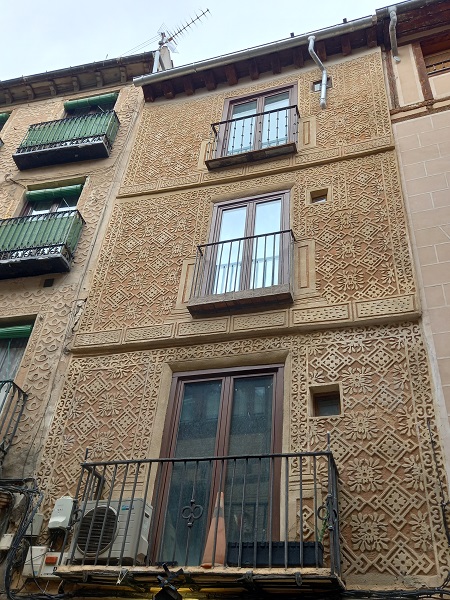
The other thing was the very unique decoration on the houses here. It is also used in some other Northern cities and is known as sgrafitto. It originates in Italy and is made up of layers of plaster. It was amazing to see all of the different designs.

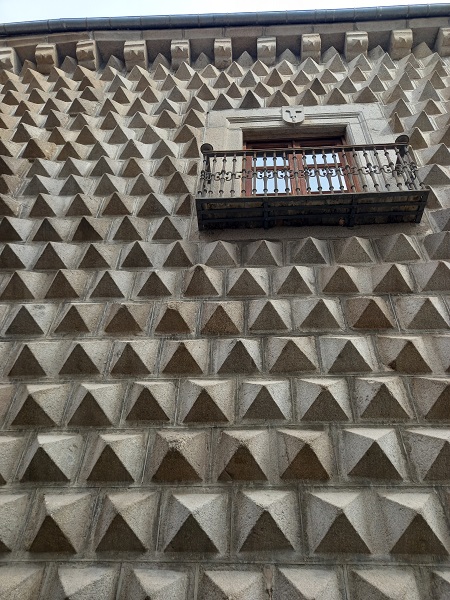
There was also a very unusual building with points all over it, that now houses the School of Art.

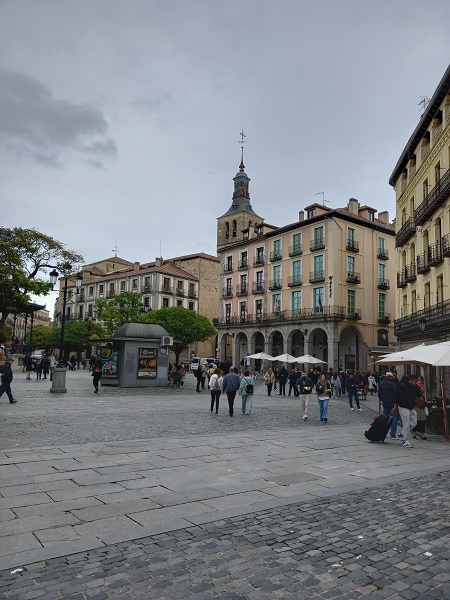
I had a slow wander up through the city with the views getting more and more amazing, until I reached the city square.

There were lots of shops selling regional produce, the area is known for its meat products and pork crackling is very popular here.

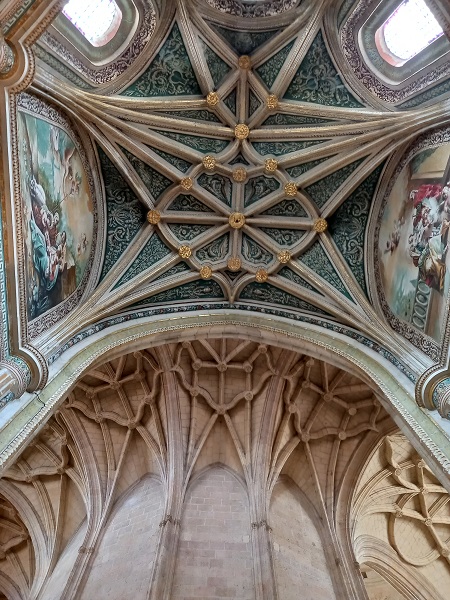
The cathedral was very beautiful, not as ornate as the one at Burgos inside, but with wonderful painted ceilings in all of the side chapels.

I love the shapes that are carved into the ceilings, and the contrast of the bare and painted stone.

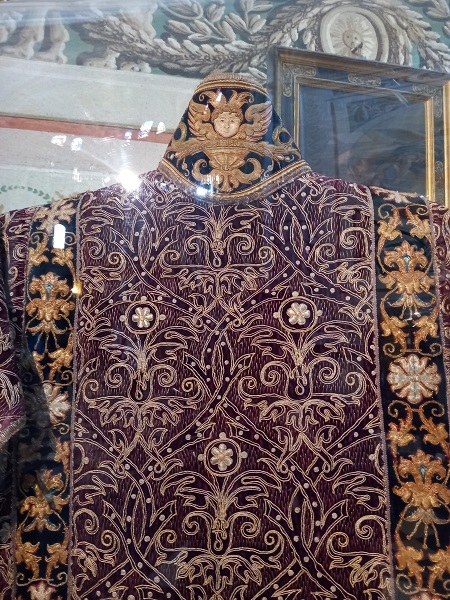
As with all Spanish cathedrals, there was a lot of ecclesiastical goldwork. I particularly like the red and gold combinations on these vestments.

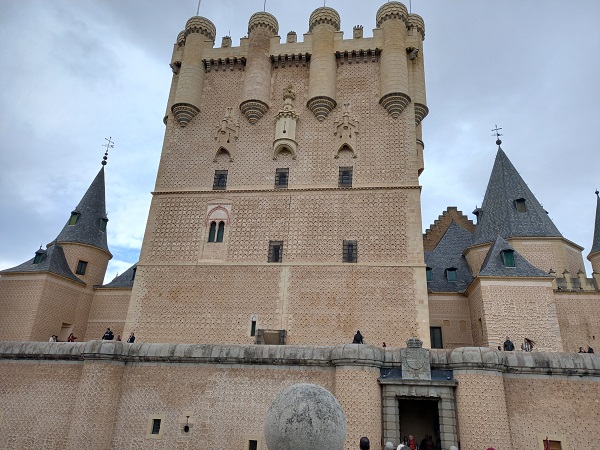
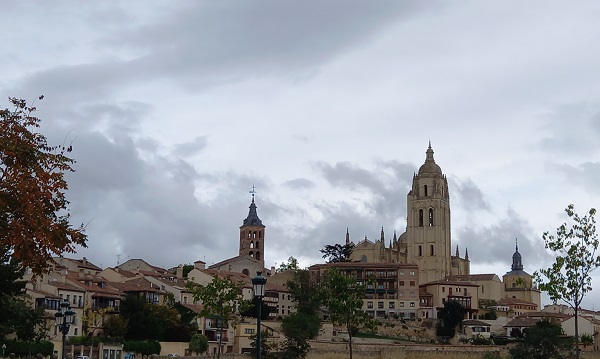
After the cathedral I made my way through the narrow streets to visit the castle, which stands at the edge of the old city, overlooking the valley. This was another reason that Segovia is so different to other cities, this castle, which dates from the 12th century, looks like something from a fairy tale. It has the same kind of plasterwork on the exterior as the other buildings.

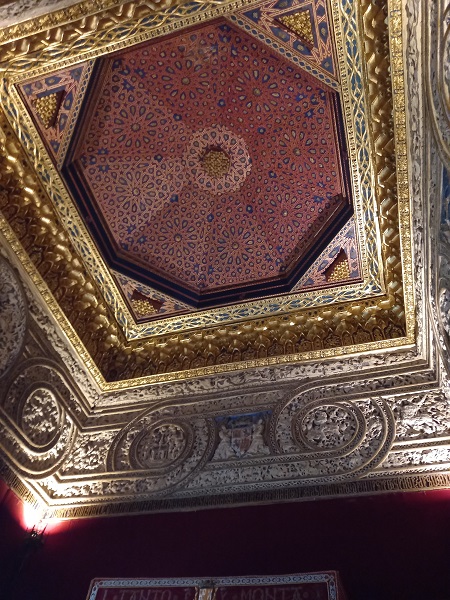
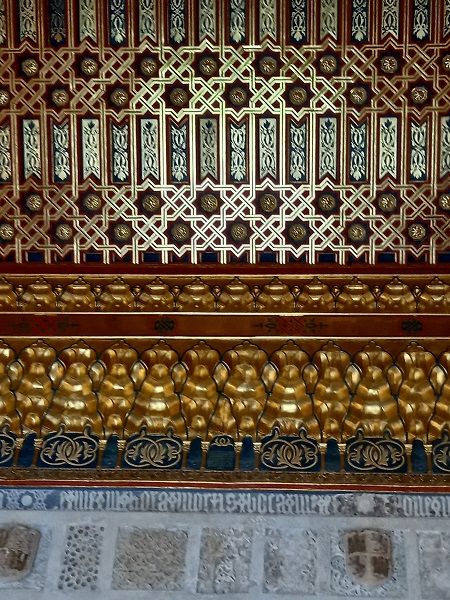
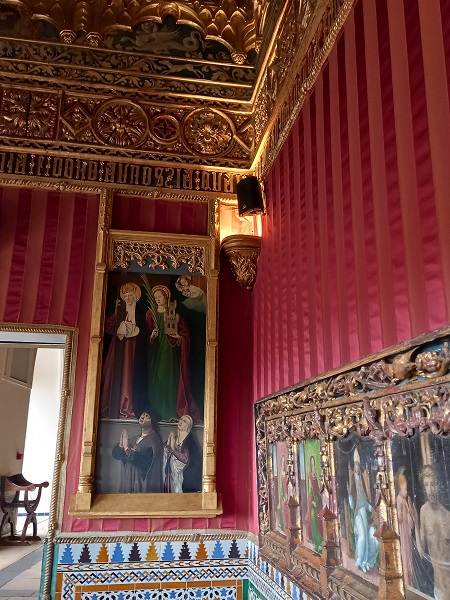
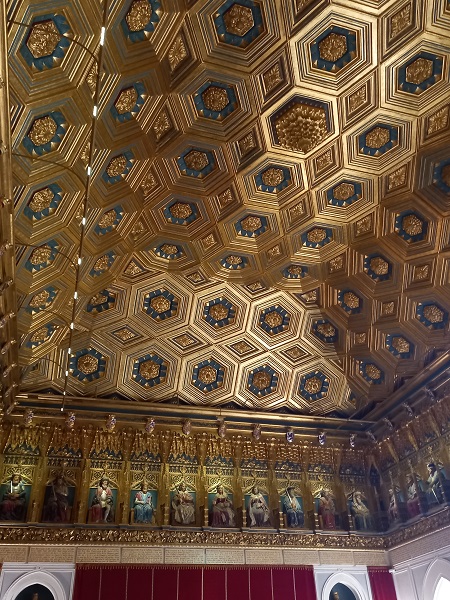
Inside it is full of the most gorgeous Islamic inspired architecture, rivalling the Alhambra in the complexity of the ceiling designs. Although it has always been a Catholic stronghold, the decoration reflects the Muslim conquest of the south of Spain, with their ornate carved ceilings. One of the rooms, the picture top right, has a ceiling made of 392 carved wooden pine cones, and was built to celebrate the birth of the King John the second’s first son in 1452.

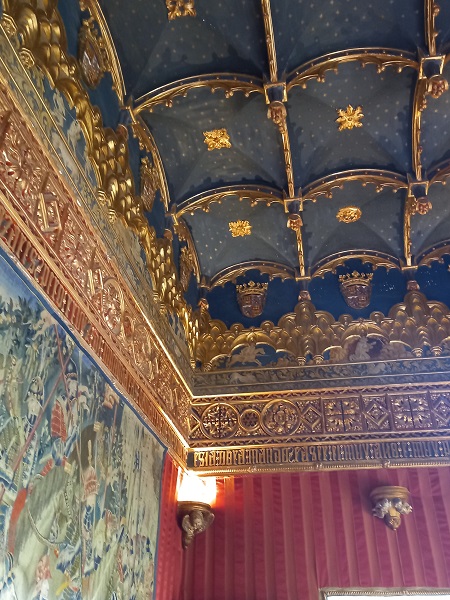
Another incredible room has an English connection. The Gallery, or Ambassadors Room, was created by Catherine of Lancaster. She was the daughter of John of Gaunt, who was son of Edward 3rd, and became Queen of Castile when she married Henry 3rd in 1388. At the time she was 15 and her husband was 9, it was very much a political alliance, as her father wanted to secure his alliances in Spain.

I found this painting of Catherine at this website. I don’t know if it was painted during her lifetime but it is a beautiful depiction of her. Her great-granddaughter, Catherine of Aragon, one of my all time favourite historical people, was named after her. As I have mentioned before I love filling in the gaps in my historical knowledge and making links with English and Spanish history.

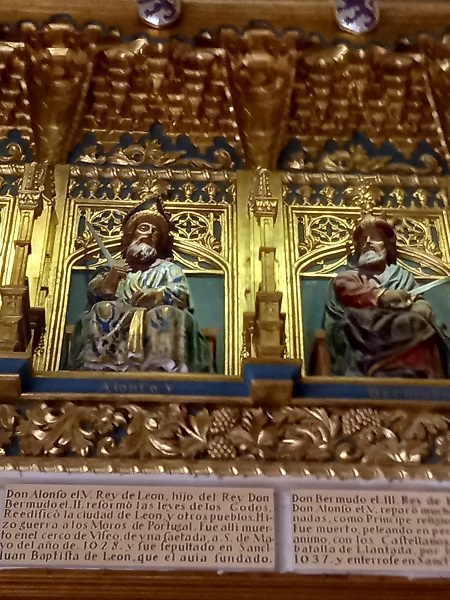
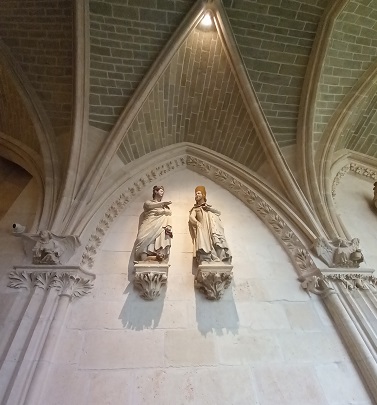
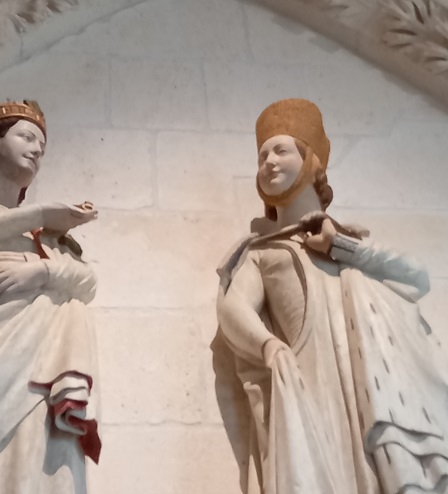
The room was deigned to impress visiting ambassadors, as there are statues of all of the kings and queens of all the different regions of Spain placed underneath the very beautiful ceiling.

I think it was the combination of the aqueduct, the unusual buildings and the fairy tale castle that combined to make Segovia one of the most fascinating places that I have visited. You could really get a sense of what it was like in the 14th century, a real piece of time travel.

I ended my visit sat in the city square near the cathedral, with a glass of wine and some tapas, thinking about all of the amazing places that I had been. A magical day and one I will remember forever. That was to be almost my last visit on the European tour, and the next city was equally amazing for very different reasons.

We have had some sunny days here, which is good as I went to the nearby town of Chesterfield to get currency and supplies for the next adventure. I have less than a week now until I leave here, so am on a mission to get the last few posts done before I leave. I shall see you again here very soon hopefully. Until then have fun, take care, stay safe and thanks for visiting.

Carved in stone

Leaving San Sebastian meant negotiating rush hour traffic on the ring road which was good experience for the next part of the trip, as the Spain part involved mainly city visits. It was only a 10 minute drive out to the motorway though, and on to Burgos.

By this point I was really confident with motorway driving, and as Spain doesn’t have many tolls I didn’t have to stop and do my convoluted yoga to pay at the booths! Sadly the weather was poor driving though the mountains, the views were good, but would have been spectacular if I could have seen more.

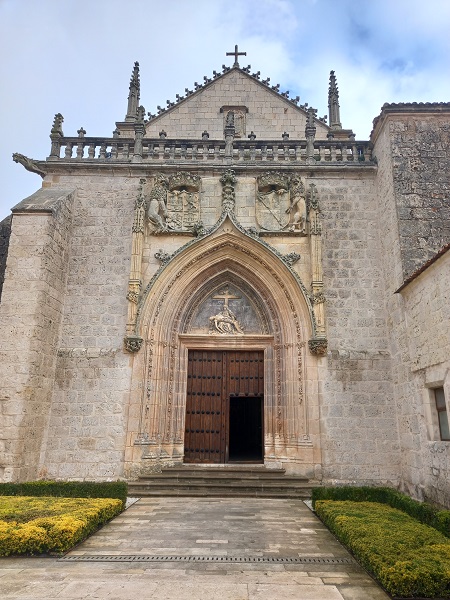
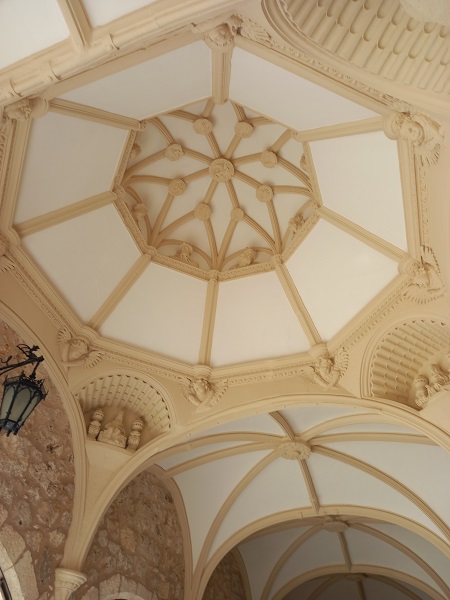
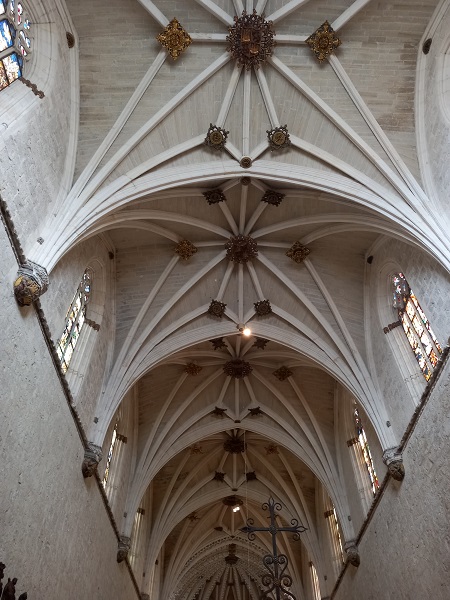
Burgos was another one of my pre-planned stays, but again I altered what I was doing, this time due to the weather. I will tell you more about accommodation later but first on to the beautiful bits. I had come to Burgos to see the cathedral, and to this particular campsite on the outskirts of the city, to see the monastery of the Carthusian monks, the Cartuja Miraflores, just a short walk from the campsite. It was one of the most beautiful, and incredible religious places that I have ever visited, and if you are a regular reader you’ll know that I visit a lot of religious places.

Not only was the monastery itself very beautiful, it is still a working community and there was a lovely video about the monks’ life which ended with the blessing, ‘God be with you on your travels’, which I felt was very appropriate for me. Making this visit, and hearing that just made me so very grateful to be able to now drive, for the trip to have gone well, and for me to have had the opportunity to leave work and spend my time travelling.

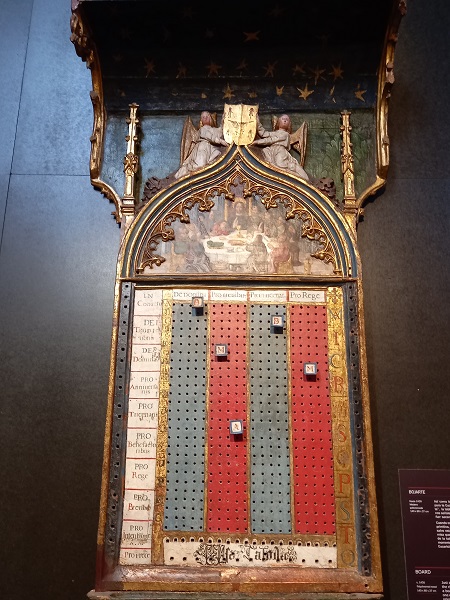
There was a very interesting insight into monastic life. This board dates from the 15th century and shows which duties each of the principal monks had during the services of each day.

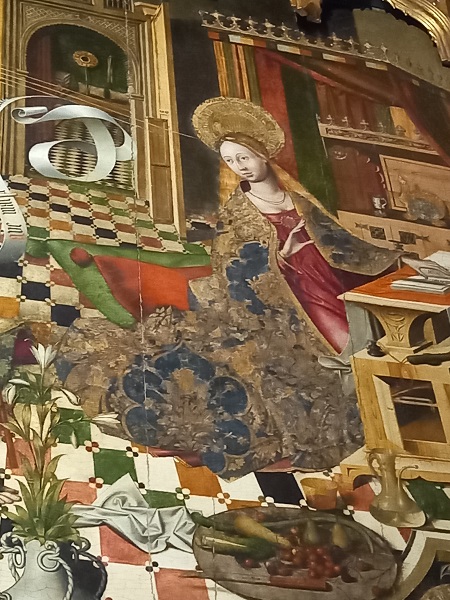
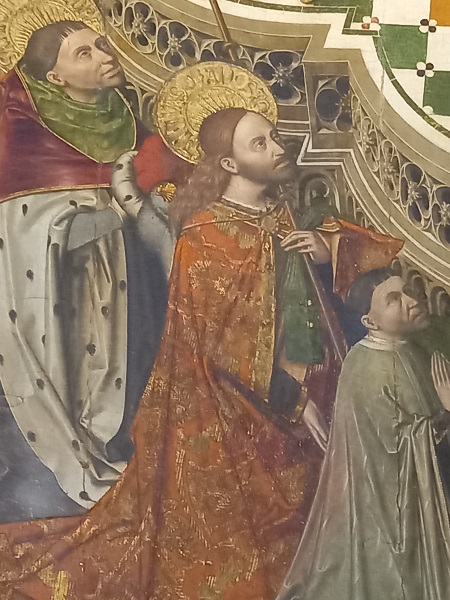
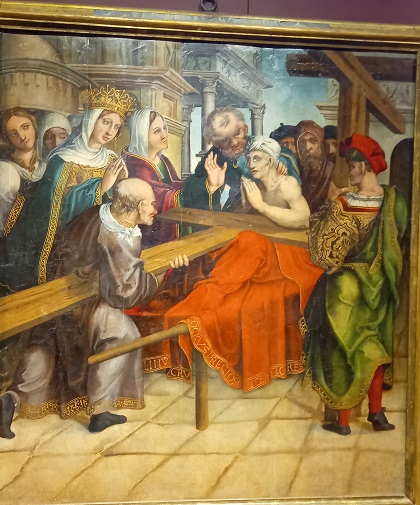
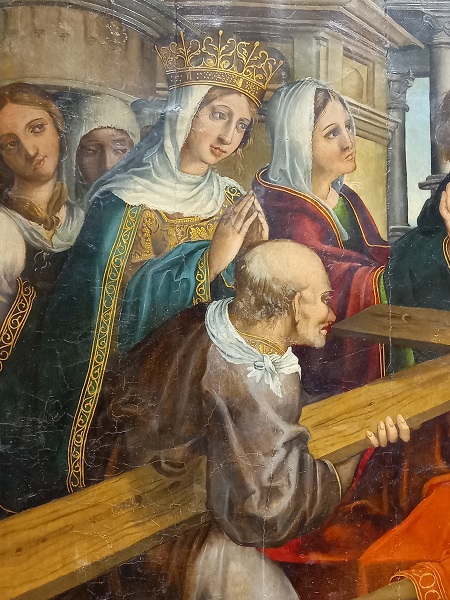
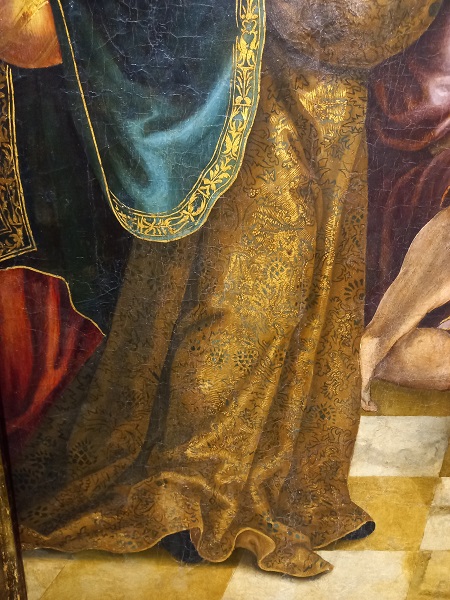
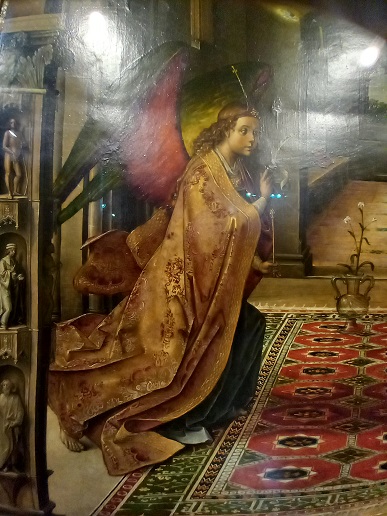
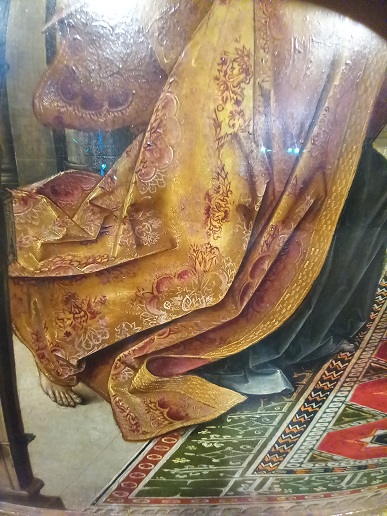
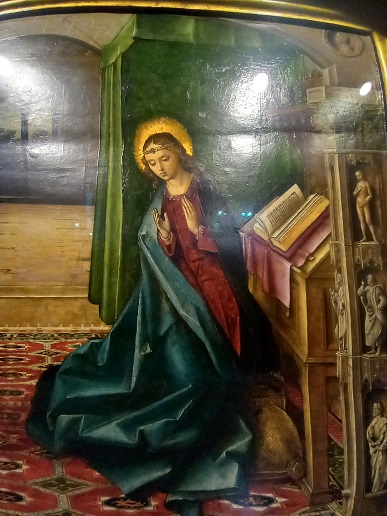
The little museum there also had some beautiful paintings. Some of which related to the quest of Queen Helena, mother of Constantine, the first Holy Roman Emperor, to find the true cross used in Jesus’s crucifixion. I cam across stories of Helena last year in Cyprus, and of the relics of the cross she left at a monastery there. The detail in the paintings was incredible, I loved her robes. There was also a beautiful version of The Annunciation, one of my favourite religious paintings.

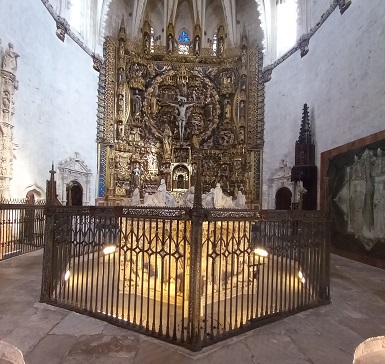
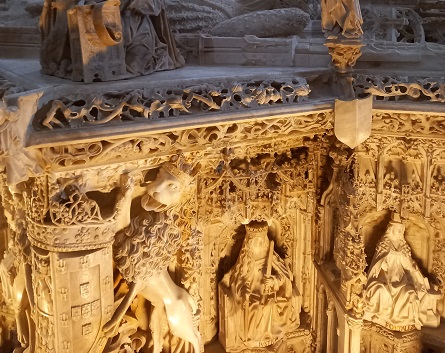
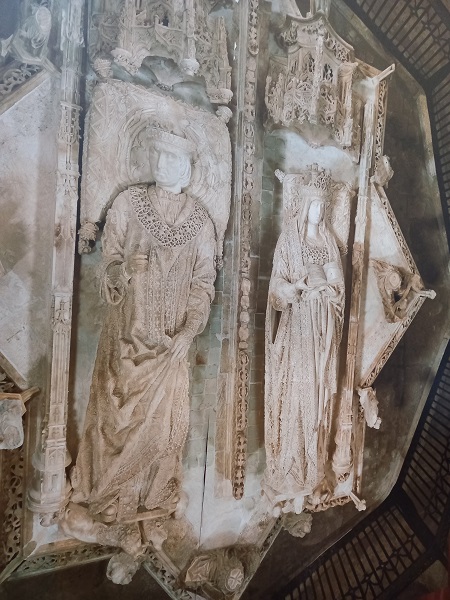
An amazing surprise was the tomb of Isabella of Castile’s parents, John and Isabella of Portugal, and of her brother Alfonso. Because they were buried there Isabella became a patron of the monastery and that helped it survive some very turbulent years, including being ransacked by Napoleon’s army.

This tomb was amazing, the detail in the marble was incredible. All around the tomb were heraldic emblems, including these amazing lions. I couldn’t get close enough to get many good pictures of the clothing they were wearing but the carving was stunning.

There is a large photo of an arial view of the tomb next to it, so you can see more of the detail.

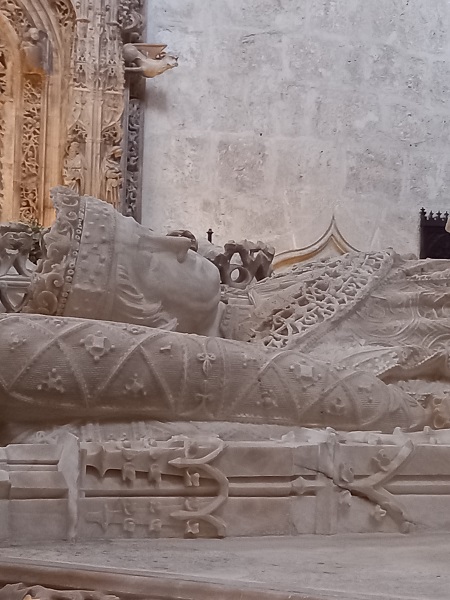
I was able to get closer to Alfonso’s tomb, which has the most wonderful detail on his robes and hat.

As the weather was really bad the first day in Burgos I had stayed in my lovely warm cabin, just watching the rain lash down. The campsite, Fuentes Blancas, was situated near the river in a country park, so my original plan had been to visit the monastery on the first afternoon, then walk the 4km into the city the following day. I had a brilliant time at the campsite, the cabin was very luxurious after all that living in Katy for months. I also had a very nice evening at the restaurant where I shared a bottle of wine and travel stories with an Irish couple.

This very much relates to what I said in the last post about solo travels. They said they would not have talked to me if I’d have been with someone, but were intrigued as to what I was doing travelling alone. The cabin would have cost about £90 for the two nights, but thanks to my rewards from Booking.com for all of my travels in Cyprus I only paid £35.

I still really wanted to visit the city, and the weather forecast was better for the following day, so decided to look for a park up, found a free one just outside the city on a bus route, and went there for a third night in Burgos. I set off early morning on the Saturday so that traffic would be less, and after a few wrong turns found the space. It is basically a very large car park, next to a sports centre, with water, waste disposal and bins, and there were lots of vans there.

There is a dedicated van area, but people were also parked all over the car park, again police patrol regularly. Here I had very nice chats, (in Spanish), with a Spanish woman who was travelling full-time, and, (in English), with a Frenchman named Pascal, who insisted on me taking a photo of him with my van to send to his friend as he said it was so cute! There were such a variety of vans there, I was parked opposite fab yellow overland truck. Generally I didn’t see much variety in the types of vans on this trip, they were all mostly standard motorhomes, so Katy did always stand out.

The bus to the city was only a short walk away and thanks to Google maps I found it easily. Buses in Spain are really cheap, this was just over a euro each way and drops you right in the centre. Just a short walk over the river and I was at the cathedral.

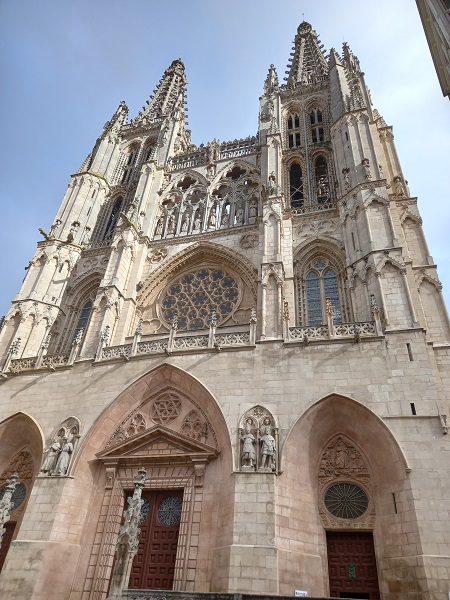
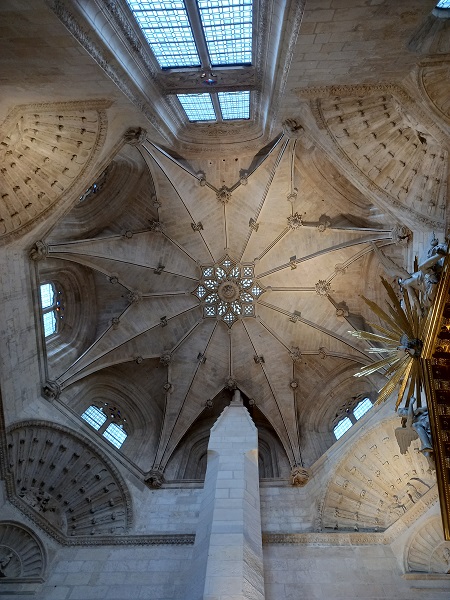
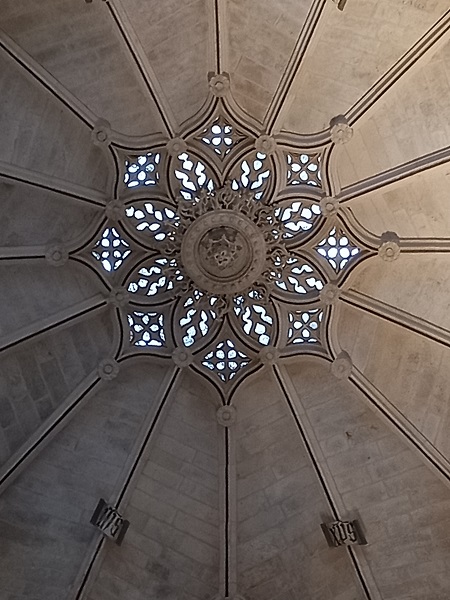
This really was a stunning one, I had wanted to visit particularly to see the tower, which is incredible. the stone work on the ceiling is just breath taking. It is a UNESCO world heritage site, and one of my wish lists is to visit all of Spain’s world and national heritage sites. I am doing quite well so far 😉

The carvings all the way round the cathedral have such incredible detail. Whenever I visit places like this I just think of the thousands of craftsmen who worked on these places, and how their work has, hopefully, been so appreciated by everyone who has seen it. They are true geniuses to have been able to make this beauty out of stone.

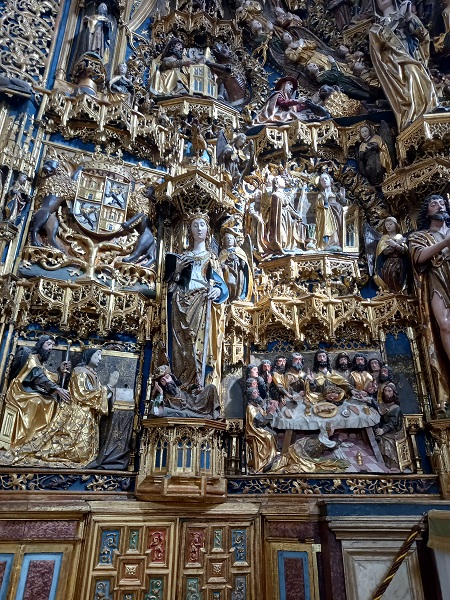
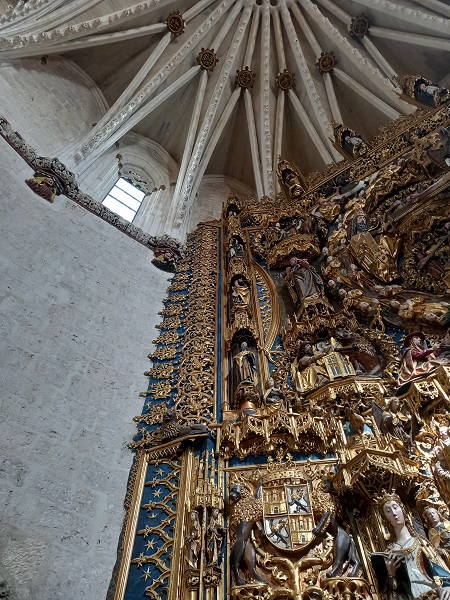
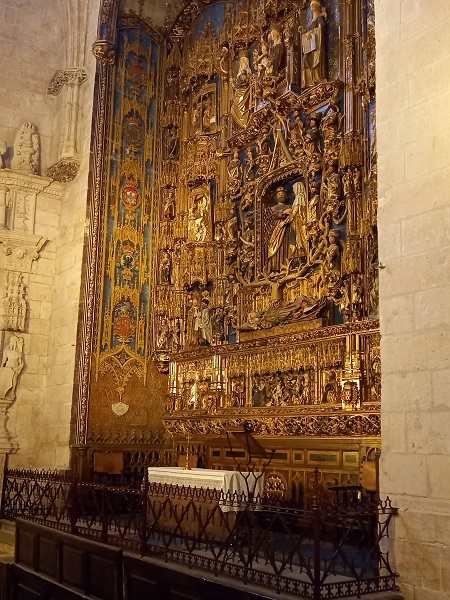
There were also beautiful wooden carvings, intricately done, and painted and guilded.

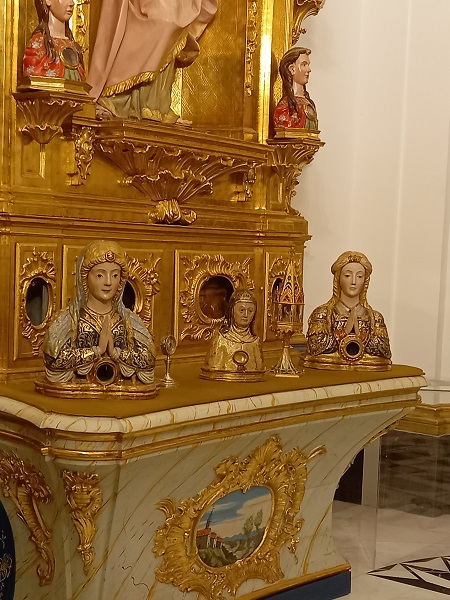
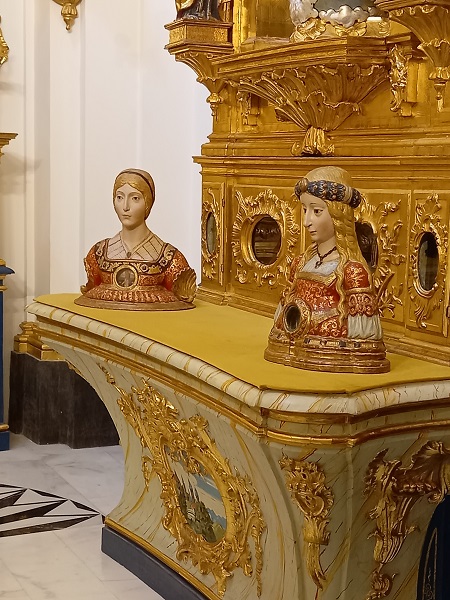
I came across some unusual reliquaries as well, these are in the form of female saints, which I’ve not seen before.

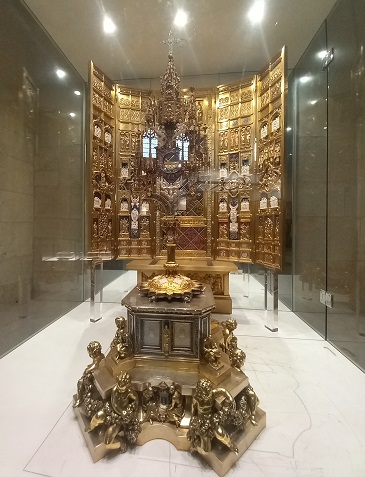
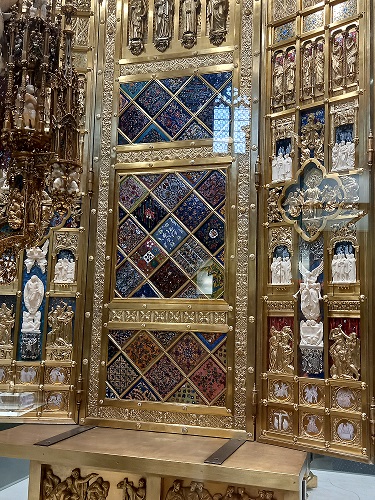
This very large reliquary was decorated with squares of enamel, which I’ve not seen much of before in this kind of floral design.

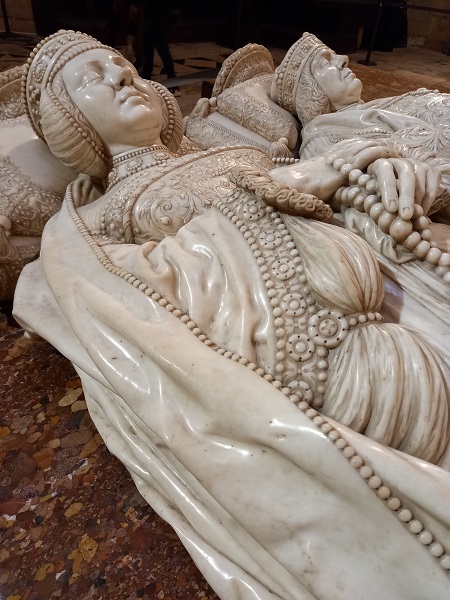
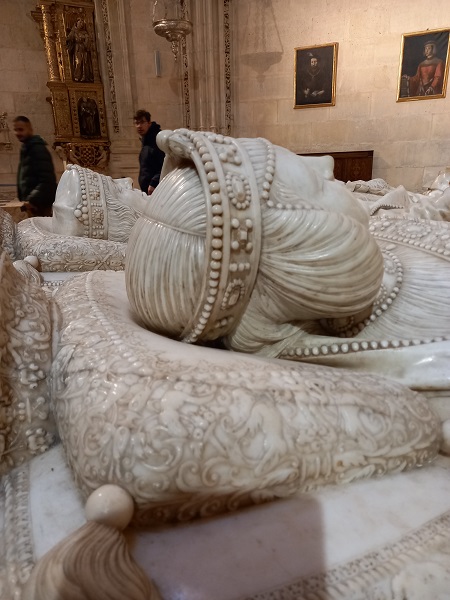
There were also some more stunningly detailed effigies on the tombs, the first set of these pictures is from the cathedral, they are of Pedro Hernandez de Velasco, Constable of Castile, and his wife, Maria de Mendoza. He died in 1492 so I assume the effigy is from around that time.

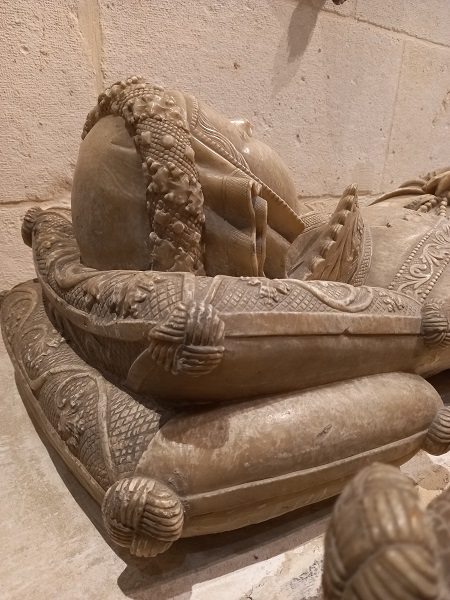
The two pictures above are from the Burgos museum that I visited later, and are of Don Gomez Manrique and Dona Sancha de Rojas, dating from the mid 15th century.

The cloisters were quite plain, though with some interesting statues and lovely stained glass, so I took some arty pictures of the cathedral through the windows.

I had a quick wander around the city after visiting the museum, which had an inner courtyard laid out like a Roman villa. The city square was pretty, and the city gate was amazing, with again wonderful carving.

I came across this gorgeous bronze statue in one of the streets, the woman is crocheting, so I had to take a few close up pictures. I have been crocheting with Ellen while she was in Spain and have been improving, thanks to her excellent tuition, so will show the results when I do a catch up crafting post next week.

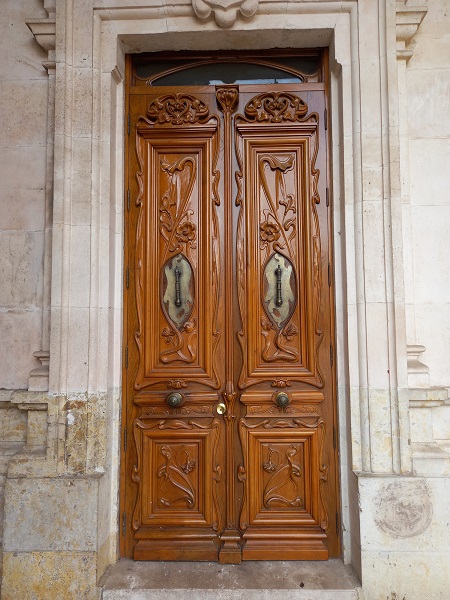
And of course there were beautiful doors, I had missed my Spanish doors. They are always so gorgeous.

A really amazing few days. There are so many cities in this area that I want to visit so it was hard to choose but I’m very glad I included Burgos. In the next post I will be moving further south, through more amazing countryside, and some of the best cities I have ever been to. Come back soon for more stunning architecture! Until then have fun, take care, stay safe and thanks for visiting.

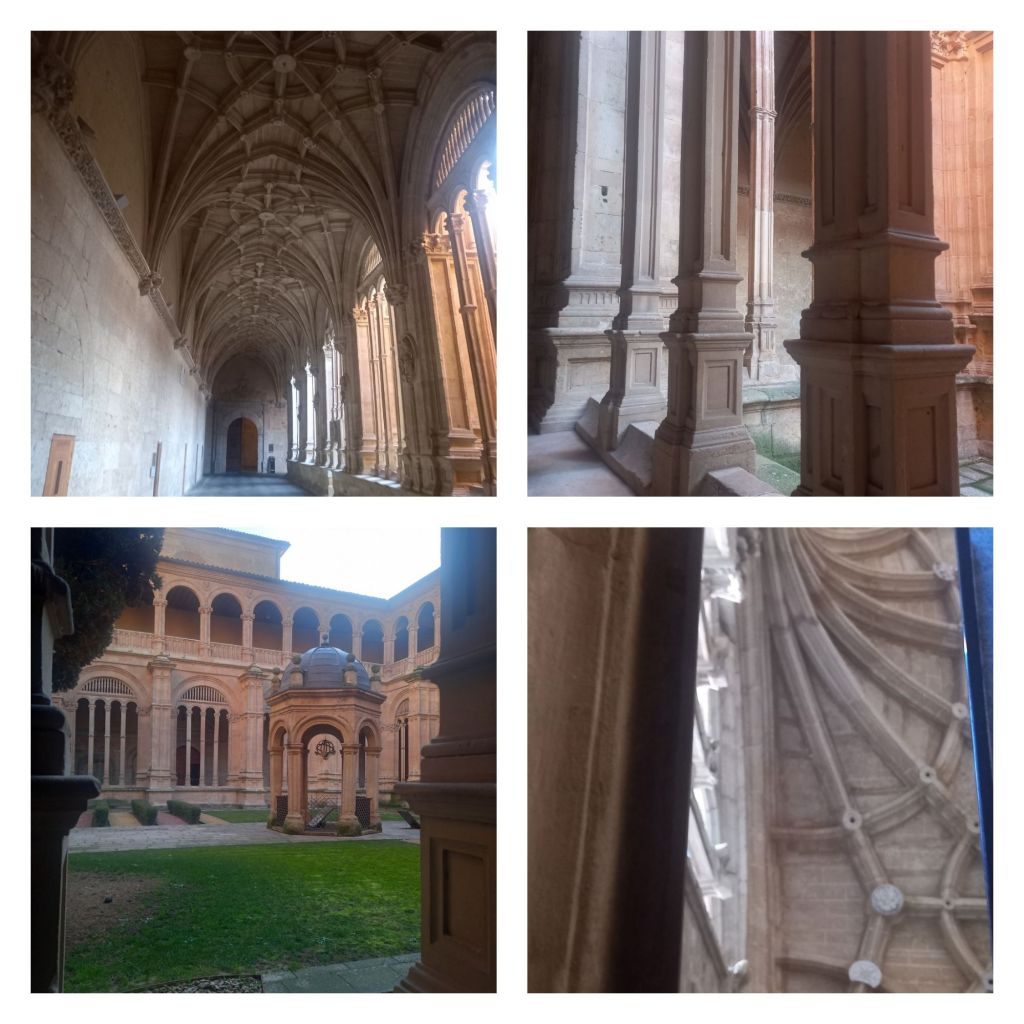
Crossing the border and a change of plans

I mentioned to you in the last post that I had been following Billy and Leanne on Instagram. Originally when I was looking at places to stay around the border I couldn’t find anything really useful. Because of this I had decided to stay on the French coast, then head into Spain and just get an overnight park up somewhere, before going to a previously booked campsite near Burgos.

However, Billy and Leanne had stayed at San Sebastian, a city that I had really wanted to visit, and as the weather forecast wasn’t great for the next few days I decided to head for the hills, well the mountains, cross the border a day earlier than planned, and get to the park up in San Sebastian that they had mentioned. Luckily they warned us that it was popular, being the only one in this area. After a brilliant drive on the motorway, where I could see the start of the Pyrenees, and by now having mastered the art of using tolls on my own from the wrong driver’s side 😉 a mere hour and a half later I was in Spain at the park up!

It was a good move to arrive early, as when I got there at 10.30 there were only four places left out of forty five. This is a really cheap aire, only 4 euros a night, and you can stay as long as you want so it gets very busy. It is also very near the Santander ferry, so there are lots of people using it as an overnight stop before or after their trip. I decided to stay two nights here, as there was so much that I wanted to see, and I had the time before the next stop. It was great have another two night stop, when I plan my next trip in Europe I will definitely look at driving further, and staying longer at each place, now I know I can do it.

The police also patrol the aire regularly to check that everything is ok, something which was a very nice feature of all the cheap, or free aires that I stayed in whilst in Spain. None of these places had barriers so it gives a feeling of extra security, particularly if you have an expensive motorhome. I don’t think anyone would want to steal Katy, lovely as she is, but sadly thefts of these are on the increase.

The first people I met were a couple from England, who had just come from the ferry, and I was able to help them and a couple of others with the slightly complex, multilingual payment machine. It was nice to pay back for all the help I have had with barriers and make good use of my Spanish! The aire has water and waste disposal and there are lots of bars and restaurants nearby. It is basically a car park at the back of the University campus, and is 20 minutes walk from the city centre.

In the van next to me on the left in the above photo were a really friendly Irish couple who insisted on giving me some of the stew they had made for tea. Van life people are so kind, and although the places were the focus for the trip, the people I met really made it great.

A lot of people have told me I’m very brave to travel on my own, especially in Europe, but what I have found is that being a solo traveller isn’t lonely. I talk to people every day, and I actually think that people are more likely to speak to you if you are on your own. There is always a chat with others about where you are going, and good tips of places to see or stay, so I never felt isolated, even though I was on the road for four months in total.

I spent most of the first day just walking to and from the city centre, along the splendid promenade. My Mum came to San Sebastian as a teenager with her family, and came back with my aunt a few years ago. She had always talked about how beautiful it was and it was brilliant to see some more of a very different part of Spain. I really enjoyed my trip to Galicia last June, and would love to come back to this region of Spain.

Not only the natural landscape, with the curving bay, the small islands and surrounding hills are stunning, but also the architecture in the city centre. I love these grand Spanish buildings with their balconies and ornamentation. And always such gorgeous streetlamps!

The old town was brilliant, full of little bars and gift shops so I had a happy wander there for a while, and my first tapas for months in a busy little bar, which was delicious. I was particularly fascinated by the signs everywhere. The Basque language is very different to the standard Spanish that I’ve been learning, so much so that I couldn’t understand any of it.

San Sebastian is part of the Basque area of Spain, and there have been many attempts to make it a separate country. It is an autonomous community at present. I remember hearing about these conflicts as a teenager, but there has been a ceasefire since 2011. Basque culture still remains very different to that of the rest of Spain, and, like Galicia, it does feel very different from where I live. It was really interesting to go from France to Spain in a day by road and see the change as you crossed the border, not just little things like speed limits, but architecture and the general feel of the area.

I visited the ethnographic museum on the second day, it is housed in a former monastery, so there were some great cloisters and the original church had been kept as it was, but used as a gallery.

There were some fascinating displays of traditional Basque headwear. As far as I could make out, most of these were just made of twisted linen. There is more information, and some modern recreations at this blog post.

The other thing I really liked was the textiles section. As well as displays of embroidery, and tools, there were some really fascinating photos of the women who spun linen, and the way they lived. I loved this, and think it brings these skills to life so much better than just having a case full of spindles. It gives acknowledgement to the hard work, and the skill of these women, something you know that I am passionate about.

Of course there were some church visits as well, it wouldn’t be me without a few very ornate churches, with their incredible altar pieces. I have lots more very wonderful ecclesiastical art coming in the next few posts as well. The rest of locations in Spain were very much about city visits with amazing cathedrals and castles so come back soon for those.

I really loved San Sebastian, it is probably a place that many people don’t stop at, as there are so many other wonderful places along that coast, but if you are there, do stay, just make sure if you want a space in the aire to get there early!

I have been doing lots of writing and knitting while I am here at Ellen’s, and really enjoying myself just relaxing. I am also spending time planning the next few months of adventures, which start again in just over a week! I am going to attempt to catch up with all the blog posts about the European trip before then. I can then hopefully start sharing my adventures from a very different place! I will have my laptop with me there, and wifi, as I am staying in hotels and apartments, so blogging will be a lot easier than from the road.

I will be back in a few days with the second Spanish city of my trip, until then have fun, take care, stay safe and thanks for visiting.
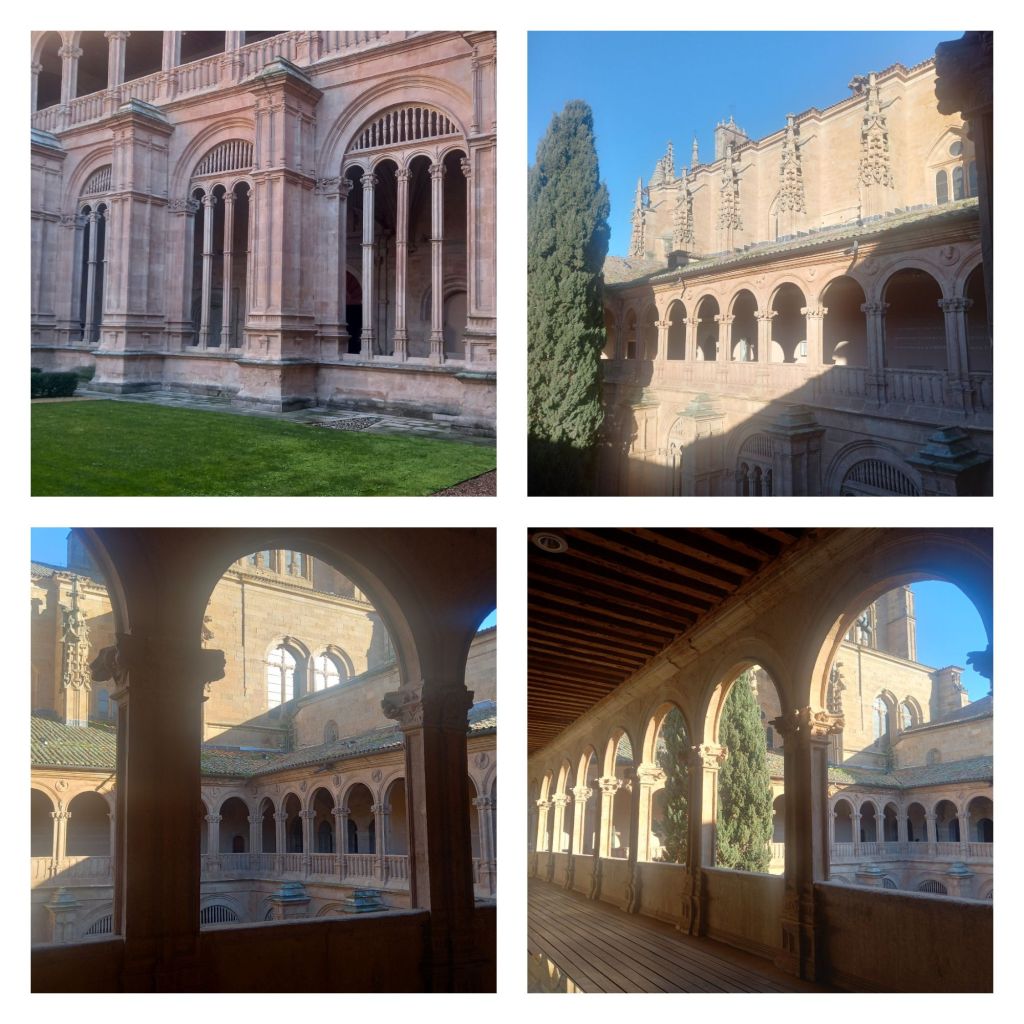
Feats of engineering

So after some lovely days of driving in France, with sunny weather and glorious views, I decided that I would modify my route and head for the coast sooner, to take advantage of the lovely sun. I was also a lot more confident at this point, so decided to use the motorways for the first time as well. I hadn’t been checking the weather forecast, so wasn’t really aware how bad things had been, and started driving only to hit what I think was the tail end of Storm Babet!

Suffice to say it was a bit of a challenging experience, as once I had got onto the motorway the weather got really bad, and visibility was very low. I just followed a lorry, as at least I could see that, and pushed on. I was feeling very proud of myself for coping with all of this, and the weather was starting to clear as we got nearer the coast, when out of the gloom arose this, pictures from Google.

I had checked the route on Google maps, but hadn’t realised that it was going to involve crossing France’s longest bridge, a wonderful feat of engineering at St Nazaire. I’m sure the views would have been stunning if I could have seen anything, I was just concentrating on hanging on to the wheel and getting Katy across as it was very windy! It is just as steep as it looks from that second photo.

Once safely across I headed to the new park up that I had found on the coast, only to find it completely deserted. As it was down a very small lane, and had a barrier, I decided to look for something else close by, and thanks to the lovely Park4Nite app found a free aire next to the Tourist Office at Bourgneuf-en-Retz.

It may not look like very much, but it had a toilet, and it was a lovely safe spot to spend the night. I was very relieved to get here, and had just made myself a cup of tea when a very kind French woman came over, and asked my if I wanted a hot drink and to sit in her van. She had seen me arrive, and as I was only in my little Katy, was concerned that I wouldn’t have anywhere to sit or a hot drink.

We had a little chat about the weather, and I assured her that I was fine, She too had been driving earlier that day, and had stopped as it was so bad. She then decided to carry on her journey, as the weather had started to clear up a bit, so left the aire after we had talked. It was so kind of her to check that I was ok, that is the thing I love most about travelling and van life, the kindness of strangers. It had not been the most fun of days, but I ended it very happy.

I was booked into a campsite at nearby Surgeres for the following two nights. I had planned a rest stop here as I had wanted to visit the area around La Rochelle for a long time. I have flown over this area many times and loved the look of the coastline.

Unfortunately there was still some bad weather the following day. I did get over to the Isle de Re, driving on this marvellous bridge, thankfully the views were brilliant as it was sunny at that point.

I spent a happy hour visiting the old ruined abbey there, and admiring the views across the bay.

As the weather was then getting worse I head for my campsite and actually did manage to pitch the tent before it got really wet! The campsite was lovely, with a mix of lodges and tents, as well as sheltered pitches with access to bbq areas and seating. The stay cost me £15 a night, and it was great to have access to showers and toilets, luxury.

I had chosen this campsite as it was next to the town castle and an amazing church. I was lucky the next day as the weather cleared up for a couple of hours so I went for a walk. The castle dominated the little town, it was originally built by the Duke of Aquitaine for defence, as you can see from the walls and the main gate. It was later more residential and was modified to include a very grand 17th century gateway. It is now the town hall.

The church was one of the most beautiful I have seen, again an amazing feat of engineering and craftmanship, especially given the era that it was built in. The stonework on the main façade was absolutely stunning.

Sadly it was closed, so I can only imagine how beautiful it was inside. Both church and castle date from the 12th century. As with much of this part of France it was briefly under English rule, as the lands were owned by Eleanor of Aquitaine, who married Henry 2nd of England.

The town was very pretty and I had a little wander around some of the lovely buildings before heading back through the park, where there was a poetry trail. I love this little hand door knocker, I saw many of these on my travels.

A really lovely couple of days, despite the less than auspicious start. Thankfully I didn’t encounter quite that much rain after that, though the experience did give me a lot of confidence in my driving. I am in the process of planning the route back through France for April, and my camping adventures this summer, and am so looking forward to travelling through France again, such a beautiful country.

In my next post I will share with you the last few gorgeous park ups in France. I had some really stunning places to stay and absolutely loved the travelling. Until then have fun, take care, stay safe and thanks for visiting.
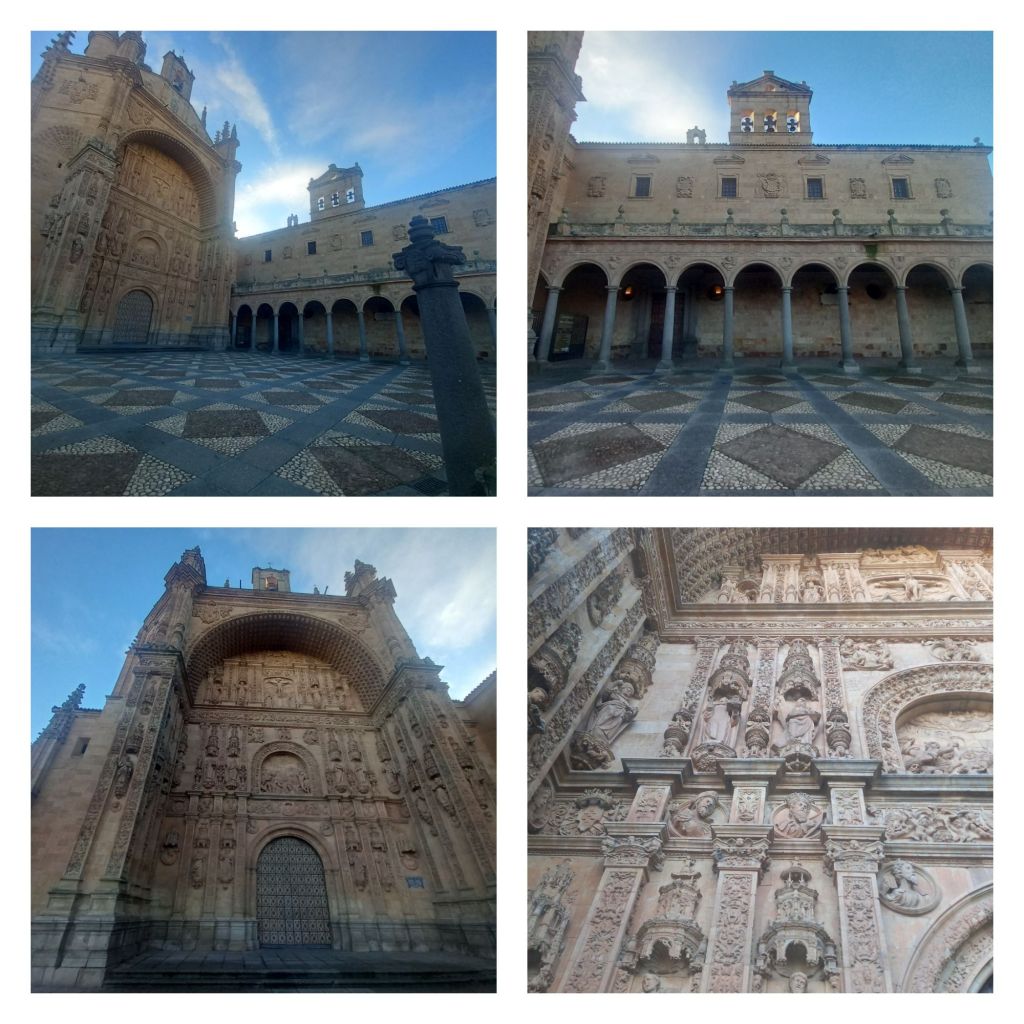
A tale of two cathedrals

I visited many wonderful cathedrals on my recent trip, both in the UK and Spain. Two that struck me as very similar, in terms of their history and location were Norwich and Canterbury. Both are particularly famous as religious centres, and both have cathedral schools attached, so during my visit there were lots of children around.

Norwich had the most gorgeous cloisters, I spent so much time wandering round and looking at them from different angles, and the way that they framed the tower. There is something fascinating to me about the combination of stonework, arches and fans, and the light and dark between the cloister walls and the courtyard spaces they enclose.

On one of the pillars was this, I am not sure whether it is a mason’s mark, or just graffiti, but it is a little touch of human involvement in all this splendour. Whoever EA was, I’m sure they were just as amazed by the place in 1630, as we are now, maybe more so given that we are able to build tall and magnificent structures all the time now.

The inside of the cathedral is also wonderful, so many beautiful windows, and the fan vaulting on the ceiling is just stunning.

Two of the windows celebrate one of Norwich’s most famous religious figures, Julian of Norwich. She was a a nun, and anchoress, who lived in seclusion in Norwich in the mid 1300s and is credited with writing the first English language works by a woman, ‘Revelations of Divine Love’, though as we know there may have been other women writing under male names.

I read this many book years ago, as part of my research for my role as a nun within re-enactment, and her most famous saying ‘all shall be well, and all shall be well. and all manner of things shall be well’, is one that has stayed with me since I first read it, and something I have often said to myself when things got stressful. I couldn’t get a good photo of my favourite window, showing her and her cat, so this is via Google.

Canterbury is famous as a site of pilgrimage, and the cathedral precinct is stunning. You enter through this amazing gate.

I was lucky as I was visiting on a beautiful sunny day, so the contrast between the stone and the sky was amazing.

The inside contains some incredibly detailed stonework, the picture below is unlike anything I have even seen, such a wealth beautiful detail in the carvings.

There are also beautiful cloisters, though I think Norwich’s have the edge for sheer scale.

As Canterbury is so famous it has many significant tombs. This one is the tomb of Henry Chichele, archbishop in the early 1400s. The carvings on this tomb are some of the best that I have ever seen.

There were similar carvings around the priest’s lectern as well.

The most famous tomb is that of the Edward, The Black Prince This was of particular interest to me for several reasons. One of which is that Edward’s heraldic coat is in the cathedral, in the lower level, (no pictures allowed), and a reproduction of it hangs over the tomb, along with his helmet.

I remember watching one of the Amber Buchart series, ‘A Stitch in Time’ where she recreates this garment with other fashion historians. One of my re-enactment friends, Richard, portrays the Black Prince, and his very talented partner Kat, who I have mentioned many times before here, has also made the garment. I had a very interesting chat with the volunteer who was near the tomb, and told her about our costume making for re-enactment.

The other thing I loved was another version of the Mothers’ Union banner of the Virgin Mary, this time accompanied by two saints. The stitching on this was exquisite.

If you are a regular reader you will know that I have been fascinated by these, which appear regularly in churches and cathedrals in the UK, often of a similar design. I decided to do some research about them, and while I didn’t find any answers to my questions about whether they promoted as projects nationally, and where the designs came from, I did find an interesting booklet, written by Bob Trubshaw, with a history of the Mothers’ Union. In the booklet Bob asks many of the same questions, and like me, mourns the lack of information about who made all these banners.

The chapterhouse at the cathedral was one of the most stunning, I have ever seen, the ceiling was incredible.

There was also this beautiful window, depicting monarchs and notable religious figures from British history. I loved this representation of Queen Victoria.

Truly stunning places, and an amazing testament to all of the people who worked on them originally, and now care for, and volunteer in them.

I will be back soon with the next post, where I will share with you my trips in Suffolk. I am so glad that I was able to spend so much time exploring these parts of England, it was a brilliant way to spend the summer. I am already starting to plan next summer, which is very exciting. Even though it is great to be in Spain in my little house, I am already looking forward to life back on the road next year.
Meanwhile there is Christmas crafting to be done, those last few ornaments won’t make themselves so I had better get stitching! See you all next time, until then have fun, take care, stay safe and thanks for visiting.