
I am very pleased to tell you that I did get to view the Marian Hangings at Oxburgh Hall, later on in the month that I was in Norfolk. You may recall that I took a trip with my friend from Spain, Linda, when I was camping at Sandringham, only to find a notice at the entrance to the hall saying that they had gone for conservation.
No-one knew at the time when the hangings would be available, as they were waiting to hear from the textile conservation team at the Victoria and Albert Museum in London. The hangings are in their care, but are loaned to Oxburgh.

Later in the month, when I had moved on round the coast, my lovely friends Allison and Alistair, who were one of the reasons that I went to Sandringham, as they are working on the neighbouring site as wardens during the summer, visited the hall, and sent me a photo of the hangings. They were back! Or so I thought. I was able to fit in another visit to Oxburgh on the way back to Huddersfield for my reunion.
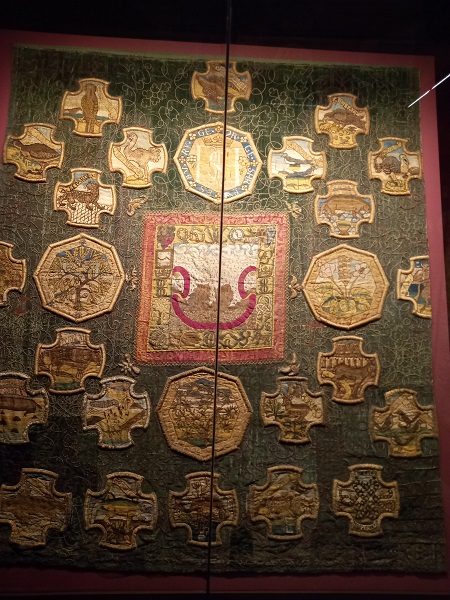
When I arrived at the hall, the volunteer greeting me asked if I had been before and told her about how sad I had been about not seeing the hangings the previous visit. It turns out that they had not been removed from the property. There had been an infestation of wasps, who had built a nest inside the glass casing that houses the hangings! The team from the V and A were going to take the hangings away at a later date, but were very busy, and as the damage was thankfully minor, the house staff had been able to open the room again.

It was a very lucky escape for the hangings, and I am so grateful to be able to see them. These are one of the most significant pieces of needlework in the UK, not only because of their age, but because of their provenance.


That they were stitched by Mary Queen of Scots is interesting enough, but that they were stitched during her captivity in England, designed by her and Bess of Hardwick, and that we know so much about these two women, their needlework, and their inspiration for the designs, is hugely significant. Because of their importance, a lot of research has been done about them.

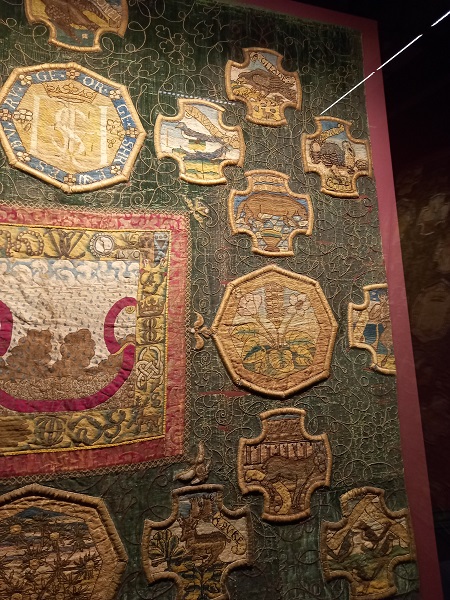
The hangings at Oxburgh are the companion set of embroideries to the needlework at Hardwick. Those at Hardwick are not attached to background fabric. Many of them are framed in screens, and this work was done by Evelyn Cavendish, the last owner of the house before it was given to the Trust. In total there are over 100 embroidered pieces between the two locations, and it is thought that they were originally meant to be assembled on one piece of cloth.


There may have been other people stitching these pieces as well as Mary and Beth, it is known that Mary had embroiders with her, and Bess employed embroiders as well. What is certain is that the overall project is very much about the two women, their lives and experiences. Thus it forms a very significant record of, not only their skills, but their challenges and inspirations.
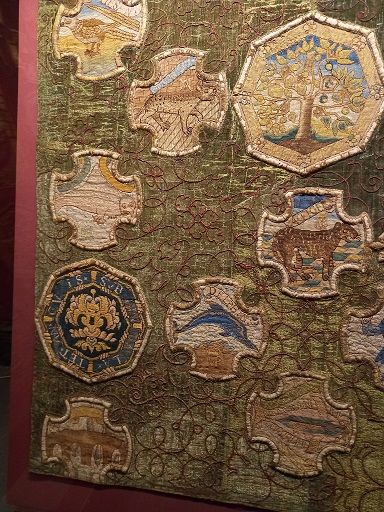

So many of the pieces are symbolic, and portray both icons that we would recognise, such as animals from illustrations, and tales such as those from Aesop’s Fables. Others are more complex, and textile historians have been left to try and unpick their meaning. Many of the pieces have mottos, or have been designed to portray something specific, particularly in Mary’s work, where recurring themes of imprisonment and loss are evident.
It is thought that this choice of a dolphin or delphin is linked to her marriage to the Dauphin of France, as the words are similar. In the piece she has ‘signed’ herself as MR with a crown, even though at that point she had lost her crown in both France and Scotland.

While she was working on these needleworks during the early years of her guardianship by Bess and her husband, George Talbot, Earl of Shrewsbury, Mary was clearly reflecting on the traumas that had brought her to her current situation, and how she could maybe get back to Scotland, her son, and her throne. Sadly that was never to happen, and after many years imprisoned in England, she was executed at Fotheringhay Castle.

I love this quote from the book.
‘In the sixteenth century, women’s writing and embroidery were seen as interchangeable, each a medium of female thought and emotion, each carrying the ‘hand’ of their author’.
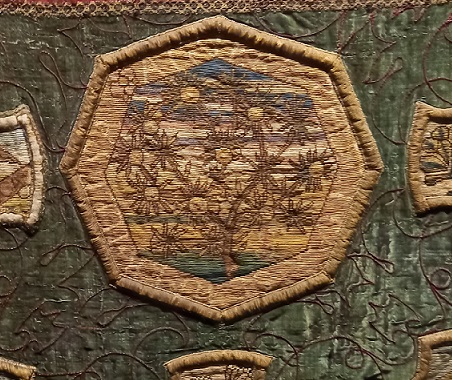
I think that is true of women’s textile work in any era, the pieces we make are chosen to express ourselves in different ways, to convey our favourite colours and designs, to celebrate and to commemorate, and to pass on our love to the recipients.
It is thought that Bess’s granddaughter, Aletha Talbot, stitched the pieces to the bed hangings. This means that they are not in the order that the original stitchers intended them to be in, and does mean some of the cruciform pieces have been cut off to fit the hangings, as you can see here.
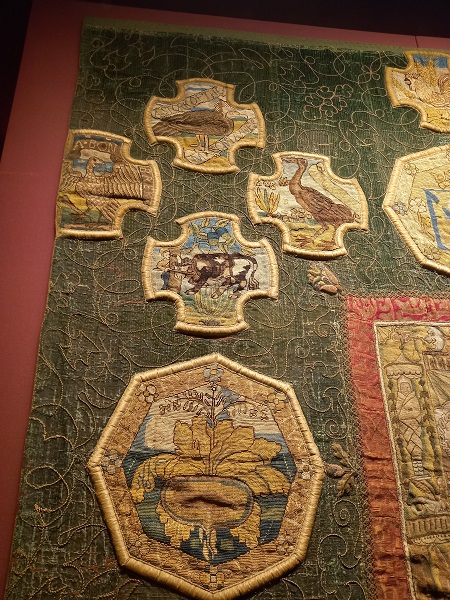
The hangings arrived at Oxburgh in 1761, when Mary Browne married Richard Bedingfield, but no-one knows how she got them. It is fascinating to think where they might have been in the years since Mary’s death, and how easily they could have been lost forever. They were used as bed hangings until the sale of the house in 1950.
As you know if you are a regular reader here, I am working on my first novel, which is set around Hardwick Hall and one of Bess’s companion needleworks. So I am particularly interested in these pieces. I have read many articles about them, as well as biographies of Bess, and done some other study online, such as this excellent free course from Future Learn, The Life and Afterlife of Mary Queen of Scots. I can recommend this as being a really good exploration of Mary’s life, if you are interested.
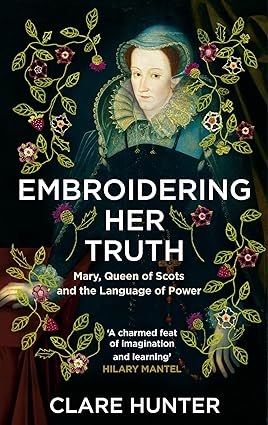
My latest read, which I am absolutely loving for its detail about Mary’s textiles, is by Clare Hunter and is called Embroidering her Truth: Mary Queen of Scots and the language of Power. This is an excellent read, with a wealth of detail about Mary’s life, clothing and needlework.
I also have Clare’s other book, Threads of Life: A History of the World Through the Eye of a Needle which I am looking forward to reading next.

There is also another book about Mary’s embroidery by Michael Bath, called Emblems for a Queen, but at £167 on Amazon, I will have to try and find a library copy somewhere!
We have had a very lovely couple of workshops at my sewing group, I posted about the ribbon flower one last time, and this week I led one using fabric applique before embroidery, based on the wonderful designs by Jenny of Elefantz. It was brilliant to see everyone enjoying themselves, and sharing our skills, I am so lucky to have met this very talented group of women. We have more workshops planned before Christmas as well so I will have to slot in a catch up post with all of the textile happenings in Spain in between the summer catch ups.
I hope that you have all a good week, and are not too cold where you are. Friends are posting snowy pictures from Yorkshire and I am glad not be trying to negotiate getting out of the village to get to work, as I used to have to do at this time of year! See you all again soon, meanwhile have fun, take care, stay safe and thanks for visiting.
 Stitches of Time
I knew wasps could nest in the most inconvenient places, but actually inside a display case is a new one on me!
I know, so glad that there wasn’t any serious damage to the hangings!